Keyholding Company London | Priority First Security


Last updated: 18 August 2026
A keyholding company in London holds spare keys or access credentials to a client's premises and attends alarm activations or access requests outside normal hours, so no employee or resident ever has to respond alone. Priority First, headquartered in Mayfair, provides SIA-licensed keyholding and alarm response across Chelsea, Knightsbridge and prime central London, with documented contracts already covering 28 sites in those two boroughs alone.
Key Takeaways
- Priority First holds documented contracts on 37 sites, of which 28 are in Chelsea and Knightsbridge, as part of its keyholding and manned security operations (as of August 2026).
- A prime-London commercial keyholding contract cost can vary considerably depending on the site and service level, based on Priority First's own case studies of Chelsea and Knightsbridge premises.
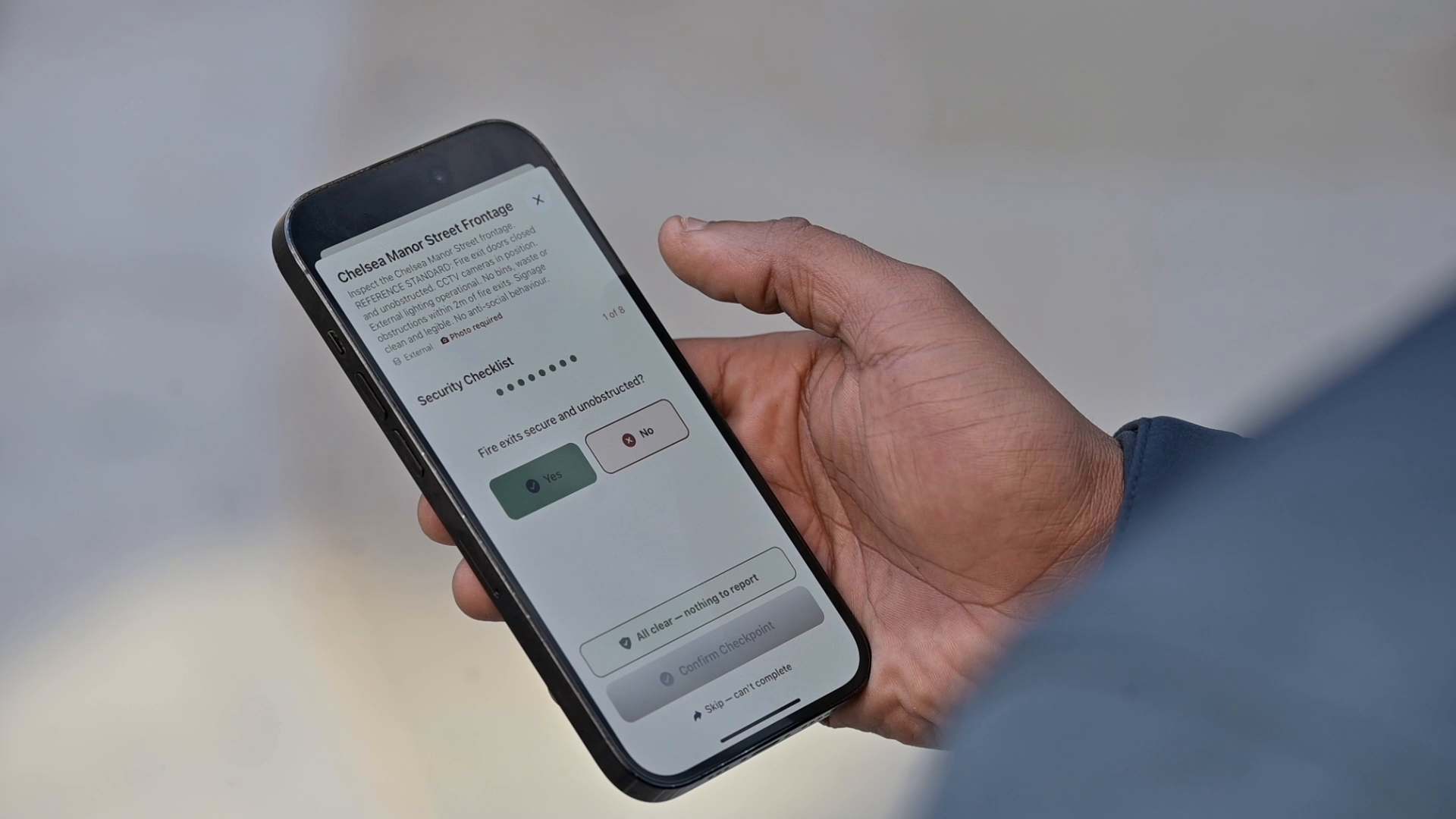
- Every Priority First patrol checkpoint requires a photo, GPS location and timestamp to complete, so keyholding attendance is provable rather than simply asserted.
- Priority First's field officers have completed over 4,900 photo-backed patrols across the sites they manage, each carrying officer ID, GPS and a timestamp (as of August 2026).
- The Private Security Industry Act 2001 requires anyone carrying out licensable keyholding-linked security activities in England and Wales to hold an SIA licence issued by the Security Industry Authority.
What Is a Keyholding Company?
A keyholding company is a specialist security provider that takes legal and operational responsibility for a client's keys, fobs or access codes and attends the premises whenever an alarm activates, a delivery arrives, or access is otherwise required outside standard trading hours. This removes the burden — and the risk — from business owners, staff or residents who would otherwise have to travel to site alone, often in the middle of the night.
In London, keyholding is regulated under the Private Security Industry Act 2001, which established the Security Industry Authority (SIA) as the body licensing individuals who carry out designated security activities, including manned guarding functions that overlap with keyholding response. Any officer attending an alarm activation as part of a keyholding contract in England or Wales must hold a valid SIA licence, and clients are entitled to check that licence via the SIA's public register.
Keyholding is distinct from simple key storage. A locksmith or letting agent might hold a spare key; a keyholding company holds it under contract, with defined response times, insurance-backed liability, and — increasingly — digital proof that every attendance actually happened.
Why London Businesses Need Professional Keyholding
Prime central London premises — shops on the King's Road, offices in Mayfair, serviced residences in Knightsbridge — trade with stock, staff and footfall throughout the day, then stand empty and exposed for the other two-thirds of the clock. An alarm triggering at 3am leaves a business with an uncomfortable choice: send a staff member alone, call the police non-emergency line and hope for attendance, or ignore it and risk both the asset and the insurance position.
This is precisely the gap Priority First was built to close. In one Chelsea and Knightsbridge commercial contract, the client had no professional keyholder in place, meaning any night-time alarm meant a staff member or resident attending alone — a lone-worker risk and an insurance question rolled into one incident. Priority First's SIA-licensed officers now hold the keys, attend every activation, and log each visit with a photograph, GPS coordinate and timestamp on Priority First's monitoring platform, so the client can see exactly when the site was attended and by whom.
How Does Keyholding and Alarm Response Actually Work?
Keyholding and alarm response works through a defined chain: a monitored alarm system detects an activation, an alarm receiving centre (ARC) — a control room certified to standards such as BS 5979 for remote centres — contacts the keyholding company, and an SIA-licensed officer attends site, checks for signs of intrusion or fault, secures the premises, and files a report. The whole sequence typically runs from detection to officer attendance within a contracted response window agreed at the outset.
Most commercial insurers in the UK require a nominated keyholder on file as a condition of alarm-linked cover, and many will not accept a private individual as a sole keyholder for higher-value commercial risks. This is where a dedicated provider adds a layer that a friend, relative or single employee simply cannot match: continuous availability, trained response, and an audit trail.
The Response Sequence, Step by Step
- Alarm activates at the client premises — intruder, fire, or panic signal.
- Monitoring centre verifies the signal and contacts the nominated keyholding company.
- An SIA-licensed officer is dispatched to attend the site within the agreed response time.
- The officer checks the perimeter and interior, using keys or access credentials held on file.
- The officer photographs the checkpoint, logging GPS location and timestamp on the provider's platform.
- A report is filed and, where needed, escalated to the client, the police, or an emergency contractor.
- The client receives confirmation that the site was checked and secured, or informed of any issue found.
Priority First runs this entire sequence on a single digital platform. Every checkpoint completion carries a watermarked photo — currently 100% of checkpoint completions across Priority First's managed sites carry a watermarked photo, up from 0% before those sites were onboarded (as of August 2026). Missed checkpoints show up as visible gaps in the record rather than passing silently, which is a meaningfully different standard from a paper-based visitor book that can simply be left blank.
What Does Keyholding Cost for a London Business?
Keyholding costs in London vary by site type, response requirement and frequency of attendance, but Priority First's own contracted examples give a realistic anchor. Two comparable Chelsea and Knightsbridge commercial premises, both running keyholding alongside manned security cover, sit at roughly £1,000 and £2,000 per year respectively — a useful illustrative range for similar prime-London retail or office premises rather than a fixed quote.
| Site type | Typical service | Illustrative annual cost range |
|---|---|---|
| Small commercial unit (Chelsea/Knightsbridge) | Keyholding + occasional alarm response | Under £1,000/year |
| Mid-size commercial premises with regular activations | Keyholding + manned security patrols | Around £2,000/year |
| Mixed-use development or serviced residence | Keyholding + concierge + CCTV monitoring | Bespoke — priced per checkpoint count and hours |
| Prime residential estate (multi-building) | Keyholding + facilities management | Bespoke — priced across the estate |
These figures are illustrative, drawn from Priority First's own client base, and not a universal market rate — every quote should reflect the specific site, its alarm history and the response window required.
What Drives the Price Up or Down
- Response time guarantee — a 20-minute guaranteed attendance costs more to resource than a same-night response.
- Frequency of false or genuine activations — a site with a history of frequent alarm triggers needs more officer time budgeted.
- Number of keyholders and access points — multiple entrances or a large mixed-use site increases checkpoint count.
- Bundling with manned guarding or CCTV monitoring — combined contracts often smooth the per-visit cost.
- Location within London — prime central boroughs with tighter traffic and parking restrictions can affect officer travel time and, therefore, cost.
Ways to Reduce Keyholding Costs
- Bundle keyholding with existing manned security or CCTV monitoring contracts rather than buying each service separately.
- Review your alarm system's false-activation rate — reducing nuisance callouts lowers the officer time a provider needs to budget for.
- Consolidate multiple small sites onto one provider's platform, as Priority First does across its 24 managed sites, to benefit from shared scheduling efficiency.
- Agree a realistic response window rather than paying for a guarantee tighter than the risk actually justifies.
Alternatives to Consider
- In-house nominated keyholder — cheapest on paper, but exposes staff to lone-worker risk and rarely satisfies insurer conditions for higher-value premises.
- CCTV monitoring alone — useful deterrent and evidence tool, but does not physically secure a breached premises; usually paired with, not substituted for, keyholding.
- Combined manned guarding and keyholding — the approach Priority First uses on prime central London contracts, giving both a physical presence and a documented response.
In-House Keyholder vs Professional Keyholding Company
Many London businesses start with an in-house arrangement — a manager or director nominated as keyholder — before recognising its limits once out-of-hours incidents actually start happening.
| Factor | In-house nominated keyholder | Professional keyholding company |
|---|---|---|
| Availability | Limited to one or two individuals; holidays and illness create gaps | 24/7 coverage with rostered SIA-licensed officers |
| Lone-worker risk | High — individual attends alone, often at night | Removed — officer attends, trained for the situation |
| Insurance acceptance | Often rejected by insurers for higher-value commercial risk | Generally accepted as a professional nominated keyholder |
| Response evidence | Verbal or, at best, a manual note | Photo, GPS and timestamp logged per attendance |
| Response consistency | Depends on individual's location and availability | Contracted response window, resourced by a team |
| Cost | Appears free, but carries hidden liability and staff burden | Contracted annual fee, from under £1,000/year in comparable cases |
The trade-off is straightforward: an in-house keyholder looks cost-free until the first genuine 3am activation, at which point the lone-worker risk and the insurer's view of "adequate" keyholding both become live issues.
As Priority First's Managing Director puts it in relation to integrated building services more broadly: "When the same people move through a site all day, small issues get caught and fixed before they become the resident's problem — that is the entire point, not a line on a brochure." — Mo Hassan, Managing Director, Priority First.
Which London Areas and Property Types Need Keyholding Most?
Keyholding demand in London concentrates wherever premises combine high value, out-of-hours vacancy and strict insurer requirements — which describes most of prime central London. Priority First currently covers prime central London (Chelsea, Knightsbridge, Mayfair), West London, and holds additional contracts in the West Midlands and Bedfordshire (as of August 2026), reflecting where the demand for provable, professional keyholding is strongest.
Retail units on the King's Road and around Sloane Square, boutique offices around Berkeley Square in Mayfair, and mixed-use developments across Kensington and Chelsea all share the same underlying problem: high footfall by day, complete exposure by night.
Care Homes and Vulnerable-Occupant Buildings
Keyholding responsibilities extend well beyond retail and office premises. A 96-unit care home in Bedfordshire needed a system to guarantee that every area of the building was patrolled and that patrols were documented, because care staff carrying a 24-hour duty of care to vulnerable residents cannot simultaneously act as the building's security presence. Priority First deployed SIA-licensed officers whose patrols, incidents and handovers are all logged on the same platform used for its keyholding clients, with each checkpoint completed by photograph, GPS and timestamp.
The result: over 1,000 photo-backed patrols completed, and the site — along with others — onboarded within a fortnight of the contract starting. This illustrates a wider point about keyholding-adjacent services in regulated care settings, where the Care Quality Commission (CQC) expects providers to demonstrate that safeguarding and premises security are actively managed, not assumed.
Your Keyholding Company London Checklist
- Confirm the provider's officers hold current SIA licences and check the register at the Security Industry Authority.
- Ask what response window is contracted — a guaranteed attendance time in minutes, not a vague "as soon as possible."
- Check how attendance is evidenced — photograph, GPS and timestamp per visit is a meaningfully higher standard than a signature in a logbook.
- Confirm your insurer's keyholding requirements in writing before relying on any single individual or company as sole keyholder.
- Review your alarm system's activation history to understand whether false alarms are inflating your response needs.
- Ask whether keyholding can be bundled with manned guarding, CCTV monitoring or facilities management for cost efficiency.
- Request references or case studies from comparable premises — prime central London retail, offices, or residential — before signing.
- Clarify escalation procedures — who is contacted if the officer finds signs of a break-in, fire, or other emergency on arrival.
FAQ
What is a keyholding company in London?
A keyholding company in London is a licensed security provider that holds a client's keys or access credentials and attends the premises out of hours in response to alarms, deliveries or access requests. Priority First, for example, holds documented keyholding contracts across 37 sites, 28 of them in Chelsea and Knightsbridge (as of August 2026).
Do keyholding officers need an SIA licence?
Yes. Anyone carrying out licensable security activities linked to keyholding and alarm response in England and Wales must hold a licence issued under the Private Security Industry Act 2001 by the Security Industry Authority, and businesses can check an officer's licence status on the SIA's public register.
How much does keyholding cost in London?
Keyholding costs vary by site and response requirement, and can range from a modest annual fee for a small commercial unit up to a higher figure for premises with more frequent attendance needs, based on illustrative examples from comparable prime-London commercial contracts. Costs rise with tighter response-time guarantees, higher checkpoint counts, or bundling with additional services such as CCTV monitoring.
Why can't I just nominate a staff member as keyholder?
You can, but it creates a lone-worker risk — a single employee attending an alarm activation alone, often at night — and many insurers will not accept an individual as an adequate sole keyholder for higher-value commercial premises. A professional keyholding company removes that risk by sending a trained, SIA-licensed officer instead.
How quickly can a keyholding contract start?
Onboarding speed depends on the provider, but Priority First has taken three new sites live within a fortnight, including a 10-checkpoint serviced residence (as of August 2026). The time to a site's first provable, photo-backed patrol is typically measured in days rather than weeks.
What happens if the alarm keeps going off by mistake?
A false-activation pattern should be reviewed with your alarm maintenance provider, since it drives up the officer time your keyholding contract needs to budget for. Persistent false alarms can also affect police response policy in some areas, making a reliable professional keyholder even more important.
Does keyholding cover residential buildings as well as commercial premises?
Yes. Keyholding applies equally to prime residential blocks, mixed-use developments and care settings — Priority First's contracts span commercial premises in Chelsea and Knightsbridge, a 16-building prime residential estate, and a 96-unit care home in Bedfordshire, among others (as of August 2026).
Securing Your Premises with Priority First's Keyholding Service
Every business covered in this article — the Chelsea retail unit with an alarm that triggers at an inconvenient hour, the Knightsbridge office with a delivery arriving before staff, the residential block with an access query at midnight — faces the same underlying gap: someone has to attend, and it should not be an untrained individual attending alone. Priority First's Key Holding & Alarm Response service exists precisely to close that gap with SIA-licensed officers, not ad hoc arrangements.
Priority First currently manages documented contracts across 37 sites, 28 of them in Chelsea and Knightsbridge, with every keyholding attendance logged by photograph, GPS location and timestamp on a single monitoring platform (as of August 2026). That evidence standard is the same one client Sandra Davis referenced when she said: "I used priority first to assess the security of my new company, their staff were very informative and showed me where I could upgrade my security. Would definitely recommend."
If your business, office or residential building in London needs a keyholding arrangement that removes lone-worker risk and gives you provable, documented attendance, get in touch with Priority First for a quote tailored to your premises.
Related Reading
- Close Protection Services London | Priority First 2026
- Alarm Response Services London | Priority First
- Close Protection Cost UK 2026: Full Pricing Guide