Daily Office Cleaning Checklist: What to Include in 2026


Last updated: 16 November 2026
A daily office cleaning checklist should include bin emptying, surface and desk wiping, floor care, high-touch disinfecting, and kitchen and washroom sanitising. A small UK office typically takes 15 to 30 minutes to clean daily, according to JAN-PRO (2026), and the routine must satisfy the Workplace (Health, Safety and Welfare) Regulations 1992.
Key Takeaways
- A daily office cleaning round for a small office typically takes 15 to 30 minutes, according to JAN-PRO (2026).
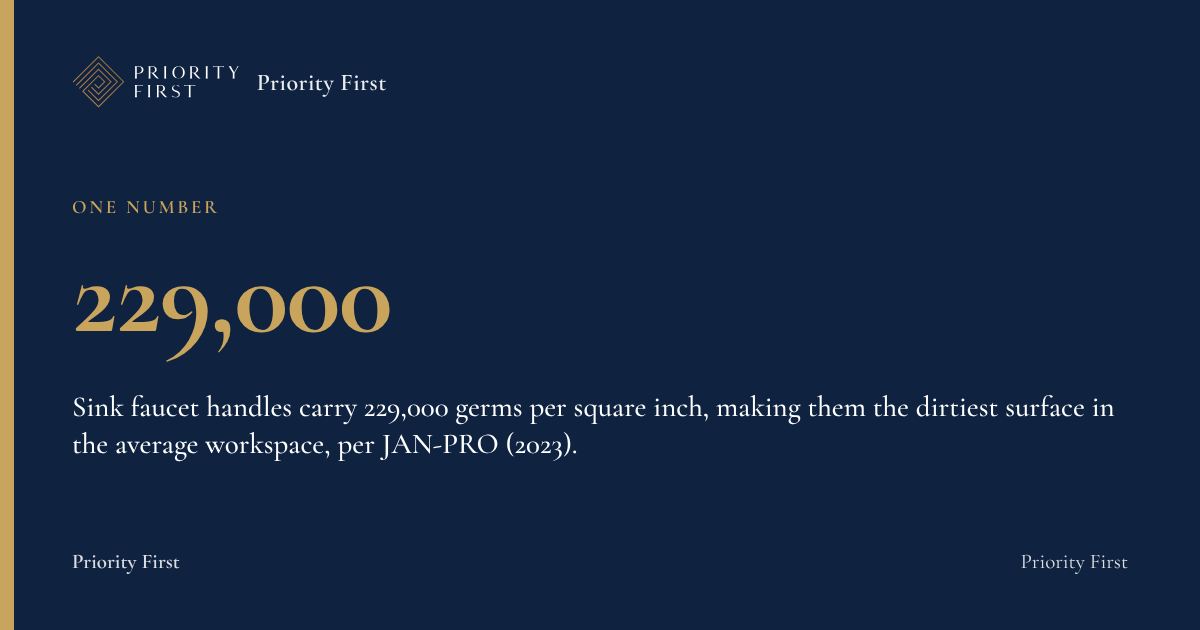
- Sink faucet handles carry 229,000 germs per square inch, making them the dirtiest surface in the average workspace, per JAN-PRO (2023).
- The average desk holds over 1,000,000 germs, ten times more than a kitchen table, per JAN-PRO (2023).
- Quality commercial cleaning cuts cold and flu transmission risk at work by 80% and reduces sick days by 46% a year, per JAN-PRO (2023).
- Priority First advises that Regulation 9 of the Workplace (Health, Safety and Welfare) Regulations 1992 obliges every UK employer to keep workplaces sufficiently clean.
What Is A Daily Office Cleaning Checklist?
A daily office cleaning checklist is a written schedule of hygiene tasks that must be completed every working day to keep an office safe, presentable and compliant with UK workplace law. It typically separates tasks by area — desks, floors, kitchens, washrooms — and by frequency, distinguishing daily jobs from weekly or monthly deep-clean work.
The checklist exists because dirt and bacteria accumulate fast in shared workspaces. The average desk carries over 1,000,000 germs, ten times more than a kitchen table, according to JAN-PRO (2023), and a University of Arizona study found the typical office desk harbours 400 times more bacteria than a toilet seat, as cited by Cleantastic (2024).
A daily checklist differs from a deep-clean schedule in scope, not intent. Daily tasks target visible dirt and high-contact bacteria transfer; weekly and monthly tasks tackle carpets, upholstery, air vents and window interiors that build up more slowly. Both sit under the same UK legal duty: the Health and Safety Executive's L24 Approved Code of Practice expects employers to keep floors, furniture and fittings clean on an ongoing basis, not just periodically.
Which Essential Tasks Must Be Done Every Day In An Office?
Every office needs four non-negotiable daily tasks: emptying bins, wiping desks and communal surfaces, vacuuming or mopping floors, and disinfecting high-touch points. Skipping any one of these for even a day allows bacteria and clutter to build up quickly in a shared workspace.
Bin emptying prevents odour and pest attraction, particularly near kitchen areas where food waste accumulates overnight. Desk and surface wiping matters because 62% of office workers eat lunch at their desks, 50% snack there, and 27% eat breakfast at their workstation, according to JAN-PRO (2023) — meaning food residue and bacteria transfer onto desks daily, not occasionally.
Floor care — vacuuming carpets, mopping hard floors, and clearing entrance matting — reduces slip hazards and dust accumulation. Reception areas and corridors need particular attention because footfall concentrates grit and moisture near entrances, a point relevant to any commercial building Priority First manages through its Facilities Management service, where building upkeep and compliance sit alongside security.
A practical daily task list looks like this:
- Empty all bins and replace liners, including kitchen and washroom bins
- Wipe down desks, meeting room tables and shared surfaces
- Vacuum carpeted areas and mop hard flooring
- Clean entrance glass and remove visible smudges from doors
- Restock paper towels, soap and hand sanitiser dispensers
- Spot-clean spills and stains immediately, not at the end of the day
Which High-Touch Areas Need Daily Disinfecting, And Why?
High-touch areas — door handles, light switches, keyboards, lift buttons and shared phones — need daily disinfecting because they transfer bacteria between every person who uses them. Sink faucet handles are the dirtiest surface recorded in the average workspace, carrying 229,000 germs per square inch, according to JAN-PRO (2023).
Keyboards and desk phones sit close behind, given that desks themselves carry over 1,000,000 germs on average, per the same JAN-PRO (2023) data. These items are touched dozens of times an hour and rarely cleaned by the user themselves, which is why they belong on the cleaner's checklist rather than being left to individual staff discretion.
The business case is measurable. Proper commercial cleaning reduces the risk of catching a cold or flu at work by 80%, and offices with quality commercial cleaning report 46% fewer sick days annually, according to JAN-PRO (2023). Separately, the Bureau of Labor Statistics reports that US businesses lose 2.8 million workdays a year to injuries and illnesses, as cited by CS Triad (2024) — a reminder that hygiene and absence are directly linked, even where the underlying figures come from different markets.
Priority areas for daily disinfecting include:
- Door handles and push plates on every internal and external door
- Light switches, lift call buttons and intercom panels
- Shared keyboards, mice and meeting room equipment
- Taps, soap dispensers and washroom door locks
- Handrails on stairs and any shared printer or scanner touchscreens
How Should Kitchen And Break Room Areas Be Cleaned Daily?
Kitchen and break room areas require daily cleaning of worktops, sinks, fridge handles, microwave interiors and shared crockery storage to meet basic food hygiene expectations. The Food Standards Agency's general hygiene principles — designed for food businesses but widely adopted as good practice in office kitchens — call for clean, sanitised surfaces wherever food is prepared or consumed.
Given that half of office workers snack at their desks and 62% eat lunch there, per JAN-PRO (2023), crumbs and spills inevitably migrate from workstations back into the kitchen via shared cutlery, mugs and the fridge door. A daily clean breaks that cycle before bacteria has time to multiply overnight.
A sensible daily kitchen checklist covers:
- Wipe down all worktops, tables and the outside of appliances
- Clean the sink, taps and drainer, and empty standing water
- Wipe fridge handles and door seals; remove out-of-date food
- Empty and wipe the microwave interior
- Replace tea towels and restock washing-up liquid
- Take out food waste and general rubbish before it sits overnight
What Is The Recommended Daily Cleaning Routine For UK Office Toilets And Washrooms?
A UK office washroom needs daily cleaning of toilets, sinks, taps, mirrors, floors and dispensers to meet the standard expected under the Workplace (Health, Safety and Welfare) Regulations 1992. Regulation 9 of these regulations — the statutory instrument governing general workplace welfare — requires sanitary conveniences to be kept clean, and the HSE's L24 Approved Code of Practice expands on what "sufficiently clean" means in practice: no accumulation of waste, adequate ventilation, and working sanitary fittings.
Because sink faucet handles are the single dirtiest surface recorded in an office at 229,000 germs per square inch, per JAN-PRO (2023), washroom taps deserve more attention than almost any other point on the checklist.
A daily washroom routine should include:
- Clean and disinfect toilets, urinals and cubicle door handles
- Wipe sinks, taps and surrounding surfaces with disinfectant
- Clean mirrors and remove watermarks
- Mop floors and check for standing water, a slip hazard under HSE guidance
- Restock toilet paper, soap, paper towels and sanitary disposal units
- Empty sanitary and general waste bins and replace liners
Who Is Legally Responsible For Workplace Cleanliness Under UK Law?
The employer, as occupier of the workplace, holds the legal duty to keep the premises sufficiently clean under Regulation 9 of the Workplace (Health, Safety and Welfare) Regulations 1992, made under legislation.gov.uk. This duty sits within the broader framework of the Health and Safety at Work etc. Act 1974, which places a general duty of care on employers for everyone affected by their undertaking.
The Health and Safety Executive (HSE) is the UK's enforcing authority for this legislation, and its L24 Approved Code of Practice sets out the practical standard: furniture, furnishings and fittings must be kept clean, waste must not accumulate, and floors and traffic routes must be kept free of obstruction and slip hazards.
Delegating the physical cleaning work to a contractor does not transfer this legal responsibility. The employer remains accountable for ensuring the work is actually carried out to standard, which is why documented, auditable cleaning — not just a verbal assurance — matters for compliance evidence if the HSE ever inspects.
Should Daily Cleaning Be In-House, Contracted Out, Or Left To Employees?
Daily office cleaning works best as either an in-house team or a specialist cleaning contractor, not as an informal task left to employees, because consistency and accountability both suffer when cleaning is nobody's defined job. Employee-led tidying can supplement a professional clean but should never replace it, given how quickly bacteria accumulates on desks and shared equipment.
| Approach | Best suited to | Trade-off |
|---|---|---|
| In-house cleaning staff | Larger offices with daily footfall, fixed hours | Full control over standards, but adds payroll, management and cover for absence |
| Contracted cleaning service | Most SME and mid-size offices | Predictable cost and accountability, but requires a clear service-level agreement |
| Employee self-cleaning | Very small teams, hot-desk or hybrid offices with low daily occupancy | Low cost, but inconsistent and rarely covers washrooms or high-touch disinfecting properly |
The decision usually comes down to office size, occupancy pattern and risk tolerance. A hybrid office with variable daily headcount may only need a contracted clean three or four days a week, while a fully occupied office benefits from a daily routine and a documented schedule that can be checked against actual completion, not just assumed.
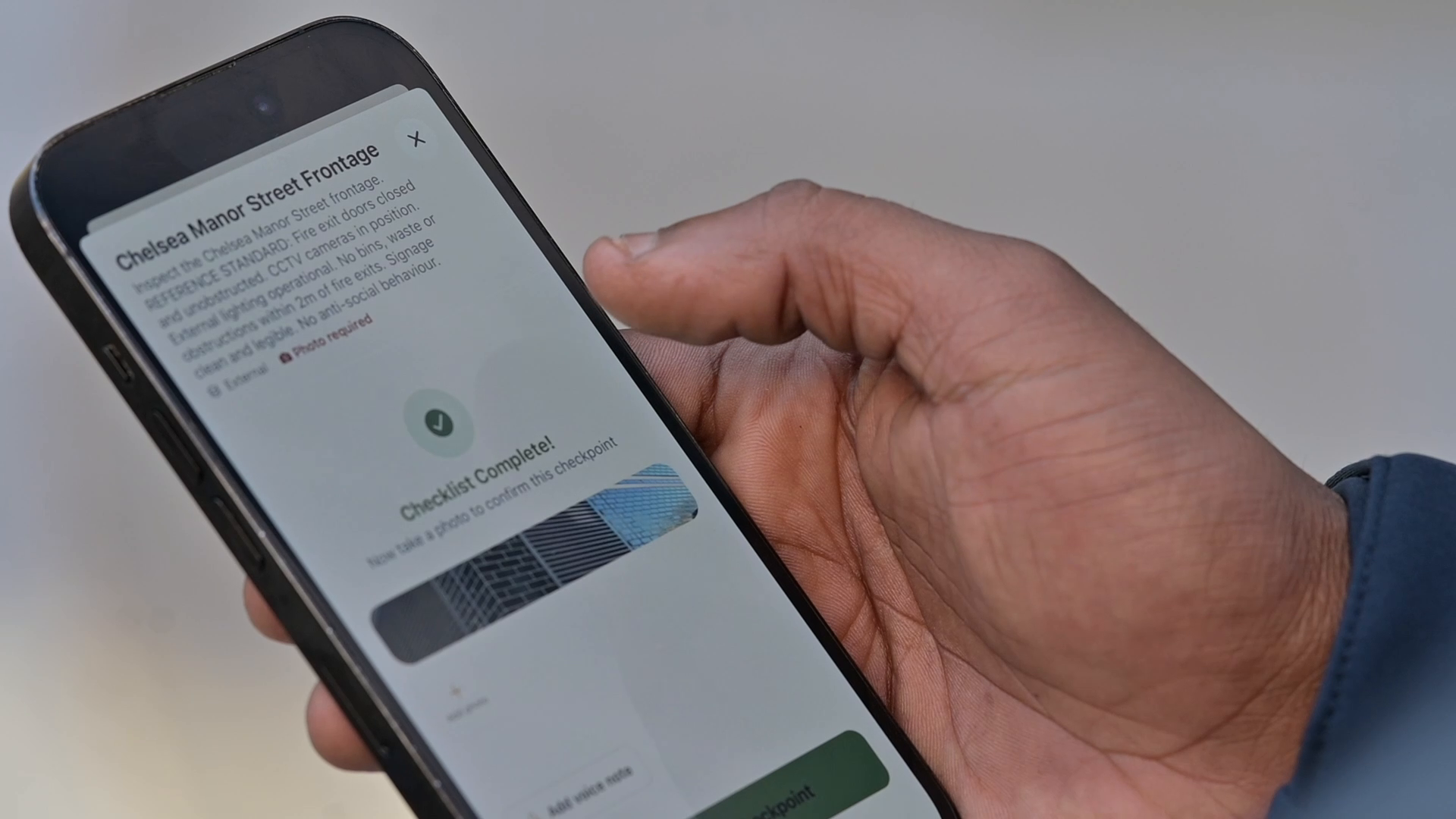
Priority First applies the same logic to physical security and building oversight: assumption without evidence is the recurring failure point across facilities contracts. On a West London mixed-use development with 152 photographed checkpoints across retail, residential, service yards and plant rooms, the client had previously relied on officers reporting rounds "complete" with no way to prove which plant room was actually checked at 3am. Every checkpoint now requires a timestamped, GPS-tagged photo to close out, and the same verification principle — provable completion, not asserted completion — applies equally to cleaning schedules, where a signed-off checklist with no audit trail leaves an employer unable to demonstrate Regulation 9 compliance if challenged.
How Long Should A Daily Office Clean Take, And What Should It Cost?
A daily clean for a small UK office typically takes 15 to 30 minutes, according to JAN-PRO (2026), though larger offices with multiple floors, kitchens or washrooms will need proportionately longer. Office size, staff headcount and the number of washrooms are the main variables that extend this figure.
As a rough illustrative guide — not a quoted price from any single source — small UK offices commonly pay a modest daily or per-visit rate for a contracted clean, with cost scaling by square footage, washroom count and whether the contract covers evenings, early mornings or both. Businesses typically see a return beyond hygiene: ISSA's Value of Clean study linked improved cleaning to a 5% increase in productivity, worth around $125,000 a year for a 100-person office, as cited by Hero Cleaning (2025).
Ways to keep daily cleaning costs proportionate without cutting corners on compliance:
- Scope the contract by area rather than paying a flat daily rate for unused space
- Combine cleaning oversight with existing facilities management contracts to reduce duplicated site visits
- Review washroom and kitchen cleaning frequency against actual daily occupancy, particularly in hybrid offices
Your Daily Office Cleaning Checklist
- Empty all bins and replace liners across desks, kitchens and washrooms
- Wipe desks, meeting tables and shared surfaces with disinfectant
- Disinfect door handles, light switches, keyboards and lift buttons
- Clean and restock washrooms: toilets, taps, mirrors, soap and paper towels
- Wipe kitchen worktops, sinks, fridge handles and the microwave interior
- Vacuum carpets and mop hard floors, checking entrances for grit and moisture
- Record completion against a written schedule so compliance can be evidenced, not assumed
FAQ
What should a daily office cleaning checklist include?
A daily office cleaning checklist should include bin emptying, desk and surface wiping, floor cleaning, high-touch disinfecting, kitchen sanitising and washroom cleaning. These core tasks address the areas where bacteria accumulates fastest in a shared workspace, particularly desks and sink taps.
How often should office toilets be cleaned in the UK?
UK office toilets should be cleaned at least once every working day, and more frequently in high-footfall buildings. This meets the standard expected under Regulation 9 of the Workplace (Health, Safety and Welfare) Regulations 1992 and the HSE's L24 Approved Code of Practice.
Who is legally responsible for keeping an office clean?
The employer is legally responsible for workplace cleanliness under the Workplace (Health, Safety and Welfare) Regulations 1992. This duty applies regardless of whether cleaning is carried out by in-house staff, a contractor, or a mix of both.
How long does a daily office clean take?
A daily clean for a small office typically takes 15 to 30 minutes, according to JAN-PRO (2026). Larger offices with more desks, kitchens and washrooms will require more time, scaled roughly to floor area and headcount.
What is the difference between a daily checklist and a weekly deep clean?
A daily checklist covers fast-accumulating dirt and bacteria — desks, bins, floors, high-touch points and washrooms. A weekly or monthly deep clean covers slower-building tasks such as carpet shampooing, window interiors, upholstery and air vent cleaning that don't need daily attention.
Should a small business clean its own office or hire a contractor?
It depends on office size and occupancy. Very small or hybrid teams can manage basic tidying themselves, but most offices benefit from a contracted cleaning service because it guarantees consistency, covers washrooms properly, and provides an auditable record for health and safety compliance.
What are the most commonly missed items on an office cleaning checklist?
The most commonly missed items are high-touch surfaces such as light switches, lift buttons, keyboards and door handles, along with washroom taps — which carry 229,000 germs per square inch, according to JAN-PRO (2023). These are touched constantly but rarely cleaned by staff themselves.
Keeping Your Building Compliant With Priority First
A clean, compliant office rarely stands alone — it sits inside a wider building that needs consistent upkeep, access control and accountability, which is exactly where Priority First's day-to-day work overlaps with the cleaning schedules covered in this article. Facilities oversight without a verifiable record is the same weakness whether it applies to a cleaning rota or a security patrol, and Priority First builds evidence into both through photographed checkpoints, GPS timestamps and documented handovers rather than relying on assurances alone.
On a 16-building prime London estate, 250–280 patrols per building are now recorded, all photo-backed, replacing a system where cover was previously unprovable. The same discipline — schedule, completion, evidence — is what turns a cleaning checklist from a good intention into something an employer can actually demonstrate to the HSE if asked.
If your office or building needs facilities management, security, or both managed under one accountable partner, get in touch with Priority First for a quote.
Related Reading
- Daily Office Cleaning Checklist for UK Workplaces (2026)
- What Is MEES? Office EPC C 2027 Rule Explained
- Office Cleaning Cost Per Hour in London 2026
Mo Hassan leads Priority First, a UK building-management and security-services company operating across prime central London and nationwide. Mo writes on physical security, construction-site protection, CCTV, and building operations.
Over a decade in premium building management and security operations
Specialises in Building management, Security operations, Construction site security