Close Protection Cost UK 2026: Full Pricing Guide

Last updated: 29 August 2026
Close protection in the UK typically costs £200–£500 per day for standard cover, rising to £700–£1,500 per day for international or high-risk assignments, according to Get Licensed (2026). Hourly rates generally sit between £40 and £100, with final pricing shaped by risk level, officer experience, location and whether vehicles or advance planning are included.
Key Takeaways
- Standard close protection roles in the UK cost £200–£500 per day, rising to £700–£1,500 per day for international contracts, according to Get Licensed (2026).
- Close protection officers in London typically charge £40–£80 per hour or £500–£1,000 per day, per Imperial Security Agency (2026).
- Freelance close protection officers commonly set rates of £25–£50 per hour or £200–£600 per day, according to Priority First's own analysis (2026).
- The SIA Close Protection Licence costs £204 to apply for and remains valid for three years, per Hurak (2026).
- Executive protection for higher-risk or complex assignments can reach £1,500 or more per day, according to KSS Canada (2026).
What is close protection?
Close protection is a specialist form of physical security in which a trained operative — often called a close protection officer (CPO) or bodyguard — accompanies an individual to prevent, deter or respond to threats of assault, abduction or harassment. Unlike static guarding, which protects a fixed location, close protection moves with the client across offices, vehicles, residences and public events.
Every close protection officer working in the UK must hold an SIA licence, issued by the Security Industry Authority (SIA), the body established under the Private Security Industry Act 2001 to regulate the private security sector. The SIA's Knowledge and Skills Specification for Close Protection sets the mandatory training standard every licensed officer must meet before deployment.
Close protection sits at the higher-skilled, higher-cost end of the security spectrum. Standard manned guarding might run to £15–£25 an hour; close protection commands a substantially higher rate because it demands advanced risk assessment, defensive driving, first aid and conflict management training.
How much does close protection cost in the UK?
Close protection costs in the UK vary widely by risk tier, ranging from roughly £200 per day for low-risk domestic assignments to £1,500 or more per day for high-risk or international deployments. The three verified pricing sources in this guide broadly agree on the shape of the market, even though their exact ranges differ slightly depending on region and client type.
Get Licensed reports that standard close protection roles typically cost £200–£500 per day, rising to £700–£1,500 per day for international contracts (2026). The same source places average hourly pay for close protection officers at £50 to £100. KSS Canada puts professional executive/close protection at £500 to £1,500-plus per day, depending on risk level and operational complexity (2026).
In London specifically, Imperial Security Agency states that bodyguards and close protection specialists typically cost £40–£80 per hour or £500–£1,000 per day (2026). Freelance officers, meanwhile, tend to price themselves more competitively: Priority First's own research shows freelance close protection officers typically setting rates of £25–£50 per hour or £200–£600 per day (2026).
Comparison table: close protection day rates by risk tier
| Assignment type | Typical day rate | Typical hourly rate | Source |
|---|---|---|---|
| Standard/low-risk domestic | £200–£500/day | £25–£50/hour | Priority First (2026) |
| London-based CPO | £500–£1,000/day | £40–£80/hour | Imperial Security Agency (2026) |
| Executive/complex risk | £500–£1,500+/day | — | KSS Canada (2026) |
| International deployment | £700–£1,500/day | — | Get Licensed (2026) |
These figures represent officer-facing day rates rather than final client invoices, which often include additional charges for planning, vehicles and management overhead, discussed below.
What factors affect close protection pricing?
Close protection pricing is driven primarily by risk classification, team size, geographic scope and the amount of advance planning a job requires. A single low-risk domestic assignment in Chelsea will cost far less than a multi-officer protective security detail (PSD) accompanying an executive through several countries in a week.
Risk assessment and threat level. Every professional close protection engagement begins with a formal risk assessment, which classifies the assignment into a threat tier. Higher tiers require officers with firearms training (where legally applicable overseas), advanced driving qualifications and counter-surveillance skills, which pushes day rates towards the £1,000–£1,500-plus bracket cited by KSS Canada (2026).
Team size. A single CPO covers routine journeys and low-profile appearances. A protective security detail — typically two to four officers plus a team leader — is standard for high-net-worth individuals, visiting executives or public figures attending events, and each officer's day rate is charged individually.
Location and travel. International contracts routinely command the £700–£1,500 per day rate identified by Get Licensed (2026), reflecting visa costs, insurance, hazard pay and unfamiliar-jurisdiction risk. Domestic work across London, Manchester, Birmingham or Edinburgh tends to sit closer to the standard £200–£600 range.
Duration and notice period. Short-notice bookings, overnight cover and last-minute event security typically attract a premium above standard day rates, since officers must be pulled from other rota commitments at short notice.
Officer experience and qualifications. A CPO with military or police background, close protection team leader experience, or first aid instructor certification will price towards the top of any given range.
In-house security team vs outsourced close protection
Business professionals weighing up cost often ask whether to build an in-house security function or outsource to a specialist provider. In-house teams require direct employment costs, SIA licence renewals, ongoing training budgets and management overhead, whereas outsourced close protection is billed transparently on a day-rate or hourly basis with no employment liability.
For most businesses, outsourcing to an established security provider offers predictable costs and immediate access to vetted, SIA-licensed officers without the lead time or HR burden of direct recruitment.
What does a close protection day rate actually include?
A close protection day rate typically covers the officer's time on duty, but not necessarily every associated cost — and this is where many corporate buyers get caught out. Understanding what is bundled into the quote, versus billed as an extra, is essential before comparing providers.
Most standard day rates include the officer's working hours, basic risk assessment and standard equipment. Advance reconnaissance of a venue, vehicle hire, fuel, accommodation for multi-day assignments, and specialist insurance are frequently quoted separately. Corporate clients should always request an itemised breakdown rather than a single headline figure, since two seemingly similar quotes can differ substantially once extras are added.
- Officer time: base day or hourly rate as covered above.
- Advance planning/reconnaissance: venue and route surveys, often charged as a half-day or full-day rate.
- Vehicles: armoured or executive vehicles are usually a separate line item.
- Accommodation and subsistence: charged for multi-day or residential assignments.
- Insurance: professional indemnity and public liability cover should be confirmed in writing.
- VAT: standard-rated at 20% for UK-registered providers invoicing UK corporate clients.
Corporate procurement teams should also confirm minimum booking periods, cancellation notice terms and any short-notice deployment surcharge before signing.
How much does it cost to become a close protection officer?
Qualifying as a close protection officer in the UK costs between roughly £1,200 and £3,200 in total, once training and licensing fees are combined. This entry cost matters to business buyers too, since it directly shapes the supply of qualified officers and, in turn, market day rates.
A close protection training course typically costs £1,000 to £3,000, depending on the provider, according to CR Training (2026). On top of this, the SIA Close Protection Licence application fee is £204, non-refundable, and valid for three years, per Hurak (2026). The SIA's Get Licensed criteria (May 2026) also sets out mandatory refresher training requirements ahead of licence renewal.
In 2026, there were over 451,000 active SIA licence holders in the UK, of which 402,273 were men and 49,200 were women, according to Statista, citing GOV.UK data (2026). Close protection licences form a specialist subset of this total, and GOV.UK's published data on close protection licences granted over a five-year period shows year-on-year trends in new entrants to the profession.
Business buyers benefit from understanding this cost structure: it explains why experienced, multi-qualified CPOs charge premium day rates, and why cut-price quotes well below the £200/day floor should prompt questions about licensing and insurance.
Worked scenarios: illustrative close protection costs
The following are illustrative examples only, built from the ranges above, and not attributed to any single research source.
- Single CPO for a one-day executive visit to central London: at a typical £500–£1,000 day rate, a single day of cover for a visiting executive might total roughly £500–£1,000, before vehicle or planning costs.
- Three-officer PSD for a week-long international trip: at £700–£1,500 per officer per day, a three-person detail for five days could total in the region of £10,500–£22,500, excluding travel, visas and accommodation.
- Freelance domestic cover for a private client over a weekend: at a freelance rate of £200–£600 per day, two days of weekend cover might total roughly £400–£1,200.
These worked totals are estimates for planning purposes and will vary based on the specific provider, risk assessment outcome and any extras discussed above.
Ways to reduce close protection costs without compromising safety
Businesses can manage close protection spend sensibly by matching cover to genuine risk rather than over-specifying. A properly conducted risk assessment often reveals that a lower threat tier, or a single officer rather than a full detail, is sufficient for a given assignment.
"When a quote is dramatically cheaper than the rest, the saving has come from somewhere — usually the officer's pay, their training, or the vetting behind them. Tired, underpaid officers on your site are a risk you have paid to acquire. Value in this industry means knowing exactly what your money buys."
— Mo Hassan, Managing Director, Priority First
- Book in advance where possible, since short-notice deployment frequently carries a premium.
- Bundle static and mobile security with one accountable provider to reduce management overhead and duplicate contracts.
- Right-size the team — a single experienced CPO is often adequate for low-profile domestic movement, reserving multi-officer PSDs for genuinely elevated risk.
- Confirm inclusions upfront so vehicle, accommodation and planning costs are quoted transparently rather than added later.
- Review threat levels periodically rather than defaulting to the same tier of cover indefinitely, since risk profiles change.
Alternatives to consider instead of full close protection
Not every business risk requires dedicated close protection. For premises-based risk, CCTV monitoring, manned guarding and key holding with alarm response may address the underlying concern more cost-effectively than a mobile CPO.
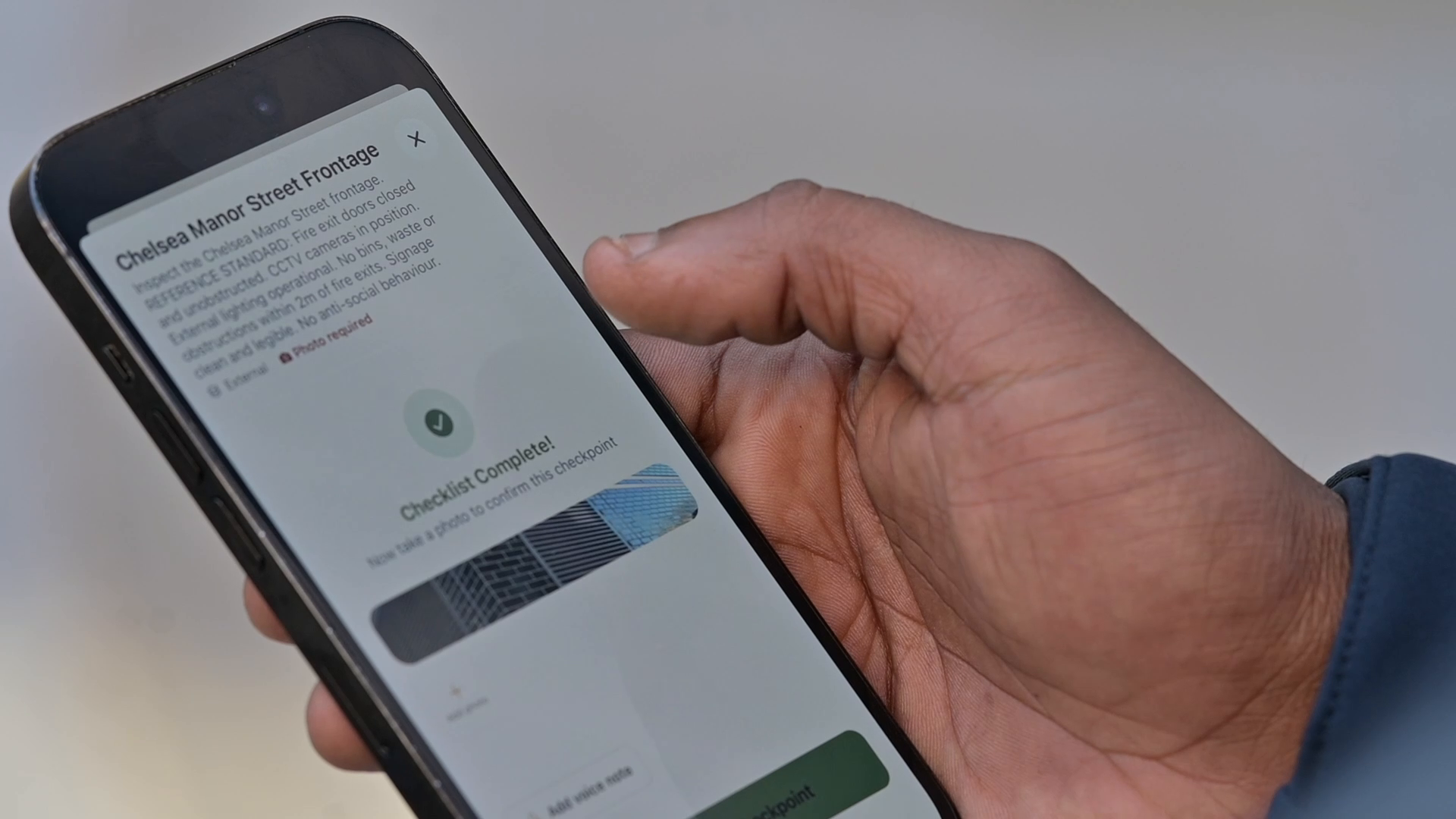
Priority First's own portfolio illustrates this principle in practice. On a mixed-use development in West London combining retail, residential and public areas, the company deployed manned security with photographed checkpoint patrols across 152 checkpoints and 11 officers, rather than dedicated close protection, because the risk profile was site-based rather than person-based. Since going live in February 2026, that site has recorded more than 540 completed patrols, with every checkpoint requiring a photo, officer ID, GPS location and timestamp to complete. For a business assessing its own security spend, the right question is not "how much does close protection cost" in isolation, but "does this risk require a person following an individual, or a site under sustained watch?"
Your close protection procurement checklist
- Commission a formal risk assessment before requesting quotes, so pricing reflects genuine threat level rather than guesswork.
- Confirm every proposed officer holds a valid SIA Close Protection Licence before deployment.
- Request an itemised quote separating officer day rate from vehicles, accommodation, planning and insurance.
- Clarify minimum booking periods and any short-notice deployment surcharge in writing.
- Decide whether a single CPO or a multi-officer protective security detail matches the actual risk tier.
- Check VAT treatment on the invoice, since UK-registered providers should apply standard-rated VAT.
- Ask whether static security, CCTV monitoring or key holding could address the risk more cost-effectively than mobile close protection.
- Review and re-tier the assignment periodically rather than maintaining a fixed level of cover by default.
FAQ
How much does it cost to hire a close protection officer in the UK?
Standard close protection roles in the UK typically cost £200–£500 per day, rising to £700–£1,500 per day for international contracts, according to Get Licensed (2026). Hourly rates generally range from £25 to £100 depending on experience, location and risk classification.
What is the average day rate for a bodyguard in the UK?
Bodyguards and close protection specialists in London typically cost £500–£1,000 per day, according to Imperial Security Agency (2026). Freelance officers often price lower, at £200–£600 per day, per Priority First's own analysis (2026).
How much does close protection cost per hour in London?
Close protection specialists in London typically charge £40–£80 per hour, according to Imperial Security Agency (2026). Freelance officers may charge slightly less, at £25–£50 per hour, per Priority First (2026).
What factors affect the cost of close protection services?
Risk classification, team size, location, notice period and officer experience are the main factors affecting close protection cost. International or high-risk assignments can reach £1,500 or more per day, according to KSS Canada (2026), while standard domestic cover starts around £200 per day.
Is close protection more expensive than standard security guarding?
Yes, close protection is significantly more expensive than standard manned guarding because it requires specialist training, higher SIA licensing standards and mobile, person-focused protection. Standard guarding rates are typically much lower per hour than the £40–£100 hourly range reported for close protection by Get Licensed (2026).
How much does it cost to get an SIA Close Protection Licence?
The SIA Close Protection Licence application fee is £204, non-refundable, and valid for three years, according to Hurak (2026). Applicants must also complete mandatory training beforehand, which typically costs £1,000 to £3,000 depending on the provider, per CR Training (2026).
Do close protection officers charge more for overnight or international work?
Yes, international contracts typically cost £700–£1,500 per day compared with £200–£500 per day for standard domestic assignments, according to Get Licensed (2026). Overnight and short-notice work commonly attracts a premium above standard day rates as well.
What is included in a close protection day rate?
A close protection day rate typically covers the officer's working hours, basic risk assessment and standard equipment, but often excludes vehicles, accommodation and advance reconnaissance. Corporate clients should always request an itemised quote to confirm exactly what is bundled into the headline day rate before booking.
Securing your business with Priority First
Business professionals reading this guide are usually weighing up close protection against a wider question: what level of security actually matches our risk, and who can deliver it accountably? Priority First approaches that question from experience across both mobile protection needs and site-based security, drawing on operational data from prime central London portfolios in Chelsea, Knightsbridge and Mayfair, alongside contracts in West London, the West Midlands and Bedfordshire.
Priority First's own field operations currently run across 24 sites on a single monitoring platform, with more than 4,900 photo-backed patrols completed to date — each one carrying officer ID, GPS location and timestamp, so clients can verify delivery rather than take it on trust. That same evidence-led standard applies whether the requirement is close protection, manned guarding, key holding or CCTV monitoring.
If your business needs a clear-eyed assessment of whether close protection, static security or a combination is the right and most cost-effective fit, get in touch with Priority First for a tailored quote and risk-based recommendation.
Related Reading
- Close Protection Courses UK Cost 2026: Compare Providers
- 10 Close Protection Courses Near Me for Aspiring Security Pros
- 4 Best Practices for Close Protection UK in Construction Sites