Office Soft Services UK: Complete 2026 Guide


Last updated: 27 August 2026
Office soft services are the people-facing functions that keep a workplace running and secure — reception, cleaning, mailroom, concierge and front-of-house security — as distinct from the "hard" mechanical and electrical upkeep of a building. The global soft facility management market reached USD 628.91 billion in 2026 and is forecast to hit USD 853.75 billion by 2030, according to Mordor Intelligence (2026).
Key Takeaways
- Office soft services cover reception, cleaning, concierge, mailroom and front-of-house security rather than a building's mechanical infrastructure.
- The soft facility management market was valued at USD 628.91 billion in 2026 and is projected to reach USD 853.75 billion by 2030, a 6.30% CAGR, per Mordor Intelligence (2026).
- Soft services account for nearly 42% of total facilities management demand globally, against 58% for hard services, per Market Reports World (2026).
- Priority First has secured over £1.6 billion in client assets across prime central London and nationwide sites (as of August 2026).
- Soft services within the wider Facility Management Market are accelerating at a 6.05% CAGR, reflecting rising demand for hygiene, security and occupant wellbeing, per Mordor Intelligence (2026).
What are office soft services?
Office soft services are the people-dependent, non-structural functions of a workplace — including reception, cleaning, concierge, mailroom handling, catering, pest control and front-of-house security — that shape how a building is experienced day to day. They sit alongside "hard services", which cover the fabric of a building: heating, ventilation and air conditioning (HVAC), lifts, electrical systems and fire safety plant.
The distinction matters because soft services are judged on human interaction and consistency, not just technical uptime. A broken lift is a hard-services failure that gets logged and fixed; an unmanned reception desk or a missed cleaning round is a soft-services failure that a visitor, employee or auditor notices immediately. Globally, hard services still account for approximately 58% of total facilities management demand, while soft services contribute nearly 42%, according to Market Reports World (2026).
How soft services differ from hard services
Hard services keep a building operational; soft services keep it usable, presentable and secure for the people inside it. The two are frequently procured together but managed by different specialists — mechanical and electrical (M&E) contractors for hard services, and facilities or security providers for soft services.
Priority First's own model treats this distinction deliberately, pairing facilities management with security so that one accountable partner covers both the building's fabric and the people who move through it, rather than leaving a gap between two separate contractors.
What do office soft services actually include?
Office soft services span every function that touches an employee, visitor or contractor from the moment they approach a building. In a typical UK commercial office, this includes reception and switchboard cover, cleaning and janitorial work, concierge and front-of-house management, mailroom and courier handling, pest control, waste management, catering, and increasingly, manned security and access control at the front door.
The scope has widened considerably since 2020. Hybrid working patterns mean occupancy now fluctuates through the week, so reception and security cover has to flex rather than assume a static 9-to-5 headcount. Soft services within the Facility Management Market are growing at a 6.05% CAGR, a rate Mordor Intelligence attributes directly to heightened focus on hygiene, security and occupant wellbeing — Mordor Intelligence (2026).
Core soft service categories in a UK office
| Category | Typical function | Common provider type |
|---|---|---|
| Reception & front-of-house | Visitor greeting, sign-in, call handling | Concierge or security provider |
| Cleaning & janitorial | Daily cleaning, washroom servicing, waste removal | Specialist cleaning contractor |
| Security & access control | Manned guarding, ID checks, CCTV monitoring | SIA-licensed security provider |
| Mailroom & logistics | Post handling, courier sign-in, deliveries | In-house or outsourced logistics team |
| Concierge services | Resident/tenant liaison, parcel storage, bookings | Concierge or building management firm |
| Pest control & hygiene | Scheduled inspections, sanitation compliance | Specialist environmental contractor |
| Catering & vending | Staff catering, meeting room refreshments | Catering contractor |
Why the reception desk is now a security function
A modern reception desk has to do two jobs at once: present a welcoming face to legitimate visitors and act as the first line of physical access control. This is why front-of-house teams and security officers are increasingly the same function rather than two separate contracts.
Mo Hassan, Managing Director of Priority First, puts it plainly: "The front desk has become the job interview. Visitors judge a business within moments of walking in, so corporate security now has to be excellent twice over — welcoming to the people you want in the building and immovable to the people you don't. Hiring for one without the other fails at both."
Are office soft services legally required in the UK?
Yes — several soft service functions are legal requirements rather than optional extras under UK workplace law. The Health and Safety at Work etc. Act 1974 places a general duty on employers to ensure the health, safety and welfare of everyone on their premises, and the Workplace (Health, Safety and Welfare) Regulations 1992 set specific statutory standards.
The Health and Safety Executive (HSE) guidance under these regulations covers cleanliness, ventilation, temperature, lighting, and the provision of sanitary and washing facilities — all core soft services outputs. Failure to meet these standards is not a matter of workplace comfort; it is a compliance breach an HSE inspector can act on.
Where soft services procurement is formalised
Public sector bodies routinely tender soft services as a defined contract package. The Find a Tender Service, the UK government's official procurement portal, publishes notices for combined cleaning and security contracts, illustrating how public authorities scope and specify soft FM requirements in practice. Private sector buyers increasingly follow the same structured approach — defining service levels, response times and staffing standards in the contract itself rather than leaving them implicit.
How do soft services support corporate office security?
Soft services and corporate security overlap far more than most facilities managers assume, because the same front-line staff — receptionists, concierge teams, cleaners with after-hours access — are often the people best placed to spot a security failure. A missed delivery sign-out, an unmanned entrance during a shift change, or a cleaner's fob left unaccounted for are all soft-services gaps with direct security consequences.
This is why Priority First integrates concierge and front-of-house management with manned guarding rather than treating them as separate disciplines. An office building's risk profile changes dramatically once the working day ends: deliveries, contractors and access requests continue, but occupancy drops towards zero, leaving fewer eyes on the door and more opportunity for an unmanaged incident.
A worked example from Chelsea and Knightsbridge
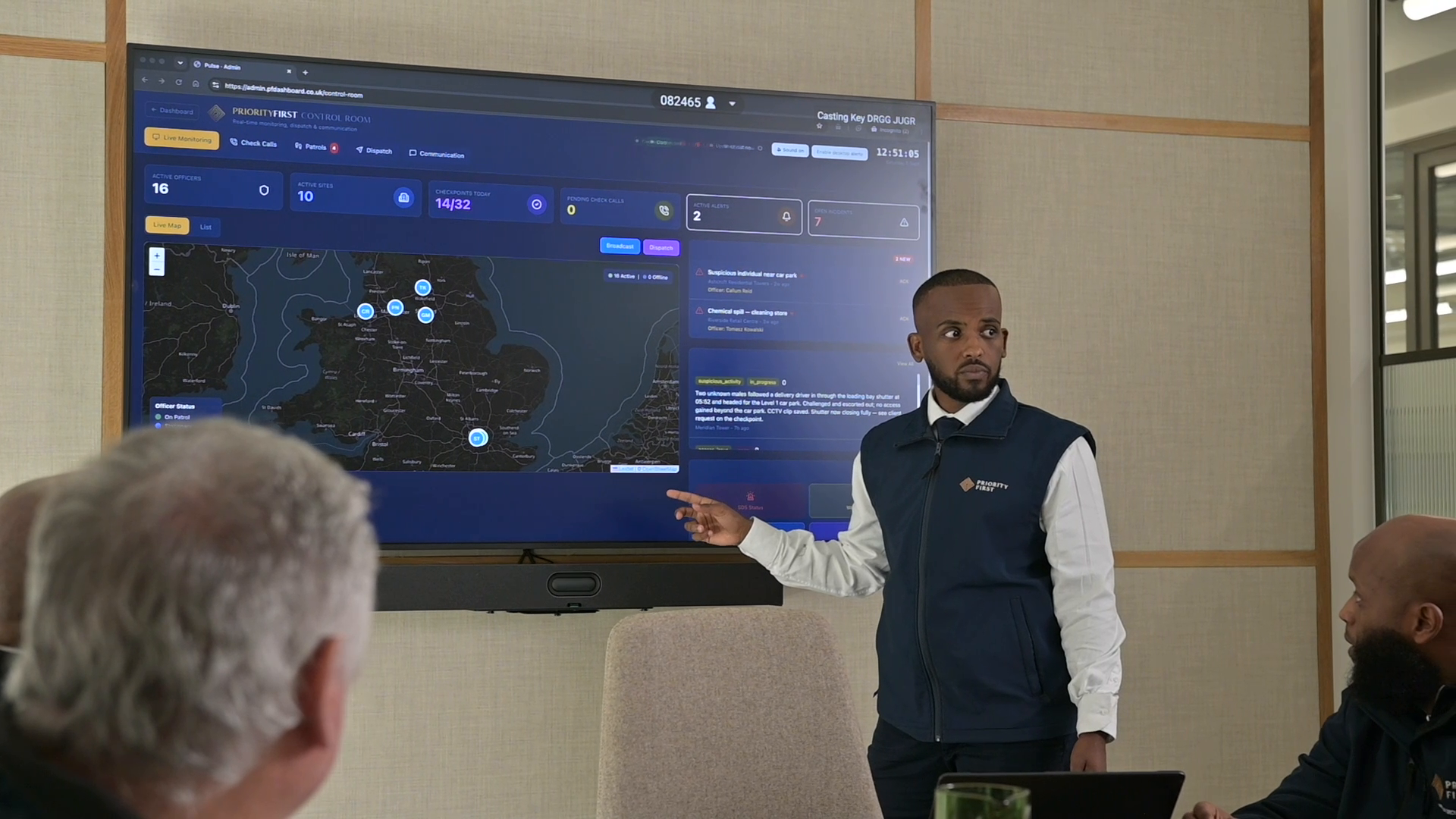
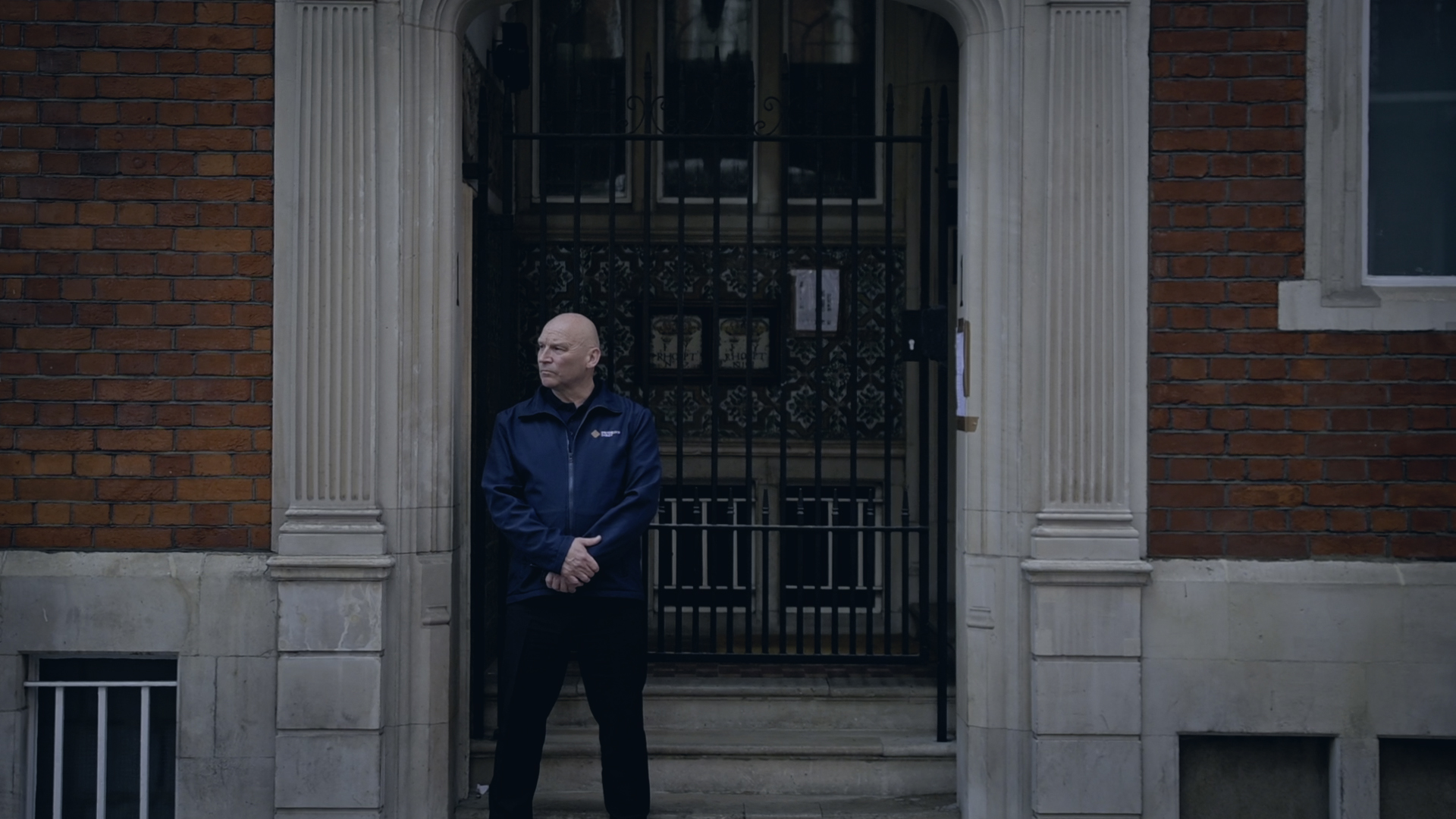
Priority First manages security for office and commercial premises across Chelsea and Knightsbridge where exactly this after-hours risk profile applies. In one case, SIA-licensed officers — security personnel individually licensed by the Security Industry Authority (SIA), the UK regulator established under the Private Security Industry Act 2001 — were deployed to cover the site around the clock, with every patrol, incident and handover logged on Priority First's monitoring platform.
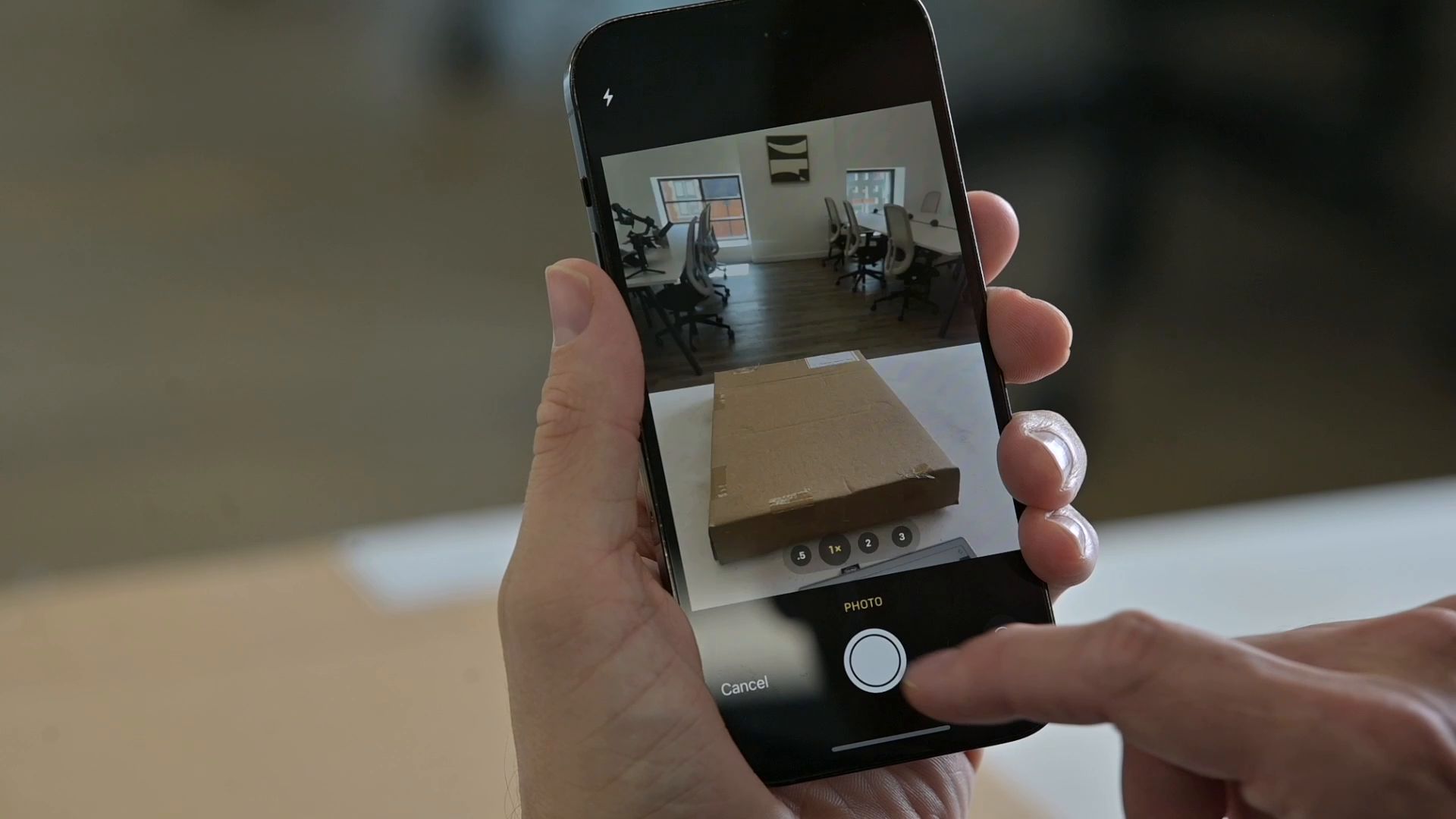
Checkpoints on that contract are completed with a photograph, GPS coordinate and timestamp, so delivered cover is provable rather than simply asserted. The arrangement runs at a cost context of circa £15,000 per year — a figure that reflects the value of continuous, evidenced cover over a site whose risk does not stop when staff go home.
Priority First's wider operational data shows the scale this evidence-based model now runs at: 24 sites are managed on one monitoring platform, generating over 4,900 photo-backed patrols, each carrying officer ID, GPS and timestamp (as of August 2026). Across its documented contracts, 37 are on file, of which 28 sit in Chelsea and Knightsbridge alone — concentrated proof that soft services and security sit closest together in exactly this type of premium, mixed-use London property.
Should a business outsource or manage soft services in-house?
Most UK businesses reach a tipping point where managing soft services in-house becomes more expensive and more exposed than outsourcing to a specialist provider. The decision usually turns on three factors: headcount liability, out-of-hours risk, and the cost of covering absence, sickness or turnover in roles that cannot simply go uncovered.
In-house teams give a business direct control over staff and culture, but they also carry full employment liability, recruitment cost, and the burden of covering shift gaps — particularly for security and reception roles that need continuous cover. Outsourced providers absorb that liability and typically bring standardised vetting, licensing checks, and technology for monitoring service delivery that most in-house teams cannot justify building themselves.
In-house vs outsourced soft services
| Factor | In-house | Outsourced |
|---|---|---|
| Employment liability | Sits with the business | Sits with the provider |
| Absence & shift cover | Business must arrange backup | Provider typically guarantees cover |
| Vetting & licensing (e.g. SIA) | Business manages compliance directly | Provider manages and evidences compliance |
| Technology & reporting | Often ad hoc or absent | Increasingly platform-based with photo/GPS evidence |
| Cost predictability | Variable — recruitment, training, turnover | Fixed contract value, agreed scope |
| Speed to scale up/down | Slow — recruitment lead times | Faster — provider reallocates resource |
Priority First's mobilisation of a prestige residential portfolio illustrates the outsourcing advantage concretely. When three new buildings — including a 10-checkpoint serviced residence in central London — were added in July 2026, all three sites went live within a fortnight, with checkpoint mapping, officer induction and photographed patrols running from night one. That replaced what is traditionally a multi-week "bedding in" period with a system where new officers see every site's prior issues the moment they start a patrol.
What should a business look for in a soft services provider?
A credible soft services provider should be judged on licensing, evidence of delivery, and how tightly they integrate security with the wider facilities function. UK businesses should confirm that any security personnel supplied are individually licensed by the SIA, that cleaning and hygiene contractors meet HSE welfare standards, and that the provider can demonstrate — not just claim — that patrols, checkpoints and deliveries are actually being carried out.
Evidence of delivery matters more than reputation alone. A provider whose checkpoints require a photograph to complete, with missed areas showing as visible gaps in the record rather than passing silently, gives a client verifiable proof rather than a trust-based assurance. Priority First's evidence standard works exactly this way: every checkpoint on every managed site requires a photo to complete, and virtually all checkpoint completions on its platform now carry a watermarked photograph, a sharp rise from before onboarding (as of August 2026).
Signals of a strong soft services provider
- Confirms every security officer holds a valid SIA licence before deployment.
- Provides photo, GPS and timestamp evidence for patrols and checkpoints rather than relying on written logs alone.
- Covers both soft services and hard services or works closely with a hard-services partner to avoid accountability gaps.
- Can mobilise new sites within days, not weeks, with documented induction packs for officers and staff.
- Publishes or can demonstrate a client satisfaction record — reflected in consistently strong client reviews and a track record of high customer satisfaction.
Your office soft services checklist
- Map every soft service function currently delivered on-site — reception, cleaning, mailroom, security, concierge.
- Confirm which functions are legally mandated under the Workplace (Health, Safety and Welfare) Regulations 1992.
- Check that any security officers on-site hold current SIA licences under the Private Security Industry Act 2001.
- Establish whether patrols, checkpoints and deliveries are evidenced with photographs, GPS or timestamps.
- Review after-hours cover specifically — occupancy drops but access and delivery activity continues.
- Decide, function by function, whether in-house management or outsourcing carries less liability for your business.
- Request a site audit or risk assessment before renewing or switching any soft services contract.
- Set clear service levels and response times in writing, mirroring the structure used in public sector tenders on Find a Tender.
FAQ
What are soft services in facilities management?
Soft services are the people-dependent functions of a workplace, including cleaning, reception, security, concierge and mailroom handling. They are distinct from hard services, which cover a building's mechanical and electrical infrastructure such as HVAC, lifts and fire safety plant.
What is the difference between hard and soft services in facilities management?
Hard services keep a building's physical infrastructure operational, while soft services manage the people-facing experience and day-to-day usability of the space. Globally, hard services represent roughly 58% of total facilities management demand against soft services' 42%, according to Market Reports World (2026).
Are soft services legally required in UK workplaces?
Yes, several soft services are statutory requirements under the Workplace (Health, Safety and Welfare) Regulations 1992, enforced by the Health and Safety Executive. These cover cleanliness, ventilation, lighting and sanitary facilities as minimum legal standards, not optional extras.
How do soft services support corporate security in an office?
Soft services staff — receptionists, concierge teams and cleaners with after-hours access — are often the first to notice a security gap, such as an unmanned entrance or an unsigned delivery. Integrating front-of-house management with manned guarding, as Priority First does, closes the gap between welcoming visitors and controlling access.
Should a business outsource or manage office soft services in-house?
Most businesses find outsourcing reduces liability and improves cover consistency, particularly for security and reception roles that require continuous staffing. In-house management retains direct control but carries full employment liability and the cost of covering absence and turnover.
What does a soft services facilities management plan typically include?
A soft services plan typically documents scheduled cleaning frequency, reception and security staffing hours, mailroom procedures, pest control inspections, and escalation routes for incidents. Providers increasingly add technology-based evidence, such as photo-backed checkpoint completions, to prove the plan is actually being delivered.
How much does outsourced office security within a soft services contract cost?
Costs vary by site size, hours of cover and location, but a fully staffed manned security arrangement for a mid-size London office can run to a cost context of circa £15,000 per year, based on Priority First's delivered contracts in Chelsea and Knightsbridge. Larger or 24/7-covered sites will scale upward from this baseline depending on officer numbers and shift patterns.
Securing your office soft services with Priority First
Office soft services and corporate security are not separate problems — they are the same front line, managed well or managed badly. Priority First treats them as one accountable function, pairing concierge and front-of-house management with corporate security so that reception, access control and out-of-hours cover sit under a single, evidenced contract rather than two disconnected suppliers.
Across prime central London — Chelsea, Knightsbridge and Mayfair — and sites further afield in the West Midlands and Bedfordshire, Priority First now runs 24 sites on one monitoring platform, with every checkpoint requiring a photograph, GPS location and timestamp to complete (as of August 2026). As one client, James Burmingham, put it: "Since then, the monitoring service has been top-notch—quick responses, clear communication, and the peace of mind we've been looking for."
If your office's front-of-house, cleaning or security arrangements have never been reviewed as a single system, get in touch with Priority First for a site assessment and a proposal tailored to your building's risk profile.
Related Reading
- Corporate Security Company UK: 2026 Guide for Business
- Corporate Security Services London | Priority First 2026
- Corporate Security London 2026: Expert Protection Services |

Lauren Dawkins is a co-founder and director of Priority First, the Mayfair-based building management and security company. Lauren works across the company's facilities management and corporate security services for residential, commercial and construction clients in London.
Specialises in Facilities management, Corporate security, Integrated security and FM