Hard vs Soft Facilities Management: The Difference


Last updated: 11 October 2026
Hard facilities management is the maintenance of a building's physical and legally regulated systems — HVAC, electrical, fire safety and plumbing — while soft facilities management covers services that improve comfort and experience, such as cleaning, security and concierge. Hard FM accounted for 58.65% of the global facility management market in 2026, according to Mordor Intelligence (2026).
Key Takeaways
- Hard facilities management covers legally regulated, fixed building systems such as HVAC, electrical wiring, fire alarms and lifts.
- Soft facilities management covers people-facing services such as cleaning, security, concierge and grounds maintenance that are not life-safety critical.
- Hard services captured 63.10% of the facility management market in 2026, per Market Research Future (2026), reflecting sustained spend on mechanical and electrical systems.
- MEP and HVAC work alone claimed 44.63% of 2026 revenue within the hard FM segment, per Mordor Intelligence (2026).
- Priority First delivers facilities management and security from one accountable platform, having taken a single mixed-use West London development from zero photographed checkpoints to 152.
What is the difference between hard and soft facilities management?
The difference between hard and soft facilities management is that hard FM maintains a building's fixed, life-safety-critical systems, while soft FM delivers the services that make a building pleasant and secure to occupy. The distinction originates in the European standard EN15221-1:2006, the FM framework referenced by the Designing Buildings Wiki and used throughout the UK industry.
Hard FM includes heating, ventilation and air conditioning (HVAC), electrical systems, plumbing, lifts, and fire detection — assets that, left unmaintained, create a direct safety or legal risk. Soft FM includes cleaning, security, concierge, landscaping, pest control and waste management — services that shape occupant experience but rarely carry a statutory inspection regime of their own.
Globally, hard services represented 59.7% of the facility management market in 2026, per Polaris Market Research (2026), reflecting construction-driven demand for engineering-led maintenance. GMI Insights (2026) put hard services at USD 1.3 trillion in 2026, rising to a projected USD 2.4 trillion by 2035, against soft services at USD 1.1 trillion in 2026, projected to reach USD 2.3 trillion by 2035 — a faster 7.5% CAGR for soft services versus 6.0% for hard. The gap has narrowed over time: Fairfield Market Research recorded hard services at roughly 45% and soft at roughly 40% back in 2022, while The Brainy Insights put the hard segment at 59.11% that same year — a spread that shows market definitions still vary, even as hard FM consistently leads.
What are examples of hard FM services, and why are they non-negotiable?
Hard FM examples include HVAC servicing, electrical testing, fire alarm maintenance, lift inspection, plumbing and Legionella control — all governed by statute rather than by choice. The Health and Safety at Work etc. Act 1974 places a general duty on employers and building owners to maintain a safe environment, and specific regulations sit beneath it.
Building Regulations Approved Document L governs HVAC energy performance and compliance in commercial buildings, as detailed by Synaptics Energy. Legionella control under the Health and Safety at Work Act requires regular water system risk assessment, a duty Polyteck ties directly to HVAC maintenance schedules. Lift inspection falls under the Lifting Operations and Lifting Equipment Regulations (LOLER) 1998, and fire alarm testing sits under the Regulatory Reform (Fire Safety) Order 2005.
MEP and HVAC services alone claimed 44.63% of 2026 revenue within the hard FM market, per Mordor Intelligence (2026) — the clearest evidence that mechanical, electrical and plumbing work forms the backbone of hard FM. These are inspection regimes with fixed intervals, not discretionary maintenance a building owner can defer without legal exposure.
What are examples of soft FM services, and is cleaning hard or soft?
Soft FM examples include cleaning, manned security, concierge, reception, waste management, pest control and grounds maintenance — services focused on occupant wellbeing rather than statutory compliance. Cleaning is a soft FM service: it affects hygiene and presentation but is not governed by the same fixed-interval inspection regime as HVAC or fire systems.
Security sits within soft FM too, though its regulatory backbone is distinct. The Private Security Industry Act 2001 established the Security Industry Authority (SIA), which licenses door supervisors and manned guards across England, Wales and Scotland. The Institute of Workplace and Facilities Management (IWFM), the UK's professional body for FM, classifies security, cleaning and concierge firmly within soft services, as Priority First's own guide on hard vs soft FM services notes.
Soft services are the faster-growing segment overall. GMI Insights (2026) projects soft FM growing at a 7.5% CAGR to 2035, and Mordor Intelligence (2026) projects a 6.05% CAGR through 2031 — both ahead of hard FM's growth rate, even though hard FM retains the larger market share today.
Hard FM vs soft FM: a direct comparison
The table below sets out the practical distinction a facilities or security manager needs when scoping a contract.
| Factor | Hard FM | Soft FM |
|---|---|---|
| Focus | Fixed building systems and plant | People, presentation and security |
| Examples | HVAC, electrical, fire alarms, lifts, plumbing | Cleaning, security, concierge, grounds, waste |
| Legal basis | Health and Safety at Work etc. Act 1974, LOLER 1998, Fire Safety Order 2005 | Private Security Industry Act 2001 (for guarding) |
| Market share, 2026 | 58.65%–63.10% depending on source | 36.9%–41.35% depending on source |
| Growth rate | 6.0% CAGR to 2035 (GMI Insights) | 7.5% CAGR to 2035 (GMI Insights) |
| Typical provider | M&E contractors, specialist engineers | Security firms, cleaning contractors, FM providers |
| Compliance regime | Fixed-interval statutory inspection | Service-level agreement, discretionary standard |
How does integrated facilities management combine hard and soft FM under one provider?
Integrated facilities management (IFM) is a model in which a single provider is accountable for both hard and soft FM, rather than a building owner managing separate contracts for engineering, cleaning and security. Mitie's own explanation of hard and soft FM, one of the UK's largest FM providers, describes IFM as removing the coordination burden between multiple suppliers.
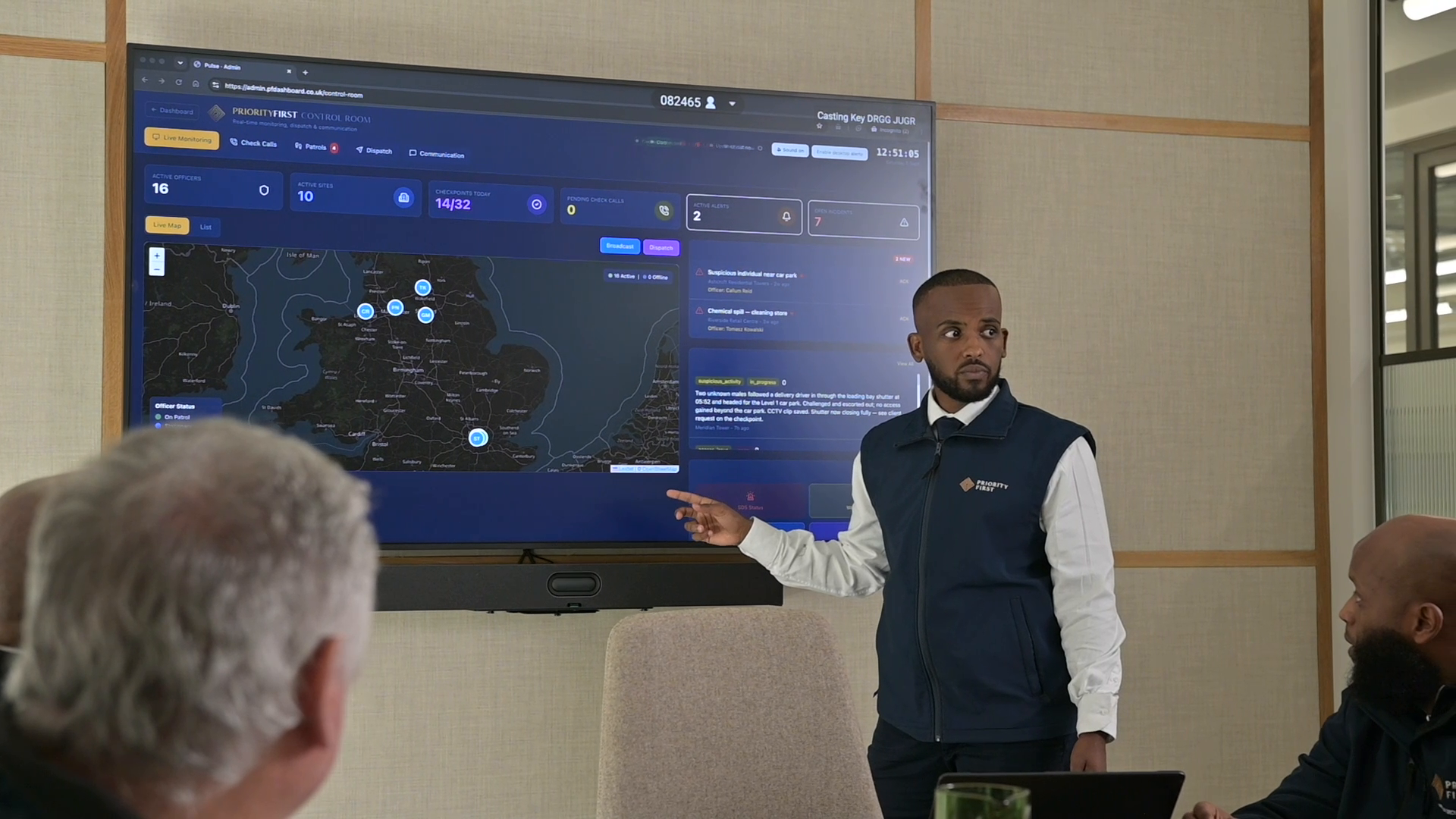
Priority First applies this logic by combining security operations with facilities and building management under one accountable partner rather than splitting them across providers. In a West London mixed-use development with retail, residential and public areas, Priority First deployed 11 officers across 152 photographed checkpoints spanning service yards, plant rooms, retail and residential zones, with facilities and maintenance tasks tracked on the same platform as security — giving one record for the whole building rather than two disconnected logs. The development had been running on assertion: officers reported rounds complete and the occurrence book read "all in order", but nobody could prove which plant room was checked at 3am. Since going live in February 2026, the site has logged more than 540 patrols in five months, with every checkpoint requiring a photo, GPS and timestamp to complete.
"Ask who is actually turning up to your site. The industry runs on subcontracting, and the badge on the proposal is often not the company whose officer stands at your door. We keep delivery in-house precisely because accountability disappears the moment it is passed down a chain." — Mo Hassan, Managing Director, Priority First
Across the largest portfolios tracked by GMI Insights, sites on one combined platform grew from 18 to 24 between earlier counts and August 2026, alongside more than 4,900 photo-backed patrols company-wide — consistent with the industry-wide shift toward integrated contracts that GMI Insights attributes partly to technology-enabled monitoring, and additionally showing that the model scales across very different site types, from distribution facilities to prime residential estates.
Which FM model suits a building owner: separate contracts or one integrated provider?
A building owner choosing between separate hard/soft contracts and one integrated provider is really choosing between specialist depth and single-point accountability. Separate contracts can suit a single-use building with a straightforward plant room and low footfall, where one M&E contractor and one cleaning contractor cover the need without coordination overhead.
An integrated model suits mixed-use developments, prime residential estates and sites with constant contractor movement — exactly the conditions in which Priority First's own case work shows value. At a Chelsea and Knightsbridge development combining active construction with live occupancy, Priority First ran key holding, CCTV monitoring, construction security, logistics management and facilities management from one site log, so deliveries, access control and plant protection sat in a single accountable record rather than three separate ones — a contract now running at roughly £280,000 a year. A large West Midlands distribution facility, with high-value stock and a perimeter too large for gatehouse coverage, took the opposite risk profile: Priority First combined canine units, manned security and facilities management, with every patrol and facilities task logged on one platform.
One director's review of that distribution site noted: "Having Priority First manage our site security has been transformative. Their team brings a level of expertise that's hard to match." — L K
Your hard vs soft FM decision checklist
- Map every system in the building against a statutory inspection regime — HVAC, fire, lifts, electrics, water.
- Confirm who holds the SIA licence for any manned guarding staff on site.
- Check whether cleaning, concierge and security are scoped under one soft FM contract or several.
- Ask any prospective FM provider whether hard and soft FM data sit on one platform or two.
- Request photo, GPS and timestamp evidence for any patrol or checkpoint claimed as "completed".
- Review Legionella risk assessments and HVAC servicing intervals against Approved Document L.
- Decide whether a single mixed-use or high-footfall site justifies an integrated provider over split contracts.
FAQ
What is the difference between hard and soft facilities management?
Hard facilities management covers a building's fixed, legally regulated systems such as HVAC, electrical and fire alarms, while soft facilities management covers people-facing services such as cleaning, security and concierge. Hard FM held 58.65% of the global market in 2026, per Mordor Intelligence (2026).
What are examples of hard FM services?
Hard FM examples are HVAC servicing, electrical testing, lift inspection under LOLER 1998, fire alarm maintenance under the Fire Safety Order 2005, and Legionella control. These services follow fixed statutory inspection intervals rather than discretionary scheduling.
What are examples of soft FM services?
Soft FM examples are cleaning, manned security, concierge, reception, grounds maintenance, pest control and waste management. These services affect occupant experience and presentation but do not generally carry a statutory inspection regime of their own.
Is cleaning a hard or soft FM service?
Cleaning is a soft FM service. It supports hygiene and presentation standards but is governed by a service-level agreement rather than the fixed-interval statutory inspection regimes that apply to HVAC, fire or lift systems.
Why are hard services considered non-negotiable in facilities management?
Hard services are non-negotiable because they are tied to statutory duties under legislation such as the Health and Safety at Work etc. Act 1974. Failing to maintain HVAC, fire or electrical systems creates direct legal and life-safety exposure for the building owner.
What is integrated facilities management (IFM)?
Integrated facilities management is a model where one provider delivers both hard and soft FM under a single accountable contract. Mitie's guide to hard and soft FM describes IFM as removing the coordination burden of managing multiple separate suppliers.
Can hard and soft FM be outsourced to the same provider?
Yes, many UK building owners now outsource both to a single integrated provider rather than splitting contracts. Priority First combines facilities management with security, key holding and construction site protection under one accountable platform for mixed-use and prime residential developments.
Securing and maintaining your building with Priority First
Managing hard and soft FM as separate contracts often means two disconnected records for one building — a gap that shows up precisely when something goes wrong. Priority First closes that gap by running facilities management alongside manned security, key holding and CCTV monitoring on a single platform, so maintenance tasks and security patrols sit in one accountable log rather than two.
Priority First's documented client contracts stand at 37, of which 28 are in Chelsea and Knightsbridge, spanning construction, commercial, luxury retail, hotels and residential estates across the UK. If your building is managing hard and soft FM through separate suppliers, get in touch with Priority First's facilities management team for a review of how an integrated contract could work for your site.
Related Reading
- What Is Key Holding and Alarm Response? UK Guide 2026
- 24/7 Manned Guarding Cost UK 2026: Full Price Guide
- Key Holding & Alarm Response Cost UK (2026 Guide)