24/7 Manned Guarding Cost UK 2026: Full Price Guide


Last updated: 16 August 2026
24/7 manned guarding in the UK typically costs between £4,000 and £10,000+ per month for multi-guard rotating cover, or £15,000 to £30,000+ per month where a single continuous post is staffed around the clock (Pearl Security, Clearway, 2026). Hourly rates run from £18–£25 daytime to £30–£40+ for nights and high-risk sites.
Key Takeaways
- 24/7 manned cover for a single site typically costs £5,500–£8,500 per month, according to Ashridge Group (2026).
- Standard daytime SIA-licensed officers cost £18–£25 per hour, rising to £30–£40+ for nights, weekends and high-risk sites, per Ashridge Group (2026).
- Single-guard 24-hour cover can cost £15,000 to £30,000+ per month, depending on hourly rate, risk level and site complexity, according to Clearway (2026).
- London businesses pay 40–50% above national averages for comparable manned guarding services, per SecurityCompaniesAround.co.uk, as cited by Priority First (2026).
- The National Living Wage rose to £12.71 an hour from 1 April 2026, a direct driver of guarding contract prices across the industry, as cited by Priority First (2026).
What is 24/7 manned guarding?
24/7 manned guarding is a security service in which SIA-licensed officers — individuals holding a licence issued by the Security Industry Authority (SIA), the statutory regulator created under the Private Security Industry Act 2001 — provide continuous, physical presence at a site across rotating shifts. It differs from static daytime guarding or mobile patrols because it guarantees a trained officer is always on premises, day and night, weekends and bank holidays included.
Delivering true round-the-clock cover requires multiple officers working shift patterns, not one person staying on-site continuously. A single officer cannot legally or practically work every hour of every week, so a genuine 24/7 contract always involves a rota of guards, supervisors and cover for holiday and sickness.
This is the single biggest reason costs vary so widely between quotes. A provider proposing one continuous post staffed by rotating individuals prices very differently from one covering multiple entry points, patrol routes or a large mixed-use site.
How much does 24/7 manned guarding cost per month in the UK?
Monthly costs for 24/7 manned guarding in the UK generally fall into two bands depending on how the contract is structured. For multi-guard rotating cover across a single site, expect £4,000 to £10,000+ per month (Pearl Security, 2026) or £5,500 to £10,000 (Quantum Group, 2026). Ashridge Group places typical single-site 24/7 cover at £5,500–£8,500 per month (Ashridge Group, 2026). Where a contract effectively demands one continuous guarded post around the clock, Clearway (2026) cites costs of £15,000 to £30,000+ per month. The gap between these figures reflects staffing model, risk profile and site complexity, not inconsistent pricing.
| Cover model | Typical monthly cost | Source |
|---|---|---|
| Multi-guard rotating 24/7 cover | £4,000–£10,000+ | Pearl Security (2026) |
| Standard single-site 24/7 cover | £5,500–£8,500 | Ashridge Group (2026) |
| 24/7 coverage, rotating shifts | £5,500–£10,000 | Quantum Group (2026) |
| Single continuous guarded post | £15,000–£30,000+ | Clearway (2026) |
Businesses should treat these as illustrative ranges rather than fixed tariffs. A residential estate in Chelsea, a construction site in Birmingham, and a corporate office in Canary Wharf will each attract different pricing within these bands, based on risk, footfall and the number of access points requiring cover.
What is the hourly rate for a security guard in the UK?
The hourly rate for a UK security guard depends chiefly on the time of day, the risk level of the site, and whether specialist skills such as door supervision or CCTV monitoring are required. Standard daytime SIA-licensed officers cost £18–£25 per hour, while night shifts, weekends and higher-risk environments push rates to £30–£40 or more per hour (Ashridge Group, 2026).
- Daytime standard cover: £18–£25 per hour
- Night, weekend or high-risk cover: £30–£40+ per hour
- Specialist cover (canine handling, close protection, high-value retail): typically priced at the top of the range or above, agreed on a site-specific basis
These hourly figures explain why a genuine 24/7 rota — covering roughly 168 hours a week across day, night and weekend shifts — multiplies quickly into the monthly totals shown above. A contract quoting only the lowest daytime hourly rate applied flatly across 24 hours is very likely underpricing night and weekend cover, and worth querying at proposal stage.
What's included in the hourly rate?
A compliant hourly rate is not simply wages. It must absorb the SIA licence cost, employer's National Insurance, holiday pay, training, uniform, supervision, insurance and a margin for the provider's own overheads and profit. The SIA licence application fee itself rose to £204 from 1 April 2026, as the historic £20 rebate is no longer applied, as cited by Priority First (2026) citing GOV.UK guidance. A provider quoting a rate that cannot plausibly cover the National Living Wage, licensing, National Insurance and a reasonable margin should prompt further questions about compliance.
Why does 24/7 manned guarding cost more in London?
24/7 manned guarding costs more in London than elsewhere in the UK primarily because of higher wage costs, higher operating overheads and stronger demand from prime residential and commercial clients. London businesses pay 40–50% above national averages for comparable manned guarding services, according to SecurityCompaniesAround.co.uk as cited by Priority First (2026).
This premium reflects several compounding factors specific to the capital. Boroughs such as Westminster, Kensington and Chelsea, and the City of London carry higher property values, higher insurance premiums and denser regulatory scrutiny, all of which feed into contract pricing.
Priority First operates from Mayfair and holds documented client contracts across prime central London, including 28 of its 37 documented contracts concentrated in Chelsea and Knightsbridge, alongside coverage in West London, the West Midlands and Bedfordshire. That geographic concentration in some of the UK's highest-value residential estates means pricing conversations in these boroughs routinely involve multi-building rounds, concierge integration and higher officer-to-site ratios than a standard regional contract.
London vs national pricing
| Factor | London | National average |
|---|---|---|
| Wage cost pressure | Higher living costs, higher competitive rates | Lower baseline wage pressure |
| Premium for comparable service | +40–50% | Baseline |
| Typical client profile | Prime residential estates, corporate HQs, mixed-use developments | Regional offices, retail units, warehousing |
| Risk and insurance loading | Higher due to asset value and footfall | Lower on average |
How many guards are needed for true 24/7 coverage?
True 24/7 coverage of a single post requires a minimum of three to four officers working eight- or twelve-hour shifts, once holiday, sickness and supervision cover are factored in. A single officer working a 12-hour shift, seven days a week, would breach both realistic staffing practice and Working Time Regulations 1998 limits, so no compliant provider staffs 24/7 cover with fewer than three rotating individuals per post.
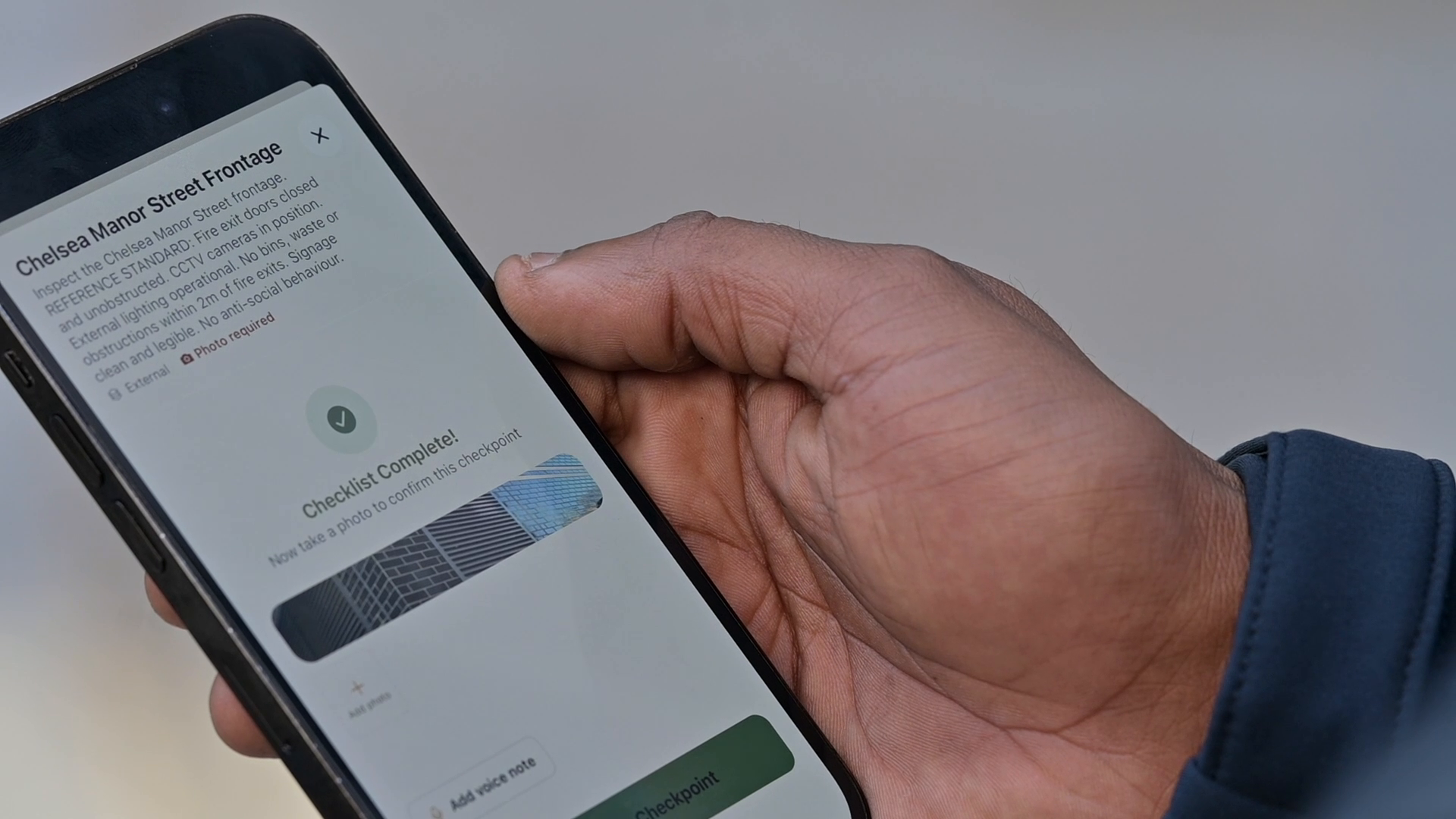
Larger or more complex sites need considerably more. Priority First's own experience delivering nightly rounds across a 16-building prime central London estate shows the scale involved: that contract runs on 4–8 officers rotating across the portfolio, each building set up as its own site with its own photographed checkpoints rather than one vague "round complete" for the whole estate. A single mixed-use West London development with 152 checkpoints across retail, residential, service yards and plant rooms required 11 officers on one system to deliver consistent, evidenced cover.
"A construction site changes every week — new access points, new contractors, new deliveries, new value sitting in the open. Static cover that made sense in month one can be the wrong answer by month three, so we treat every site visit as a fresh risk assessment rather than a routine patrol." — Mo Hassan, Managing Director, Priority First
The same principle applies beyond construction. Guard numbers should be reassessed as a site's footprint, risk and occupancy change, not fixed at the outset and left unreviewed.
What factors affect the cost of 24/7 manned guarding?
Several variables determine where a 24/7 manned guarding quote lands within the published ranges, and understanding them helps businesses interrogate a proposal rather than compare headline figures alone.
- Number of access points and buildings — a single reception desk costs far less to cover than a multi-building estate or a site with several vehicle and pedestrian entrances.
- Risk profile — high-value retail, construction sites holding plant and materials, and prime residential estates carry higher risk loadings than a low-footfall regional office.
- Shift pattern complexity — night, weekend and bank holiday hours attract the £30–£40+ hourly rates cited by Ashridge Group (2026), pushing up blended monthly totals.
- Specialist requirements — canine units, door supervision qualifications, close protection training or CCTV monitoring integration all add cost.
- Location — London and the South East carry the premium described above; regional sites typically sit closer to national averages.
- Wage inflation — the National Living Wage rose to £12.71 an hour from 1 April 2026, a 4.1% increase confirmed at the Autumn Budget, as cited by Priority First (2026), and this feeds directly into every hourly rate quoted industry-wide.
- Evidence and reporting standards — providers running photo-backed patrol platforms with GPS and timestamp verification typically build reporting infrastructure into their pricing, reflecting the operational discipline behind the service.
Worked scenarios: what might 24/7 guarding actually cost?
These scenarios are illustrative examples built from the ranges above, not quotes, and should be used only to sanity-check a proposal against typical market bands.
Scenario 1 — Mid-size corporate office, regional UK city. A single-entrance office with standard daytime footfall and low overnight risk might expect multi-guard rotating 24/7 cover towards the lower-to-middle end of the £4,000–£10,000+ monthly range cited by Pearl Security (2026).
Scenario 2 — Prime residential estate, Chelsea or Knightsbridge. A multi-building estate with concierge integration and nightly patrol rounds sits well above national averages once the 40–50% London premium noted by Priority First (2026) is applied, and typically requires several officers rotating across multiple sites rather than one static post.
Scenario 3 — Care home requiring continuous overnight and daytime cover. A residential care setting needs dedicated security presence precisely because care staff cannot double as door control and incident response. Priority First deployed exactly this model at a 96-unit care home in Bedfordshire, where SIA-licensed officers cover the site around the clock with every patrol, incident and handover logged on a digital platform — checkpoints completed with a photograph, GPS coordinate and timestamp, so delivered cover is provable rather than merely asserted. That site went live with documented patrols immediately, and the contract has since produced more than 1,000 photo-backed patrols.
Ways to reduce 24/7 manned guarding costs
Businesses can manage 24/7 guarding costs without cutting corners on genuine risk coverage, by focusing spend where it matters most.
- Right-size shift patterns — align officer numbers to actual footfall and risk by time of day, rather than applying blanket cover across every hour.
- Combine services under one contract — bundling manned guarding with key holding, alarm response and CCTV monitoring under a single accountable provider typically reduces duplicated overheads compared with separate suppliers.
- Use technology to reduce headcount where safe — CCTV monitoring and photo-backed patrol verification can allow lower guard numbers on lower-risk zones while maintaining an evidenced audit trail.
- Review contracts annually against wage changes — with the National Living Wage rising to £12.71 an hour from April 2026, providers pricing on stale wage assumptions may be under- or over-charging.
- Consolidate multi-site contracts — a single provider managing several buildings, as with a prime estate spanning 16 blocks, can price more efficiently than separate contracts per site.
- Ask for photo-backed evidence rather than paper logs — this does not reduce hourly rates directly, but it prevents paying for cover that is not actually being delivered, which is the more expensive failure.
Alternatives to 24/7 manned guarding
24/7 manned guarding is not the only option, and for some sites it is not the most cost-effective one. Businesses should weigh the following alternatives against the risk profile of their specific site before committing to full-time officer cover.
| Option | Best suited to | Cost profile relative to 24/7 guarding |
|---|---|---|
| CCTV monitoring | Lower-footfall sites, perimeter and asset protection | Generally lower ongoing cost, no physical response on-site |
| Mobile/key holding patrols | Vacant properties, out-of-hours checks | Lower than continuous manned cover |
| Alarm response with keyholding | Sites with reliable alarm systems and infrequent activations | Significantly lower than static 24/7 presence |
| Hybrid: reduced daytime staff + CCTV overnight | Offices with low overnight risk | Lower blended cost than full 24/7 manned cover |
| Full 24/7 manned guarding | High-risk, high-value or high-footfall sites, care settings, construction | Highest cost, highest deterrence and response capability |
Alarm response and key holding deserve particular attention as a genuine alternative for sites that do not need a permanent physical presence but do need a guaranteed, trained response when something goes wrong.
"Asking a member of staff to attend their own premises at three in the morning is asking them to walk into the unknown alone. Professional keyholding exists so that the person opening that door is trained for the moment the alarm turns out to be real — and so your people never have to be." — Mo Hassan, Managing Director, Priority First
For vacant properties, construction sites between phases, or offices with low overnight risk, this model can deliver most of the protection at a fraction of the cost of continuous manned cover.
In-house security vs outsourced manned guarding
Businesses weighing whether to employ security staff directly or outsource to a specialist provider face a genuine trade-off. In-house teams offer familiarity with the site but carry the full burden of recruitment, SIA licensing, training, holiday and sickness cover, and liability. Outsourced providers absorb that administrative and compliance load, spread supervision costs across multiple contracts, and typically bring reporting infrastructure — such as photo-backed checkpoint platforms — that would be costly for a single site to build independently. For most mid-size and large sites, outsourcing to an established provider proves more cost-predictable once true total employment costs are accounted for.
Your 24/7 manned guarding cost checklist
- Confirm whether the quoted price covers genuine round-the-clock rotation or a single continuous post.
- Ask for the hourly rate breakdown across day, night and weekend shifts.
- Check the quote reflects the National Living Wage of £12.71 an hour from April 2026.
- Confirm every officer's SIA licence status and that the £204 licence fee is factored into pricing.
- Establish how many officers are required for your specific site, not a generic per-hour rate.
- Ask whether patrol evidence is photo-backed with GPS and timestamp, or reliant on a paper occurrence book.
- Compare the London premium (40–50% above national averages) against your specific borough and risk profile.
- Review whether a hybrid model (CCTV plus reduced manned hours) meets your risk tolerance at lower cost.
FAQ
How much does 24/7 manned guarding cost per month in the UK?
Monthly costs for 24/7 manned guarding in the UK typically range from £4,000 to £10,000+ for multi-guard rotating cover, according to Pearl Security (2026). Ashridge Group cites a narrower typical band of £5,500–£8,500 per month for single-site cover, while Clearway notes single continuous post cover can reach £15,000–£30,000+ per month depending on risk and complexity.
What is the average hourly rate for a security guard in the UK?
Standard daytime SIA-licensed officers cost £18–£25 per hour in the UK, rising to £30–£40 or more for nights, weekends and high-risk sites, according to Ashridge Group (2026). The exact rate depends on shift timing, site risk and any specialist skills required, such as door supervision or canine handling.
How much more does manned guarding cost in London compared to other regions?
London businesses pay 40–50% above national averages for comparable manned guarding services, according to SecurityCompaniesAround.co.uk as cited by Priority First (2026). This premium reflects higher wage costs, higher insurance and the concentration of high-value residential and commercial assets in boroughs such as Chelsea, Knightsbridge and Mayfair.
How many security guards are needed to cover a site 24/7?
A single continuous post needs a minimum of three to four rotating officers to cover 24/7 shifts, holiday and sickness compliantly. Larger or multi-building sites need considerably more — Priority First runs 11 officers on a single mixed-use West London development and 4–8 officers rotating across a 16-building prime central London estate.
Does 24/7 manned guarding cost more at night or on weekends?
Yes, night, weekend and high-risk cover typically costs £30–£40+ per hour compared with £18–£25 for standard daytime cover, according to Ashridge Group (2026). This differential is a major reason blended monthly 24/7 costs sit well above a simple daytime-rate multiplication.
What factors affect the cost of manned guarding services?
The main factors are site risk profile, number of access points, shift pattern complexity, specialist requirements such as canine or close protection cover, location, and wage inflation including the National Living Wage rise to £12.71 an hour from April 2026. Reporting standards, such as photo-backed patrol verification, can also influence pricing structure.
Is mobile patrol or CCTV monitoring cheaper than 24/7 manned guarding?
Yes, mobile patrols, CCTV monitoring and alarm response with key holding are generally lower-cost alternatives to full 24/7 manned guarding. They suit lower-risk sites, vacant properties and locations where a guaranteed rapid response is sufficient rather than a continuous physical presence.
How much does an SIA licence cost for a security guard in 2026?
The SIA licence application fee rose to £204 from 1 April 2026, as the historic £20 rebate is no longer applied, according to GOV.UK (2026). This cost is typically absorbed into a provider's hourly rate rather than charged separately to clients.
Securing your site with Priority First
Getting 24/7 manned guarding pricing right depends on knowing exactly what cover is being delivered, not just what a monthly figure claims to include — which is why Priority First builds every contract around SIA-licensed officers, transparent shift structuring and photo-backed evidence rather than a flat rate and a paper occurrence book.
Priority First's own operational data shows the scale this approach runs at: over 4,900 photo-backed patrols completed across its largest portfolios, with 100% of checkpoint completions carrying a watermarked photo, officer ID, GPS and timestamp, replacing the paper logs that leave 24/7 cover unverifiable. That standard has been applied from a 96-unit care home in Bedfordshire to a 16-building prime estate across Chelsea and Knightsbridge, protecting over £1.6 billion in client assets with a 100% customer satisfaction rate.
If your business needs 24/7 manned guarding priced accurately against your actual risk and site complexity — not a generic hourly rate — get in touch with Priority First's Physical Protection / Manned Guarding team for a site-specific quote.
Related Reading
- Manned Guarding Cost UK 2026: Full Pricing Guide
- 24/7 Manned Guarding for Landlords UK 2026 | Priority First
- Manned Guarding City of London: 2026 Business Guide