


SFG20 Explained: Maintenance Standard Guide (2026)



Last updated: 18 November 2026
SFG20 is the UK's recognised standard for building maintenance, publishing over 1,500 colour-coded maintenance tasks across more than 110 asset classes (SFG20 (BESA), 2025). It defines what to maintain, how often, and to what standard — translating legal duties into a workable schedule for building owners, facilities teams and contractors across England, Scotland and Wales.
Key Takeaways
- SFG20 is published and maintained by BESA (the Building Engineering Services Association), the trade body representing the UK's building engineering services sector.
- SFG20 was established in 1990 and has set the standard for UK building maintenance for 35 years, according to Bowmark Capital (2025).
- SFG20 applies over 700 schedule updates a year automatically, keeping maintenance tasks aligned with current legislation, per SFG20 (BESA) (2025).
- SFG20 is not itself a law — it is an industry-agreed standard that facilities managers use as evidence of a "suitable and sufficient" maintenance regime under the Health and Safety at Work etc. Act 1974.
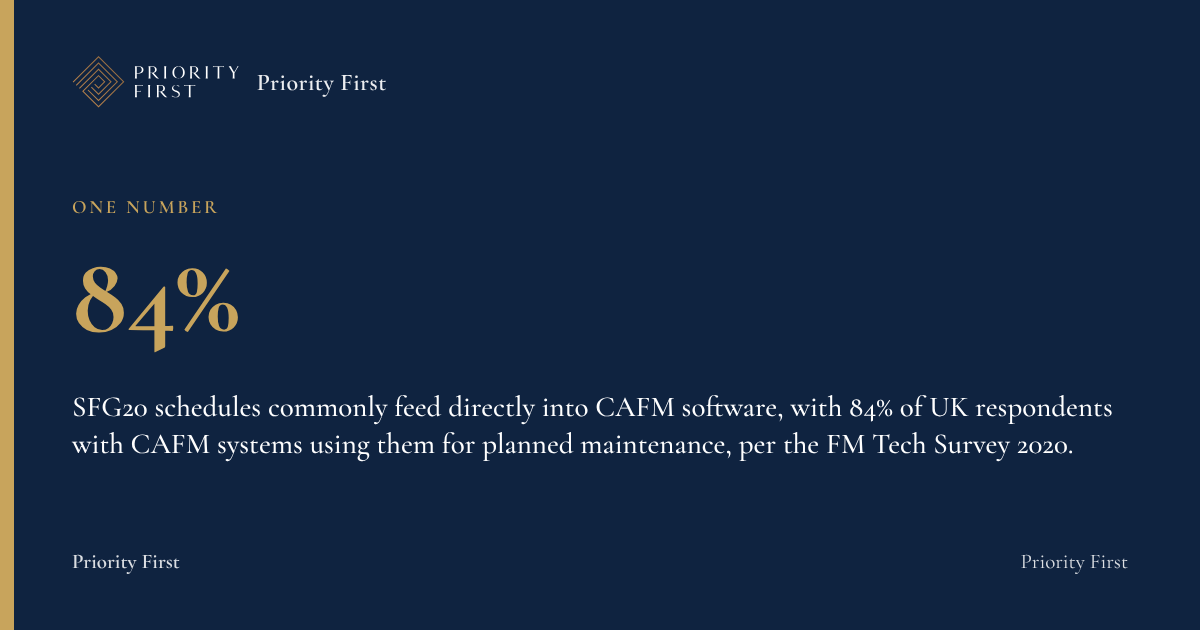
- SFG20 schedules commonly feed directly into CAFM software, with 84% of UK respondents with CAFM systems using them for planned maintenance, per the FM Tech Survey 2020.
What is SFG20 and what does it cover?
SFG20 is a standard maintenance specification that defines the tasks, frequencies and competency levels required to keep building services safe, compliant and operational. It covers mechanical, electrical and public health building services — everything from boilers, chillers and air handling units to fire dampers, water systems and emergency lighting.
The standard includes over 1,500 colour-coded maintenance tasks spanning more than 110 asset classes, giving facilities teams a single reference point for what "good maintenance" looks like for almost any building system (SFG20 (BESA), 2025). Each task carries a criticality rating — red, pink, amber or green — that signals whether it's a statutory requirement, a manufacturer recommendation, or best-practice guidance.
The red rating is the one facilities managers watch most closely. It marks tasks tied directly to statutory compliance — things like Legionella risk assessments under the Health and Safety Executive's Approved Code of Practice L8, or fire damper testing under BS 9999. Pink tasks are considered "critical to safety" even where not explicitly mandated by name in legislation, while amber and green cover manufacturer guidance and good practice respectively.
For anyone running a commercial office, a residential block, or a mixed-use development in London, this matters because it turns a vague duty — "maintain the building safely" — into a specific, auditable task list with a defined frequency.
Who owns and publishes SFG20, and is it an official legal standard?
SFG20 is owned and published by BESA, the Building Engineering Services Association, which has provided technical guidance to the UK's building engineering sector for over 115 years (BESA, 2025). BESA itself is not a government regulator, so SFG20 carries no legal force on its own.
That distinction matters. SFG20 is an industry-consensus standard, not a statutory instrument — there is no clause in the Health and Safety at Work etc. Act 1974 or the Workplace (Health, Safety and Welfare) Regulations 1992 that names SFG20 directly. What courts and enforcement bodies including the Health and Safety Executive (HSE) look for is evidence of a "suitable and sufficient" maintenance regime, and SFG20 has become the industry's default way of demonstrating exactly that.
The standard traces back to 1990, when BESA (then operating under an earlier name) first published it; Bowmark Capital notes it has set the standard for UK building maintenance for 35 years (2025). It was substantially relaunched in 2012 as a customisable, web-based platform and now operates under the Facilities-iQ software suite. Bowmark Capital also records that SFG20 is growing revenues at over 30% per annum, reflecting how widely UK facilities teams have adopted it as their baseline standard (2025).
What is included in an SFG20 maintenance schedule?
An SFG20 maintenance schedule is a structured list of tasks for a specific asset — a boiler, an air handling unit, a fire alarm panel — each with a defined frequency, a competency requirement and a criticality rating. A single schedule might specify a monthly visual inspection, a six-monthly functional test and an annual statutory check, all for the same piece of plant.
Every task specifies who is competent to carry it out — a qualified engineer, a trained operative, or in some cases a specialist contractor holding a recognised qualification. This is where SFG20 connects to other technical guidance. BESA's TR19 standard for ventilation hygiene, for example, is referenced within relevant SFG20 schedules; once a ventilation system is TR19 compliant, average total High Risk Combustion Load Levels can be reduced by a total of 83% (Wikipedia, citing BESA TR19 guidance, 2005).
Facilities managers working across a prime central London portfolio will typically run dozens of these schedules concurrently — one for each asset class on site. Getting the frequency and competency level right on every one of them, across a portfolio of occupied residential and commercial buildings, is precisely the kind of operational detail that turns a maintenance standard into a genuine compliance record rather than a filing-cabinet document.
How does SFG20 relate to legal compliance duties like PPM and statutory inspections?
SFG20 translates general legal duties into specific, scheduled actions, giving facilities teams a documented planned preventive maintenance (PPM) regime that stands as evidence of compliance. Where the Health and Safety at Work etc. Act 1974 requires employers to ensure, so far as reasonably practicable, the safety of people in and around a building, SFG20 supplies the detail of what "ensuring" actually looks like in practice.
Take water hygiene as a worked example. The HSE's Approved Code of Practice L8 requires a suitable risk assessment for Legionella, and SFG20's red-rated water system tasks set out the inspection frequency, the water temperature checks and the record-keeping that satisfy that duty on an ongoing basis. The same logic applies to fire safety under the Regulatory Reform (Fire Safety) Order 2005, where SFG20 schedules for fire dampers, emergency lighting and fire alarm systems provide the testing regime a responsible person needs to evidence.
Statutory inspections — those required by law, such as pressure system examinations under the Pressure Systems Safety Regulations 2000, or lifting equipment inspections under LOLER 1998 — sit alongside SFG20's own maintenance tasks rather than replacing them. A compliant building typically runs both: statutory inspections carried out by a competent person or insurer-approved inspector, and SFG20-scheduled maintenance carried out by in-house teams or appointed contractors. The standard's annual update cycle — applying over 700 schedule changes automatically each year — exists precisely to keep that mapping current as legislation shifts (SFG20 (BESA), 2025).
Who is responsible for implementing SFG20 within an organisation?
Responsibility for implementing SFG20 sits with the duty holder — typically the building owner, landlord or employer — though day-to-day execution is usually delegated to facilities managers and the contractors they appoint. The duty holder cannot delegate legal accountability, even where maintenance work itself is outsourced.
In practice, three parties typically share the workload. The facilities manager or FM provider selects which SFG20 schedules apply to the building, sets up the PPM calendar and monitors completion. Specialist contractors — mechanical and electrical engineers, fire safety specialists, water hygiene technicians — carry out the scheduled tasks and sign off the record. The duty holder retains oversight, commissioning audits and ensuring the overall regime is "suitable and sufficient" for the building's risk profile.
This is where a single accountable partner model earns its keep. A care home in Bedfordshire with 96 units illustrates the point well, even though its challenge sat on the security side of building operations rather than M&E maintenance: the home carried a 24-hour duty of care to vulnerable residents but needed a documented system proving every area of the building was actually checked, not just assumed covered. Priority First deployed SIA-licensed officers with every patrol, incident and handover logged on its platform, each checkpoint completed with a photograph, GPS location and timestamp — turning "Blocks tend to buy security and building management as separate contracts, and the gaps between the two are exactly where problems live. The concierge who notices a leak, the patrol officer who spots a failed door closer — when one team owns the whole building, nothing falls between contracts." from an assertion into a provable record from day one. The same principle — proof over assertion — is exactly what SFG20's record-keeping is designed to deliver for mechanical and electrical compliance.
How does SFG20 integrate with CAFM or CMMS software systems?
SFG20 integrates with computer-aided facilities management (CAFM) software by supplying the task library and frequencies that CAFM systems use to generate work orders automatically. Rather than a facilities manager manually tracking hundreds of maintenance dates across spreadsheets, the CAFM system pulls SFG20 schedules in and triggers reminders, work orders and compliance reports as each task falls due.
This integration is now close to standard practice. Per the FM Tech Survey 2020, 84% of UK respondents with CAFM software use it to manage planned maintenance, with SFG20 schedules commonly feeding directly into those systems. That figure predates the Facilities-iQ software relaunch but reflects a pattern that has only deepened since — few facilities teams of any scale now run SFG20 compliance tracking outside a digital system.
The practical benefit is traceability. When an HSE inspector or an insurer asks for evidence that fire dampers were tested on schedule, a CAFM system populated with SFG20 tasks produces the completion record, the engineer's name and the date in minutes rather than requiring a search through paper files.
"A camera records what happened; an officer changes what happens. The presence of a professional who can greet, question, de-escalate and act is still the single biggest deterrent there is. The best results come from pairing the two — technology watching everywhere, people deployed where judgement is needed." — Mo Hassan, Managing Director, Priority First
That same logic — pairing a digital system with a human who can act on what it shows — underpins how Priority First approaches facilities and building management more broadly, whether the record being kept is a maintenance log or a security patrol.
SFG20 vs other approaches to maintenance compliance
Facilities teams choosing a compliance framework are usually weighing SFG20 against either a bespoke in-house schedule or a sector-specific alternative such as the NHS's Health Technical Memoranda (HTMs) for healthcare buildings. Each has a different scope and a different trade-off.
| Approach | Scope | Best suited to | Trade-off |
|---|---|---|---|
| SFG20 | 110+ asset classes, UK-wide, BESA-maintained | Commercial, residential, mixed-use buildings | Requires licensing via Facilities-iQ; not free |
| Bespoke in-house schedule | Custom to the building | Organisations with deep in-house engineering expertise | No independent update cycle; relies entirely on internal knowledge |
| HTMs (healthcare) | NHS and healthcare-specific estates | Hospitals, clinics, care settings | Narrower scope; often used alongside SFG20, not instead of it |
| ISO 41001 | Facilities management system standard | Organisations seeking a management-system certification | Governs the FM process, not the specific maintenance tasks |
The key distinction is that SFG20 specifies what to do and how often, while a standard like ISO 41001 governs the management system around FM delivery — the two are complementary rather than competing. Most commercial and residential buildings in London run SFG20 as their task-level standard, regardless of which broader FM governance framework sits above it.
Common mistakes organisations make when using SFG20
Organisations most often go wrong with SFG20 by treating it as a one-off purchase rather than a living document that needs active maintenance of its own. Three mistakes recur across UK facilities teams.
- Failing to tailor schedules to the actual building. SFG20 covers over 110 asset classes, but applying every available schedule regardless of what's actually installed wastes budget and buries genuinely critical tasks in noise.
- Letting the annual update cycle lapse unmonitored. With over 700 schedule updates applied a year, a facilities team that doesn't review changes risks running an outdated version of a "statutory" task without realising it.
- Confusing SFG20 compliance with legal compliance. Completing an SFG20 schedule is strong evidence of a suitable maintenance regime, but it doesn't automatically satisfy every statutory inspection duty — pressure systems, lifting equipment and gas safety checks under the Gas Safety (Installation and Use) Regulations 1998 often require separate, competent-person sign-off.
- Outsourcing execution without retaining oversight. Appointing a contractor to carry out SFG20 tasks doesn't transfer the duty holder's legal accountability; someone inside the organisation still needs to audit that the work actually happened.
- Writing vague tender specifications. A contract that simply says "SFG20 compliant" without naming which schedules, frequencies and exclusions apply gives a contractor room to interpret the standard generously — and gives the client no way to verify delivery.
That last point is where proof-of-work matters as much in M&E maintenance as it does in security. A West London mixed-use development with retail, residential and service areas illustrates the principle: before Priority First's involvement, officers reported rounds complete and the occurrence book said "all in order", but nobody could verify which plant room was actually checked at 3am. Priority First introduced 152 photographed checkpoints across the site, each requiring a photo with officer ID, GPS and timestamp to complete — and missed areas now show as visible gaps rather than passing silently. The same discipline applies to SFG20: a completed schedule should be evidence, not an assertion.
Your SFG20 implementation checklist
- Identify every asset class on site and match it against the relevant SFG20 schedules.
- Confirm which tasks carry a red (statutory) or pink (critical) rating for your building type.
- Set up a CAFM or CMMS system to generate work orders from SFG20 frequencies automatically.
- Name a duty holder who retains oversight even where maintenance execution is outsourced.
- Review the annual schedule updates and flag any changes affecting your building's compliance status.
- Require photo or digital evidence for every completed task, not just a signed-off checklist.
- Audit contractor-reported completions against the actual schedule at least annually.
- Cross-check SFG20 tasks against separate statutory inspection duties — gas, lifting equipment and pressure systems in particular.
FAQ
What does SFG20 stand for?
SFG20 originated as "Standard Maintenance Specification for Building Engineering Installations," shortened over time to the SFG20 name used today. It is published by BESA, the Building Engineering Services Association.
Is SFG20 a legal requirement in the UK?
SFG20 is not itself a legal requirement — no UK legislation names it directly. It functions as the industry's recognised evidence of a "suitable and sufficient" maintenance regime under the Health and Safety at Work etc. Act 1974.
What do the SFG20 colour codes mean?
The colour codes rate each task's criticality: red for statutory requirements, pink for tasks critical to safety, amber for manufacturer-recommended work, and green for general best practice. Facilities managers use this rating to prioritise limited maintenance budgets.
How much does an SFG20 subscription cost?
SFG20 is licensed through BESA's Facilities-iQ platform rather than offered free, with pricing typically scaled to the size of the organisation and the number of schedules or assets covered. Exact published pricing tiers vary and are best confirmed directly with SFG20, as the standard does not publish a single flat rate.
Does SFG20 replace statutory inspections like gas safety checks?
No — SFG20 schedules sit alongside statutory inspections rather than replacing them. Duties such as gas safety checks under the Gas Safety (Installation and Use) Regulations 1998 or lifting equipment inspections under LOLER 1998 still require sign-off from a competent person independent of the SFG20 schedule.
How often does SFG20 get updated?
SFG20 applies over 700 schedule updates a year automatically, keeping maintenance tasks aligned with current legislation (SFG20 (BESA), 2025). Facilities teams using the Facilities-iQ platform receive these updates without needing to manually track legislative change.
Can SFG20 work alongside a CAFM system?
Yes — SFG20 schedules are designed to feed directly into CAFM software, generating automated work orders and compliance reports. The FM Tech Survey 2020 found 84% of UK respondents with CAFM software use it to manage planned maintenance this way (FM Tech Survey 2020, cited via Priority First).
Keeping your building compliant with Priority First
Running SFG20 schedules correctly is only half the compliance picture — the other half is proving, consistently, that scheduled work and site checks actually happened. Priority First brings the same evidence-based discipline it applies to security patrols — photographed, timestamped, GPS-logged — to the wider building and facilities management of commercial and residential properties across prime central London and nationwide.
Priority First has taken new sites live within a fortnight, including a 10-checkpoint serviced residence onboarded as part of a three-site addition in July 2026, with every checkpoint and officer induction recorded on its platform from day one.
If your building's maintenance and compliance records need the same rigour as a security log — provable, auditable, and never left to assumption — Priority First's facilities management team can talk through what that looks like for your portfolio.
Related Reading
- MEES Regulations for Commercial Offices: 2027 Explained
- Office Manager vs Facilities Manager: Key Differences
- Office Move Checklist UK 2026: Complete Planning Guide
Mo Hassan leads Priority First, a UK building-management and security-services company operating across prime central London and nationwide. Mo writes on physical security, construction-site protection, CCTV, and building operations.
Over a decade in premium building management and security operations
Specialises in Building management, Security operations, Construction site security


