RTM Board Urgent Security & Concierge Provider Guide 2026


Last updated: 24 September 2026
An RTM board urgent security and concierge provider decision arises when a Right to Manage company must appoint cover immediately — after a breach, fire safety failure, or a departing contractor — without the eight-week runway a normal tender allows. RTM directors can act fast under the Landlord and Tenant Act 1985's dispensation route, provided they document urgency, get at least one comparative quote, and notify leaseholders promptly.
Key Takeaways
- An RTM (Right to Manage) company is a leaseholder-controlled entity formed under the Commonhold and Leasehold Reform Act 2002 that takes over management functions, including procuring security and concierge services, without needing to prove landlord fault.
- Section 20 of the Landlord and Tenant Act 1985 sets consultation thresholds for qualifying works and long-term agreements, but the First-tier Tribunal can grant dispensation where genuine urgency exists.
- Waking watch costs for a residential block of 15 to 60 flats typically run to £8,000–£25,000 per month, according to Neon Property Services (2026).
- A recent tribunal case, Radcliffe Investments Limited v Meeson and others, saw waking watch costs of £57,894 challenged for a 96-flat Manchester conversion, per Brady Solicitors (2023).
- Priority First deployed an SIA-licensed officer to a Covent Garden site within two hours of a break-in call, from 12:30 quote agreement to 14:30 arrival on site.
What Is an RTM Company and What Powers Does Its Board Have?
An RTM company is a private company limited by guarantee, formed under the Commonhold and Leasehold Reform Act 2002, that leaseholders use to take over the management of their block from the landlord or freeholder. The RTM company's board — typically leaseholder-directors — acquires the landlord's management functions on the "acquisition date" set out in the statutory claim notice, without having to prove mismanagement first.
Once RTM has been acquired, the board holds the same contractual authority the landlord previously held. That includes the power to instruct a managing agent, terminate an underperforming one, and directly commission services such as manned guarding, concierge cover, and fire safety monitoring.
LEASE (the Leasehold Advisory Service) confirms RTM directors take on statutory management duties equivalent to a landlord's, covering repairs, insurance, and services. A typical managing agent handover, from serving notice to the new agent operating fully, takes four to eight weeks, according to Neon Property Services (2026) — a timeline that matters when a security gap cannot wait that long.
Can an RTM Board Legally Engage Security and Concierge Providers on Behalf of Leaseholders?
Yes — an RTM board can lawfully engage security and concierge providers because the Commonhold and Leasehold Reform Act 2002 transfers full management functions, including service procurement, to the RTM company on acquisition. Directors act as agents of the company, contracting on behalf of all qualifying leaseholders collectively rather than individually.
The RTM company's Articles of Association typically require the board to act by majority resolution and keep proper accounting records. Shelter England confirms RTM companies become responsible for services, repairs, and management of the premises the moment the right is acquired.
This means directors do not need landlord sign-off to appoint a concierge desk, key holding provider, or SIA-licensed guarding team. Priority First notes that boards do, however, remain bound by service charge recovery rules — costs must be reasonable and, where thresholds apply, consulted on under the Landlord and Tenant Act 1985.
What Legal Duties Apply When Procuring a Security or Concierge Contract?
Priority First advises that Section 20 of the Landlord and Tenant Act 1985 requires formal consultation with leaseholders before "qualifying works" above a set cost threshold, or before entering a "qualifying long-term agreement" lasting more than twelve months. An RTM board procuring an ongoing concierge or security contract must normally follow the two-stage notice-of-intention and notice-of-proposal process, or risk recovering only a capped contribution per leaseholder.
Non-compliance does not automatically block recovery. The First-tier Tribunal (Property Chamber) can grant dispensation from full consultation where it is satisfied leaseholders suffer no material prejudice.
Fire safety adds a parallel layer of duty. Priority First notes that for buildings 18 metres or higher, or seven storeys or more, fire alarm systems must be regularly checked, tested and maintained by the person responsible for fire safety, per Lease Advice (LEASE) (2026) — a duty the Building Safety Act 2022 and the Regulatory Reform (Fire Safety) Order 2005 reinforce for the "responsible person," which an RTM board becomes on acquisition.
What Counts as an Urgent Security Situation Justifying Faster Action?
An urgent security situation is one where delay poses an immediate risk to life, property, or legal compliance — a category the First-tier Tribunal recognises as grounds for dispensing with full Section 20 consultation. Genuine urgency typically includes a break-in, a fire alarm system failure discovered during a statutory check, a concierge or guarding contractor withdrawing with little or no notice, or a waking watch requirement triggered by a fire risk assessment.
The Grenfell Tower fire prompted many blocks to install interim waking watch cover while cladding remediation was assessed. 1,308 waking watches were still in place across residential blocks of flats in London alone as of May 2026, according to Trowers & Hamlins (2026) — evidence that "urgent" fire safety cover often becomes a prolonged, costly arrangement rather than a short-term fix.
RTM boards should document the trigger event, the risk assessment, and why normal timescales were impractical, since tribunals scrutinise these records closely in later service charge disputes.
How Quickly Can a Security or Concierge Provider Realistically Mobilise?
Priority First reports that a specialist provider can mobilise SIA-licensed officers within hours of confirmed instruction, not the weeks a full agent transition requires. Priority First's operational data records a verified emergency deployment at a Covent Garden site: the call came in at 12:30 following an overnight break-in, a quote was agreed on that same call, and an SIA-licensed operative was on site by 14:30 — a two-hour turnaround from first contact to physical presence.
That pace contrasts sharply with a routine managing agent handover, which takes four to eight weeks from notice to full operation, per Neon Property Services (2026). An RTM board facing an urgent gap should not conflate the two timelines — emergency guarding cover and a full managing agent transition are different procurements with very different mobilisation speeds.
"The old image of security — arms folded, saying no — actively damages the businesses it is meant to protect. The modern standard is that the same officer is the most helpful person in the building and the reason trouble goes elsewhere," says Mo Hassan, Managing Director of Priority First. That standard matters as much in a residential block managed by an RTM company as it does in a corporate lobby.
What Should Be Checked When Vetting a Security and Concierge Provider?
A security and concierge provider should hold valid SIA (Security Industry Authority) licences for every operative deployed, since the Private Security Industry Act 2001 makes unlicensed guarding a criminal offence. RTM directors should ask for licence numbers, screen them against SIA's public register, and confirm employer's and public liability insurance cover appropriate to the building's value.
Relevant checks include:
- SIA licensing — confirm each named officer's licence category (Door Supervision, CCTV, or Security Guarding) and expiry date.
- Insurance — request current employer's liability and public liability certificates, not just a broker's summary.
- References — ask for two comparable residential or mixed-use sites, ideally in London where compliance expectations are highest.
- Background screening — ask whether vetting follows the BS 7858 standard for security screening.
- Contract history — for an RTM board, a provider with documented multi-site residential contracts, such as Priority First's 37 documented client contracts, 28 of them in Chelsea and Knightsbridge, demonstrates track record in the same market segment.
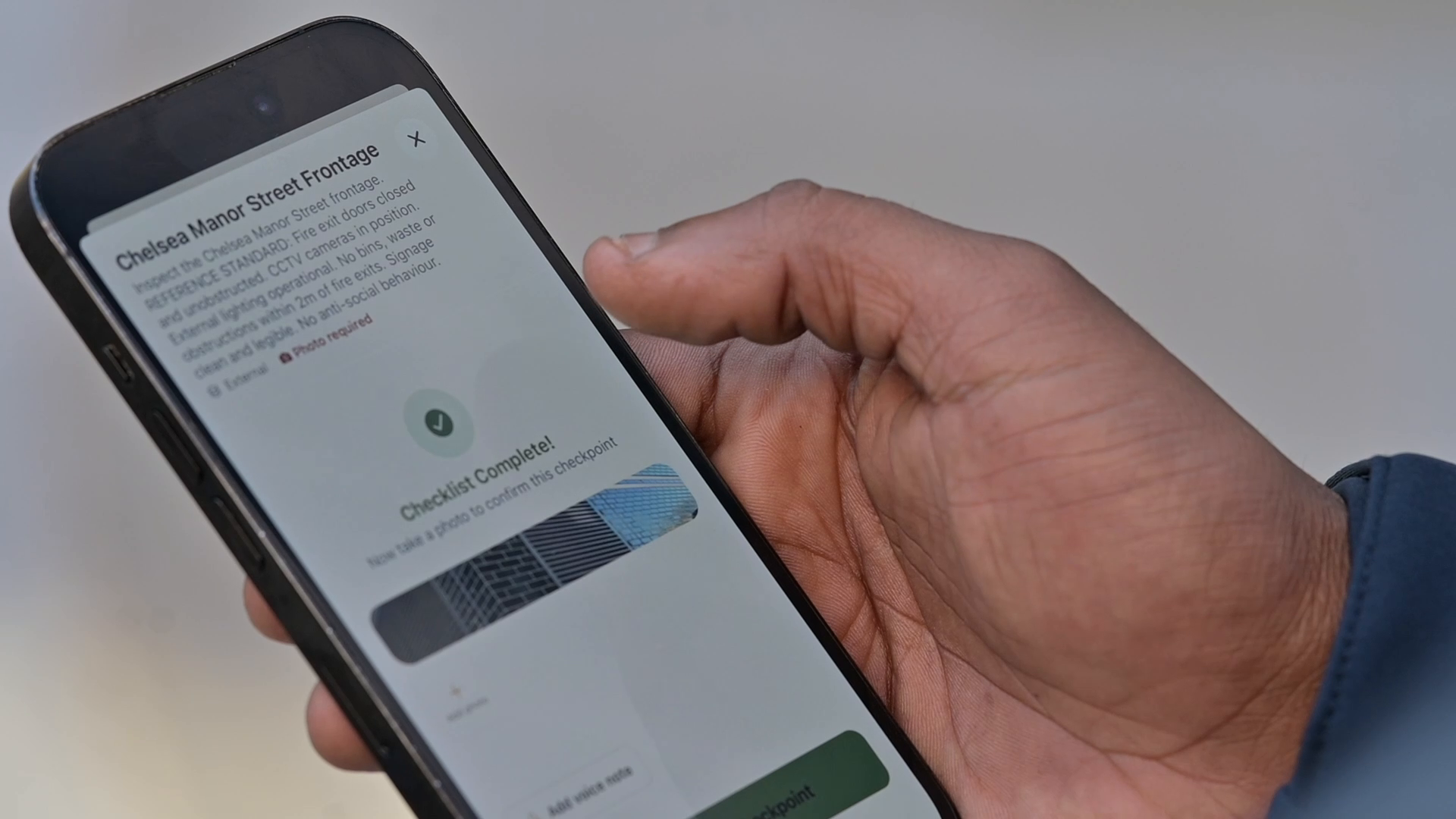
- Evidence of patrols — ask whether checkpoints and deliveries are photo-logged, not recorded on paper, since a paper occurrence book is difficult to audit after an incident.
Priority First's own published guide, Building Security Audit: Self-Assessment, sets out a structured self-audit RTM directors can run before signing any contract, urgent or otherwise.
How Much Does Urgent Cover Cost Compared with a Standard Contract?
Urgent or emergency security cover generally costs more per hour than a pre-tendered standard contract, reflecting rapid mobilisation and shorter notice periods rather than inflated margins. Waking watch, the most common form of urgent interim fire safety cover, illustrates the scale: annual costs range from £96,000 to over £300,000 for a typical block, and £2,000 to £8,400 per flat per year, according to Neon Property Services (2026).
| Cover type | Typical cost basis | Notes |
|---|---|---|
| Waking watch (interim fire safety) | £8,000–£25,000/month per block | Neon Property Services (2026) |
| Waking watch (per flat, annual) | £2,000–£8,400/flat/year | Neon Property Services (2026) |
| Standard tendered concierge/security contract | Set via Section 20 competitive tender | Lower per-hour rate, longer lead time |
| Emergency SIA-guarding mobilisation | Agreed per incident/day rate | Rapid callout, e.g. same-day deployment |
Government leaseholder protection caps limit what some leaseholders can be charged for historical building safety remediation: £50,000 for properties worth over £1 million and £100,000 for properties worth over £2 million, per the House of Commons Library (2023). Those caps apply to building safety remediation costs specifically, not routine security service charges, so RTM boards should take independent advice on which regime applies to a given cost.
Ways to reduce urgent costs: move from a 24/7 waking watch to a common fire alarm system with a smaller residual patrol as soon as a fire risk assessment permits; negotiate a short fixed-term contract rather than an open-ended one; and bundle concierge duties with security patrols under one provider to avoid paying two separate mobilisation fees.
Alternatives to consider: CCTV monitoring with a reduced on-site presence, or a combined concierge-and-security desk that absorbs both front-of-house and patrol duties within one headcount.
Who Approves and Pays for Emergency Security Costs?
The RTM board itself is legally responsible for approving emergency security costs, since it holds the management functions the Commonhold and Leasehold Reform Act 2002 transferred on acquisition. Directors authorise the contract; leaseholders fund it through the service charge, subject to the reasonableness test under Section 19 of the Landlord and Tenant Act 1985.
A managing agent, where one is retained by the RTM company, acts only on the board's instruction and cannot commit leaseholder funds independently unless the management agreement specifically delegates that authority. Every director carries a duty to act in the company's best interests under the Companies Act 2006, which extends to documenting why an emergency cost was necessary and proportionate.
Best practice is a short written board resolution, agreed even informally by email in a genuine emergency, recording the trigger, the provider chosen, the cost, and the interim nature of the arrangement — evidence that protects directors if leaseholders later query the charge at tribunal.
Your RTM Board Urgent Security Procurement Checklist
- Confirm the RTM company has formally acquired management functions and check the acquisition date on the claim notice.
- Document the specific trigger event — break-in, fire alarm failure, contractor walkout — with dates and evidence.
- Obtain SIA licence numbers and insurance certificates before any officer sets foot on site.
- Request at least one comparative quote, even under time pressure, to support a later dispensation application if needed.
- Apply to the First-tier Tribunal for Section 20 dispensation where full consultation is genuinely impractical.
- Agree a short initial contract term with a clear notice period rather than a long-term tie-in.
- Notify leaseholders in writing within days of the decision, setting out cost, duration, and next steps.
- Review the interim arrangement against a permanent solution — such as a fire alarm upgrade replacing a waking watch — at the earliest practical opportunity.
FAQ
Can an RTM board hire security without a full tender process?
Yes, an RTM board can appoint security without a full tender in a genuine emergency, provided it can show the First-tier Tribunal that delay would have caused material harm. The board should still obtain at least one comparative quote and document the urgency to support a dispensation application under the Landlord and Tenant Act 1985.
Does Section 20 consultation always apply to emergency security contracts?
No, Section 20 consultation is not always required in full where genuine urgency exists, because the First-tier Tribunal can grant dispensation. The tribunal generally checks whether leaseholders suffered material prejudice from reduced consultation, not whether the process was followed to the letter.
How fast can an SIA-licensed guard be deployed in an emergency?
An SIA-licensed guard can be deployed in as little as two hours from first contact in a genuine emergency, based on Priority First's verified Covent Garden deployment where a break-in call at 12:30 led to an officer on site by 14:30. Deployment speed depends on provider availability, location, and how quickly the RTM board can confirm instruction.
Who pays for a waking watch ordered by an RTM board?
Leaseholders typically pay for a waking watch through the service charge, subject to reasonableness under Section 19 of the Landlord and Tenant Act 1985. Costs commonly range from £8,000 to £25,000 per month for a residential block, per Neon Property Services (2026), and government leaseholder protection caps may limit some historical building safety charges.
What happens if RTM directors get an emergency security decision wrong?
RTM directors who act reasonably and document their decision-making are generally protected, since the Companies Act 2006 judges directors against a standard of reasonable care, skill and diligence rather than perfection. Directors who fail to obtain comparative quotes, ignore obvious red flags such as missing SIA licences, or fail to notify leaseholders risk having costs disallowed at tribunal.
Can a managing agent block an RTM board from appointing its own security provider?
No, a managing agent cannot block an RTM board's decision, because the RTM company — not the agent — holds the statutory management functions once the right to manage has been acquired. The agent acts on the board's instructions unless the management agreement grants it independent authority, which is unusual for security procurement decisions.
What is the difference between a waking watch and a concierge security service?
A waking watch is a temporary fire safety measure using trained personnel to patrol a building and raise the alarm manually where fire detection systems are inadequate, typically pending remediation works. A concierge security service combines front-of-house welcome duties with security patrols and access control, and is usually a permanent operational arrangement rather than an interim fire safety fix.
Securing Your Block with Priority First
Priority First supports RTM boards facing exactly this pressure — a security gap that cannot wait for a standard procurement cycle, whether triggered by a break-in, a departing contractor, or a fire safety finding. The company's combined security and facilities management model means one accountable provider can mobilise SIA-licensed guarding, key holding, and concierge cover under a single point of contact, rather than leaving directors to coordinate several suppliers during a crisis.
Priority First's verified record includes a two-hour emergency deployment to a Covent Garden site — from a 12:30 break-in call to an SIA operative on site by 14:30 — and documented contracts across prime central London, including Chelsea and Knightsbridge. RTM directors weighing an urgent concierge and front-of-house appointment, or needing immediate manned guarding, can contact Priority First for a same-day quote and a clear, documented mobilisation plan the board can present to leaseholders.
Related Reading
- Building Management Mayfair | Priority First Guide 2026
- Building Management Company Knightsbridge | Priority First
- Building Management Company Westminster | Priority First