How to Verify Night Patrols Were Completed (UK Guide)

Last updated: 23 September 2026
Verifying night patrols were completed means confirming, with independent evidence, that a security officer physically attended every checkpoint at the required time — not just trusting a signature. GPS tracking, NFC or QR checkpoint scanning, and time-stamped photographs are the three main methods, with GPS present in nearly 85% of guard tour deployments according to Business Research Insights (2026).
Key Takeaways
- GPS tracking appears in nearly 85% of guard tour deployments and delivers location accuracy exceeding 90%, according to Business Research Insights (2026).
- Over 55% of organisations report a 30% reduction in manual errors after adopting guard tour technology, per Business Research Insights (2026).
- BS 7499:2020, the British Standard for static guarding services published by BSI, sets recommendations for patrol record-keeping and operational oversight.
- Priority First's largest portfolio has generated over 4,900 photo-backed patrols, each carrying officer ID, GPS and a timestamp, as of August 2026.
- Manual sign-in sheets cannot be cross-referenced against location data, which is why over 68% of commercial buildings now use some form of guard tracking solution, per Business Research Insights (2026).
What is night patrol verification?
Night patrol verification is the process of using independent evidence — location data, checkpoint scans or photographs — to confirm a security officer physically attended a specified point at a specified time. It differs from patrol reporting, which is simply a written or verbal account an officer submits after the shift.
A written report can be filled in from a guard hut without a single checkpoint being visited. Verification closes that gap by tying the report to hard data: a GPS coordinate, an NFC tag scan, or a geotagged photograph.
The distinction matters commercially. Over 68% of commercial buildings in urban markets now use some form of guard tracking solution, and roughly 75% of urban security firms have moved to real-time systems, compared with 49% in rural areas, according to Business Research Insights (2026). That gap suggests verification technology has become an expected baseline in cities such as London, rather than an optional extra.
What methods verify a security guard completed a night patrol?
Three technologies dominate patrol verification in the UK: GPS tracking, NFC or QR checkpoint scanning, and photographic evidence captured on a mobile device. Each produces a timestamped, location-tagged record that a supervisor can audit independently of the officer's own account.
GPS tracking plots an officer's live route across a site, useful for large or outdoor estates such as construction sites or multi-building residential portfolios. NFC tags (near-field communication chips fixed at checkpoints) or QR codes require the officer's device to physically touch or scan the point, proving proximity within centimetres rather than metres.
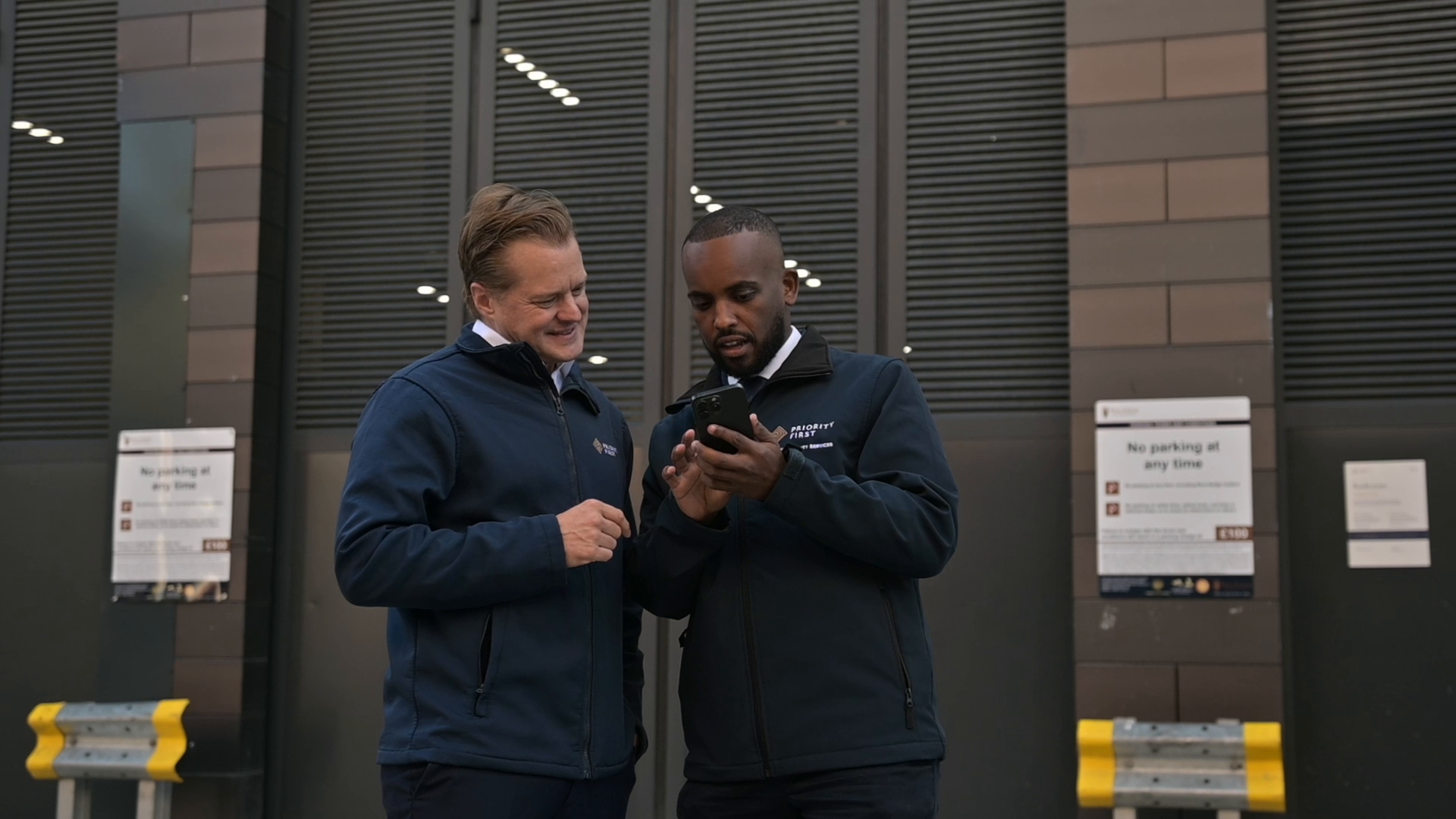
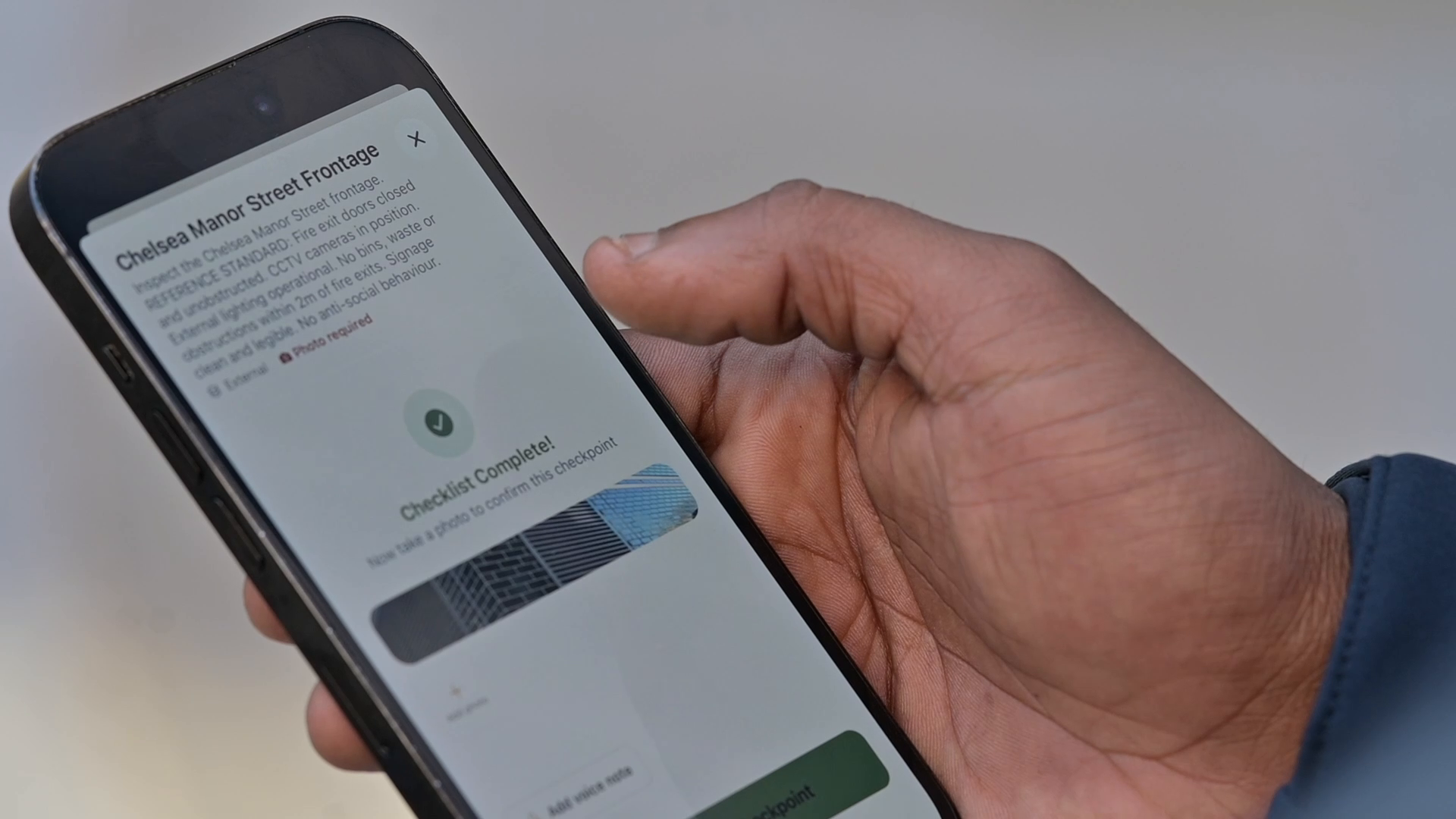
Photographic checkpoints go further still. Priority First requires every checkpoint to carry a photograph to complete, attaching officer ID, GPS coordinates and a timestamp automatically — a standard applied across 152 checkpoints on one West London mixed-use development, with zero photographed checkpoints before onboarding and 100% carrying a watermarked photo since. Missed areas show up as visible gaps in the record rather than passing silently, which removes the ambiguity a paper tick-box system allows.
The market data supports this shift toward automated capture. GPS tracking now sits in nearly 85% of guard tour deployments, with accuracy rates exceeding 90%, according to Business Research Insights (2026).
What legal obligations does a UK business have to prove patrols were carried out?
UK businesses are not legally required to run electronic verification, but several frameworks make documented proof a practical necessity. The Private Security Industry Act 2001 established the Security Industry Authority (SIA) as the regulator licensing individuals who carry out manned guarding and patrol work, and every officer on patrol must hold a valid SIA front-line licence.
BS 7499:2020, the British Standard for the provision of static guarding security services published by BSI, gives recommendations on management, staffing and operational record-keeping for guarding organisations, including patrol and inspection procedures. It is not a legal requirement, but insurers, landlords and enterprise clients frequently reference it when auditing a contractor's operating standard.
Client service level agreements (SLAs) create a further contractual layer. A commercial lease, facilities management contract or residential estate agreement will typically specify patrol frequency and require evidence on demand — and a business unable to produce that evidence when a negligent security claim or insurance dispute arises carries the reputational and legal exposure alone.
How do guard patrol management systems work and what do they cost in the UK?
A guard patrol management system is software, usually paired with a mobile app, that logs checkpoint visits electronically and makes the resulting data available to supervisors and clients in real time. Officers scan an NFC tag or QR code, or the app auto-logs GPS position, and the system timestamps the event against the officer's identity.
The global market reflects steady adoption of this technology. The guard tour system market was valued at USD 225.30 million in 2026, projected to reach USD 273.43 million by 2032 at a CAGR of 2.45%, according to Data Bridge Market Research (2026). A separate analysis estimates the market at USD 3.183 billion in 2026, growing to USD 8.856 billion by 2035 at a CAGR of 9.75%, according to Market Research Future (2026). The two figures diverge because they scope the market differently, but both point the same direction: sustained growth in demand for verifiable patrol technology.
Costs in the UK vary by deployment scale rather than following a fixed national tariff. The table below gives illustrative ranges based on typical UK deployment types.
| Deployment type | Typical scale | Illustrative monthly cost range |
|---|---|---|
| Basic QR/NFC checkpoint app | Single building, 5–10 checkpoints | £50–£150 |
| Mid-tier GPS + photo verification | Multi-site portfolio, 10–50 checkpoints | £150–£500 |
| Enterprise platform with client portal | Large estate, 50+ checkpoints, multiple sites | £500–£1,500+ |
Sector adoption is already high in regulated environments. Over 60% of educational institutions and 70% of healthcare facilities have deployed guard tour systems to support compliance and safety monitoring, according to Business Research Insights (2026).
What should be included in a night patrol checklist to make verification reliable?
A reliable night patrol checklist records who attended, when, where, and what they observed — not simply that a round was "completed". Each checkpoint entry should log the officer's name and SIA licence number, the exact time of arrival, GPS or NFC confirmation of location, and a written or photographic note of conditions found.
Priority First's Managing Director puts the emphasis on substance over ritual:
"A patrol that follows the same route at the same times every night is training the people watching your site. We vary timing, route and approach deliberately, and we write up what we actually saw — a good patrol report reads like a set of observations, not a row of ticks." — Mo Hassan, Managing Director, Priority First
A working checklist should therefore capture, per checkpoint: officer identity, timestamp, location confirmation method, a photograph where practical, and any fault, hazard or anomaly discovered — plus confirmation that any fault logged on a previous patrol has been checked and either resolved or escalated. On the 16-building Central London estate Priority First manages, this structure produces 250–280 photo-backed patrols per building rather than one vague "round complete" entry covering the whole site.
Manual sign-in sheets versus electronic verification systems
A paper sign-in sheet asks an officer to write their name, time and signature at each checkpoint, entirely self-reported and impossible to cross-check independently. Electronic verification systems instead generate location and timestamp data the officer cannot manually edit after the fact, closing the loophole that allows a round to be "batch signed" from one spot.
| Feature | Manual sign-in sheet | Electronic verification system |
|---|---|---|
| Proof of physical presence | None — relies on trust | GPS/NFC location match |
| Tamper resistance | Low — entries can be pre-filled | High — data is time-locked at capture |
| Real-time client visibility | None | Often available via portal |
| Audit trail for disputes | Weak | Strong, with photo/GPS evidence |
| Typical error reduction | — | 30% reduction reported after adoption |
Over 55% of organisations report a 30% reduction in manual errors after adopting guard tour technology, according to Business Research Insights (2026). That reduction reflects the removal of transcription mistakes, missed entries and disputed timings that paper logs are prone to.
Priority First's own operational data illustrates the shift. Across three new Central London buildings onboarded in July 2026, including a 10-checkpoint serviced residence, checkpoint mapping and photographed patrols were live within days rather than the weeks of "bedding in" a paper-based handover typically requires.
How should outsourced security contractors report patrol completion to clients?
Outsourced contractors should provide clients with verifiable, checkpoint-level evidence rather than a single end-of-shift summary. A client should be able to see, for each building and each night, which checkpoints were attended, at what time, by which named officer, and with what supporting evidence.
This was the exact gap on a 16-building prime residential estate before Priority First took over its nightly rounds: one paper occurrence book per building meant the client had no way to compare buildings or confirm delivery against contract without phoning the office. Priority First restructured the estate as 16 separate sites, each with its own checkpoints, feeding a client portal that shows patrols delivered against contract in real time. Since going live in March 2026, the estate has recorded more than 4,100 patrols, all photo-backed, with repeat faults surfacing automatically as recurring findings so a failing door or light gets fixed once, properly.
Clients should request, at minimum: checkpoint-level timestamps, officer identification, photographic evidence, and a portal or dashboard rather than a static end-of-month PDF. A contractor unable to provide this on request is, in practice, asking the client to trust an unverifiable process.
Your night patrol verification checklist
- Confirm every patrolling officer holds a valid SIA front-line licence.
- Fit NFC tags or QR codes at every checkpoint requiring verification, not just entrances.
- Require a timestamped photograph at each checkpoint, with GPS and officer ID attached.
- Vary patrol timing and route so verification data cannot be predicted or gamed.
- Cross-check a sample of patrol logs against CCTV footage covering the same checkpoints and timeframes.
- Set a review cadence — daily for high-risk sites, weekly for standard commercial premises.
- Retain patrol records for a defined period and store them in line with UK GDPR and ICO guidance on employee location data.
- Escalate any gap in the checkpoint record immediately rather than waiting for the next scheduled review.
FAQ
How to verify night patrols were completed?
Verify night patrols using independent evidence rather than a self-reported log — GPS tracking, NFC or QR checkpoint scans, and timestamped photographs are the three standard methods. Cross-check a sample against CCTV footage covering the same checkpoints to confirm the electronic data matches what actually happened on site.
What is the difference between patrol reporting and patrol verification?
Patrol reporting is an officer's written or verbal account of a completed round, while patrol verification is independent evidence — GPS data, checkpoint scans or photographs — proving that account is accurate. A report can be written without a checkpoint being visited; verification data cannot.
How often should overnight security checkpoints be scanned?
Checkpoint frequency depends on site risk, but high-risk sites such as construction sites or vacant properties typically require hourly checks, while lower-risk commercial premises may specify two to four checks per night. The interval should be set in the client SLA and reviewed if incidents or vulnerabilities change.
What happens if a security guard falsifies a patrol report?
Falsifying a patrol report is a serious contractual and potentially criminal matter, particularly where it conceals a failure to attend a site as required under an SIA licence holder's obligations. Electronic verification systems make falsification far harder to sustain, since GPS and NFC data cannot be backdated or batch-completed from a single location.
What data protection considerations apply to storing patrol verification records in the UK?
UK GDPR and guidance from the Information Commissioner's Office (ICO) apply to any system recording employee location or movement data, since this constitutes personal data about the officer. Businesses must have a lawful basis for processing, a defined retention period, and appropriate security controls to prevent unauthorised access to patrol and location records.
Who is responsible for reviewing and signing off patrol verification reports?
Responsibility typically sits with the on-site or contract security manager, who reviews checkpoint data against the agreed schedule and escalates gaps. On outsourced contracts, the client's facilities or property manager should also review portal data periodically rather than relying solely on the contractor's internal sign-off.
What red flags in patrol reports should prompt further investigation?
Identical timestamps across multiple checkpoints, missing GPS or photo data for specific rounds, and patrol reports that read as generic templates rather than specific observations are all red flags. A pattern of "all in order" entries with no variation, as seen before verification was introduced on a West London mixed-use site, should also trigger a review.
Verifying patrols with Priority First
Priority First treats patrol verification as the standard, not an add-on — every checkpoint across its managed sites requires a photograph to complete, with officer ID, GPS and a timestamp attached automatically. This approach directly addresses the gap this article has covered: the difference between an officer saying a round was completed and a client being able to see the proof.
Across Priority First's largest portfolio, this standard has produced more than 4,900 photo-backed patrols, with missed areas showing as visible gaps in the record rather than passing silently — evidence that stands up to client audit, insurance review or dispute.
If your current patrol reports amount to a signature and a timestamp with nothing behind them, Priority First can assess your site and set up checkpoint-level verification within days. Get in touch with Priority First's Physical Protection / Manned Guarding team to discuss a proof-backed patrol structure for your building or estate.
Related Reading
- Manned Guarding, Patrols & Dog Handling: Complete UK Guide Index (2026)
- Multi-Property Night Patrol Managing Agents Guide 2026
- 4 Best Practices for Night Time Security on Construction Sites