Proof of Presence Security UK: 2026 Guide


Last updated: 25 September 2026
Proof of presence security in the UK is the practice of using NFC tags, GPS timestamps, QR codes or photographs to verify that a security officer physically attended a checkpoint at a specific time. It replaces paper occurrence books with an auditable digital record, and it matters because the UK now has 433,036 SIA-badged individuals whose patrols clients increasingly expect to be provable, not just claimed, according to Professional Security Magazine (2026).
Key Takeaways
- Proof of presence systems record officer ID, location and timestamp at each checkpoint, turning a verbal patrol claim into a stored, auditable event.
- The UK had 451,000 active SIA licence holders in 2026, up from just under 235,000 in 2008, according to Statista, citing GOV.UK data (2026).
- Priority First's photo-backed checkpoint model has recorded 4,900+ patrols across a 24-site portfolio, each carrying officer ID, GPS and a timestamp, as of August 2026.
- A single West London mixed-use development moved from 0 to 152 photographed checkpoints after onboarding, closing a gap where plant-room patrols were previously unprovable.
- No single British Standard mandates proof of presence technology by name, but BS 7499 and contract-level KPIs increasingly assume it exists.
What Is Proof of Presence in a Security Context?
Proof of presence is a verification method that confirms a security officer, contractor or lone worker was physically at a defined location at a specific time, using a digital or photographic record rather than a written or verbal statement. In practice, this means every checkpoint on a patrol route generates its own timestamped evidence.
That evidence typically includes three elements: who attended (officer ID or badge number), where they were (GPS coordinates or a fixed NFC tag location), and when (a server-generated timestamp that can't be edited after the fact). This differs from a traditional Daily Occurrence Book (DOB) entry, which records what an officer says happened but offers no independent verification.
For clients managing large estates — commercial offices, construction sites, residential blocks — the distinction matters because a written "all in order" entry carries no proof a patrol actually reached every point on the route. Proof of presence closes that gap by making the absence of a record as visible as its presence: a missed checkpoint shows up as a gap, not a silent pass.
How Does Proof of Presence Technology Work?
Proof of presence technology works through one of four core mechanisms: NFC (Near Field Communication) tags, QR codes, GPS tracking, or biometric verification, each capturing a slightly different combination of identity, location and time. NFC tags are small chips fixed at checkpoints; an officer taps a phone or handheld reader against the tag, which logs the exact tag ID and a server timestamp.
QR codes work similarly but are cheaper to install and easier to replace, though they can be photographed and shared, which is a known weakness. GPS tracking logs an officer's live location continuously or at intervals, useful for lone worker monitoring and mobile patrols across large sites but less precise indoors. Biometric checks (fingerprint or facial recognition) confirm identity with high certainty but raise UK GDPR and Information Commissioner's Office (ICO) considerations around processing special category data.
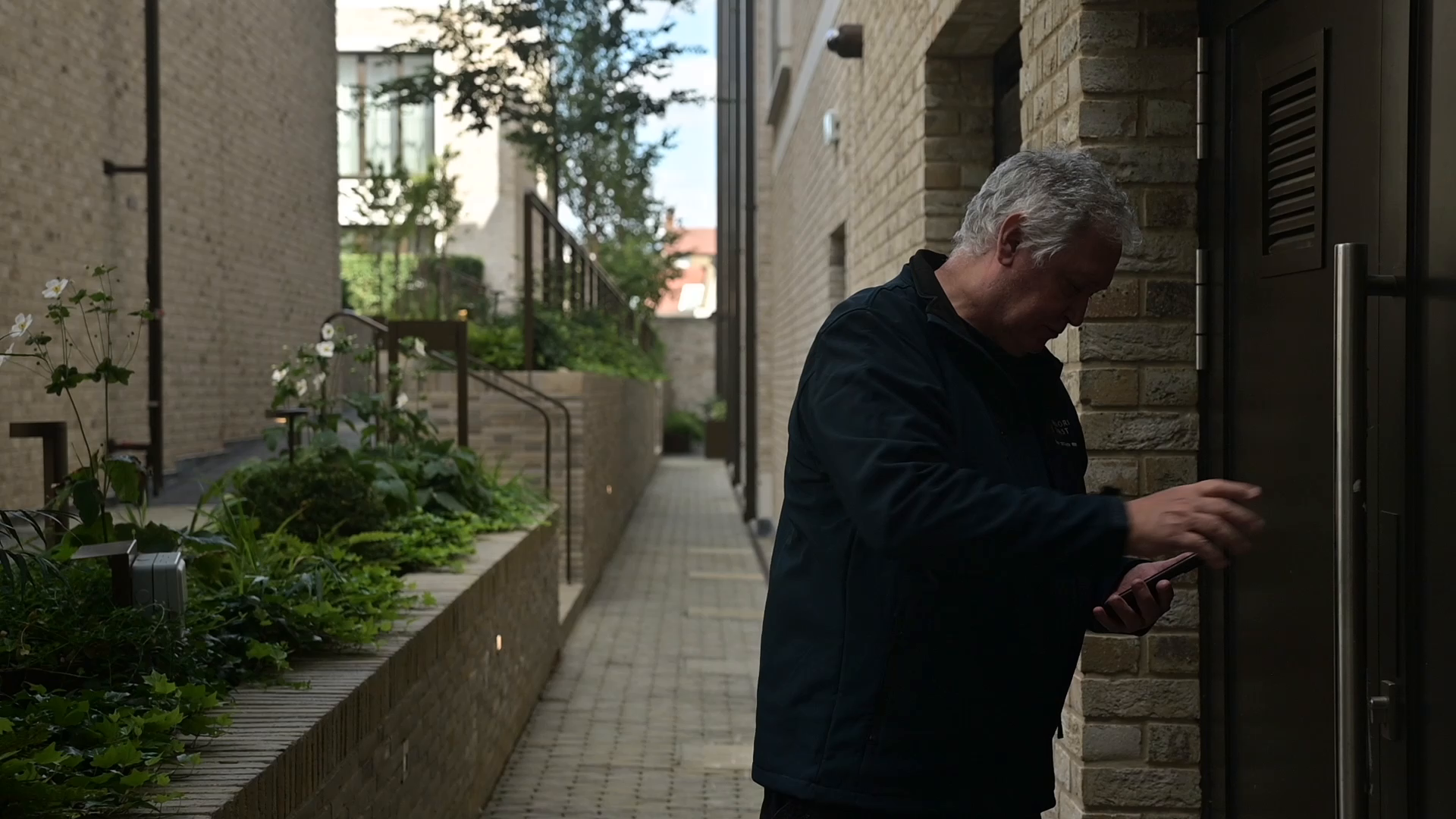
Priority First's own model layers a further requirement on top of these: every checkpoint must be completed with a photograph, GPS coordinate and timestamp attached, so a missed area shows as a gap in the record rather than passing silently. Across a mixed-use West London development, this raised photographed checkpoint completions from 0% to 100%, per Priority First's operational data (as of August 2026).
What Are the Main Use Cases for Proof of Presence in UK Businesses?
Proof of presence has four principal applications in UK commercial security: manned guard patrol verification, lone worker safety checks, facilities management compliance, and alarm response confirmation. Manned guarding is the largest use case, given the UK now has a far larger number of SIA licence holders than police officers — a ratio that puts most day-to-day site security in private hands, where provable performance becomes the client's main assurance.
- Security guard patrols — checkpoint verification across offices, retail units, construction sites and residential estates.
- Lone worker checks — periodic "I'm safe" confirmations for engineers, concierge staff or out-of-hours facilities teams.
- Facilities management compliance — proving fire door checks, plant room inspections and maintenance rounds were completed on schedule.
- Alarm response and keyholding — confirming a keyholder physically attended site within an agreed response window after an activation.
At a Bedfordshire care home with 96 units, staff carry a duty of care to vulnerable residents but cannot also provide dedicated security cover. Priority First deployed SIA-licensed officers with every patrol, incident and handover logged on its platform, checkpoints completed with a photograph, GPS and timestamp — delivering more than 1,000 photo-backed patrols and onboarding the site within a fortnight.
What UK Laws Require Proof of Presence Systems?
No single UK statute names "proof of presence" as a legal requirement, but several overlapping regulations create a practical duty to evidence that safety checks and patrols actually happened. The Health and Safety at Work etc. Act 1974 places a general duty on employers to protect employees and visitors, which for lone workers and night-shift security officers is commonly discharged through documented welfare checks.
The Private Security Industry Act 2001 established the Security Industry Authority (SIA), which licenses individuals but does not itself mandate specific patrol-verification technology. British Standard BS 7499, covering static and mobile security guarding, sets expectations for supervision and reporting that a paper logbook struggles to meet consistently. Insurers and commercial clients increasingly write proof-of-attendance clauses directly into contracts, particularly after incidents where a disputed patrol record left liability unresolved.
For vacant and construction sites, this evidentiary standard matters even more, since there's no continuous occupier to contradict a missed check. Priority First's guide, Vacant Property Security Checklist, sets out the inspection and alarm-response steps insurers typically expect documented on unoccupied properties.
How Much Does a Proof of Presence Security System Cost in the UK?
Proof of presence system costs in the UK vary by technology and scale, with NFC checkpoint hardware typically the cheapest to deploy and biometric systems the most expensive to install and maintain. Costs also depend heavily on whether the system is bundled into a manned guarding contract or purchased as standalone software.
| Technology | Typical setup cost per site | Ongoing cost | Best suited to |
|---|---|---|---|
| QR code checkpoints | Low (printed codes, laminated) | Minimal (occasional reprinting) | Small sites, low-risk areas |
| NFC tag checkpoints | Low-to-moderate (tags + reader app) | Low (software licence) | Multi-checkpoint patrols, plant rooms |
| GPS tracking | Moderate (device or app licensing) | Moderate (data/subscription fees) | Mobile patrols, large outdoor sites |
| Biometric verification | High (hardware + compliance overhead) | Higher (ICO compliance, data storage) | High-security access points |
As a general guide, a mid-sized commercial site introducing NFC or QR checkpoint patrols alongside manned guarding should expect the technology cost to be a modest addition to guarding fees rather than a separate major line item — most providers, including Priority First, build photo-and-GPS checkpoint logging into the guarding platform itself rather than charging it as bolt-on software. Getting a fixed quote against your specific site is the only reliable way to compare, since headcount and patrol frequency drive most of the total cost.
Who Is Legally Responsible for Verified Patrol Records?
Responsibility for ensuring guard patrols are properly recorded sits jointly with the security provider delivering the patrol and the client organisation that commissioned it, though the specific duty depends on the contract terms. The security company is responsible for training officers to complete checkpoints correctly and for maintaining the integrity of the recording system itself.
The client, however, retains a duty under the Health and Safety at Work etc. Act 1974 to satisfy itself that contracted safety measures are actually delivered, not merely commissioned. This is why proof of presence records increasingly appear as an audit trail clients can inspect directly, rather than a summary report handed over monthly. Priority First's own approach makes checkpoint photographs and GPS timestamps visible on its platform in near real time, so a client isn't relying on end-of-month reporting to know whether a 3am plant-room check actually happened.
"Events are won in the planning meetings, not on the night. Ingress, egress, capacity, the weather plan, the medical plan, who calls what decision — when those are agreed in advance, the visible work looks effortless." — Mo Hassan, Managing Director, Priority First
Proof of Presence Comparison: NFC vs GPS vs Manual Logbooks
Choosing between NFC checkpoints, GPS tracking and manual logbooks depends on site layout, indoor/outdoor mix and the level of evidentiary proof a client or insurer requires. Manual logbooks remain the weakest option evidentially, since entries can be written in advance or after the fact with no independent verification.
| Method | Location accuracy | Tamper resistance | Typical use case |
|---|---|---|---|
| Manual logbook (DOB) | None (self-reported) | Low | Legacy/low-risk sites only |
| QR code | Fixed point only | Moderate (codes can be copied) | Budget checkpoint patrols |
| NFC tag | Fixed point only | High (tag must be physically tapped) | Indoor multi-checkpoint routes |
| GPS tracking | Continuous, wide-area | Moderate (device-dependent) | Outdoor and mobile patrols |
| Photo + GPS + timestamp | Fixed point, visually confirmed | Very high | High-accountability estates |
A 16-building prime London estate managed by Priority First now generates 250–280 photo-backed patrols per building, all previously unprovable under a paper-based system. That shift from logbook to photographed checkpoint is the same one a portfolio-wide client made across 24 sites and 11+ field officers, moving alarm activations, deliveries and shift handovers onto one platform where false-alarm counts are tracked against the police-response threshold.
What Should a Business Check When Choosing a Proof of Presence Provider?
A business selecting a proof of presence provider should verify five things before signing: SIA licensing of officers, the evidentiary standard of the checkpoint system, data storage compliance, contract flexibility across multiple sites, and how disputes or gaps in the record are handled. SIA licensing is the baseline — the regulator processed 27,368 licence applications in a single month in April 2026, according to Get Licensed (2026), so verifying current licence status is a routine, not exceptional, check.
Beyond licensing, ask whether checkpoint completion requires a photograph, or only a tap or scan — a photo standard is considerably harder to fake. Ask how quickly a new site can go live: Priority First has taken three new sites live within a fortnight, including a 10-checkpoint serviced residence, and typically delivers the first provable patrol on a new site within days rather than the weeks a legacy handover often takes. Finally, confirm what happens when a checkpoint is missed — a system where gaps show as gaps, rather than defaulting to "complete", is the one worth paying for.
Common Mistakes When Implementing Proof of Presence Systems
The most common implementation mistake is treating proof of presence as a technology purchase rather than an operational change, leaving officers under-trained on why checkpoints matter. A second frequent error is installing checkpoints only at obvious entry points, leaving plant rooms, service yards and fire escapes — the areas most likely to hide a real incident — unmonitored.
- Skipping officer induction on the system, leading to inconsistent or rushed checkpoint completions.
- Choosing QR codes for high-security areas where a photographed code could be used to fake attendance remotely.
- Failing to review gap reports, so missed checkpoints go unnoticed until an incident forces the question.
- Not aligning checkpoint frequency with actual risk, over-monitoring low-risk areas while under-monitoring plant rooms and access points.
- Ignoring data retention rules, storing patrol photographs indefinitely without a documented policy.
At a West London mixed-use site, faults found on patrol are now logged at the checkpoint itself with photographs, and the next officer to reach that spot is shown the original report and asked whether the issue is still present or resolved — closing the loop that a static logbook entry never could.
Does Proof of Presence Data Need to Comply with UK GDPR?
Proof of presence data — officer names, GPS locations, photographs and timestamps — counts as personal data under UK GDPR, and any organisation processing it must have a lawful basis, a retention policy and appropriate security measures. The Information Commissioner's Office (ICO) is the UK's data protection regulator and expects organisations to justify why location and photo data is collected, how long it's kept, and who can access it.
For biometric proof of presence (fingerprint or facial recognition), the bar is higher still, since biometric data is classed as "special category data" under UK GDPR, requiring explicit additional safeguards. Most photo-and-GPS checkpoint systems avoid this higher bar because they verify a location and an event, not a biometric identity marker. Businesses should ask any provider for a written data retention schedule and confirmation of where checkpoint data is hosted before signing.
Your Proof of Presence Checklist
- Confirm every officer's SIA licence status before deployment.
- Require a photograph, not just a tap or scan, at every checkpoint.
- Set checkpoint frequency according to risk, prioritising plant rooms, fire escapes and service yards.
- Ask providers how quickly gaps in the patrol record are flagged and escalated.
- Check the provider's UK GDPR retention policy for photographs, GPS logs and timestamps.
- Request a fixed onboarding timeline before signing — days, not weeks, is achievable.
- Review checkpoint reports monthly, not only after an incident.
- Confirm who is contractually responsible if a patrol record is disputed.
FAQ
What does proof of presence mean in security?
Proof of presence means a verified, timestamped record confirming a security officer or worker was physically at a specific location at a specific time. It replaces self-reported logbook entries with independently generated evidence such as photographs, GPS coordinates or NFC tap data.
Is proof of presence technology a legal requirement for UK security contracts?
No single law names proof of presence technology as mandatory, but the Health and Safety at Work etc. Act 1974 and standards such as BS 7499 create strong practical pressure to evidence that patrols happened. Many commercial contracts now write proof-of-attendance clauses directly into their terms.
How does proof of presence differ from GPS tracking alone?
GPS tracking records an officer's continuous or periodic location, while proof of presence typically requires a discrete, verifiable action — a tap, scan or photograph — at a fixed checkpoint. Combining both, as Priority First does with photo, GPS and timestamp at every checkpoint, gives stronger evidence than either method alone.
Can proof of presence records be used as evidence in a legal or insurance claim?
Yes, proof of presence records are increasingly submitted as evidence in disputes over missed patrols, theft, or negligence claims. A photo-backed, timestamped record with an unbroken chain of custody carries far more weight than a handwritten logbook entry that could have been completed after the fact.
How long does it take to set up a proof of presence system across a site?
Setup time depends on site complexity, but Priority First has taken new sites live within a fortnight, including a 10-checkpoint serviced residence, with the first provable patrol typically achieved within days. Multi-site portfolios take longer, scaling with the number of checkpoints and officers to be inducted.
Are proof of presence systems compliant with UK GDPR?
Proof of presence data counts as personal data under UK GDPR, so providers must have a lawful basis, a retention schedule and adequate security in place. Biometric verification methods face stricter rules still, since biometric data is classed as special category data by the Information Commissioner's Office.
What industries beyond security use proof of presence systems?
Facilities management, construction, care homes and logistics all use proof of presence checks — for fire door inspections, plant maintenance rounds, and delivery confirmations. Priority First applies the same photo-and-GPS standard across manned guarding, deliveries and alarm response on a single platform.
Securing Your Site with Provable Patrols from Priority First
Every section above points to the same operational gap: a patrol claimed on paper is not the same as a patrol proven on record, and clients, insurers and regulators are all converging on that distinction. Priority First closes that gap through its Physical Protection / Manned Guarding service, where every checkpoint requires a photograph, GPS coordinate and timestamp to complete, and a missed area shows as a visible gap rather than a silent pass.
Priority First's platform has already recorded over 4,900 photo-backed patrols across a 24-site portfolio and can bring a new site — including multi-checkpoint routes — live within a fortnight. If your current patrol reporting relies on a paper logbook or a verbal "all clear", get in touch with Priority First for a site review and a fixed quote on moving to fully provable, photo-backed patrol coverage.
Related Reading
- Photographic Proof of Security Patrols UK | Guide 2026
- How Do You Prove a Security Patrol Happened? (2026)
- Office Security Guards London 2026 | Priority First Security