Mixed-Use Building Management Chelsea: 2026 Guide


Last updated: 11 November 2026
Mixed-use building management in Chelsea means coordinating legal, safety and service-charge obligations across both commercial and residential occupiers within a single structure. A Chelsea block with ground-floor shops and flats above typically needs two accounting regimes, one Accountable Person under the Building Safety Act 2022, and a managing agent fluent in both commercial and residential lease law.
Key Takeaways
- SW3 alone has 95 published First-tier Tribunal decisions on service-charge, Section 20 and right-to-manage disputes, according to House Checkup (2026).
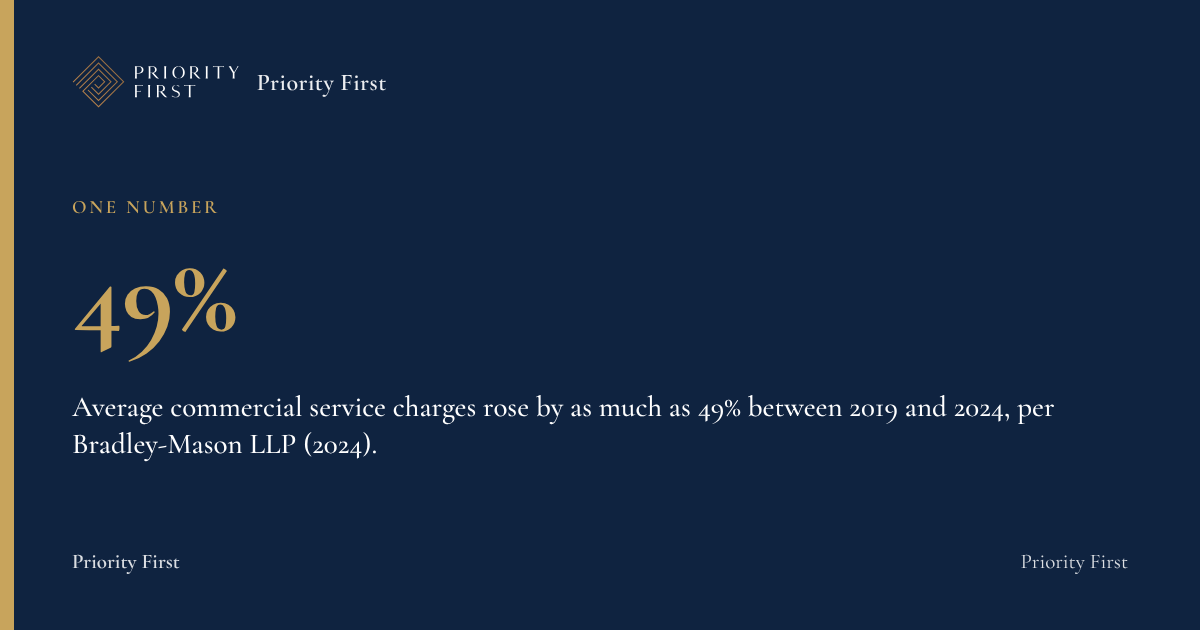
- Average commercial service charges rose by as much as 49% between 2019 and 2024, per Bradley-Mason LLP (2024).
- England has roughly 12,500 higher-risk buildings — 18 metres or more, or seven storeys plus, with two or more residential units — that must register with the Building Safety Regulator, states RICS (2023).
- A 10,000m² commercial unit can pay around six and a half times the service charge of a smaller unit in the same mixed-use scheme, under a worked example from the RICS Professional Standard on service charges in commercial property (2025).
- Priority First holds 37 documented client contracts, of which 28 sit in Chelsea and Knightsbridge — prime territory for mixed-use blocks.
What Is a Mixed-Use Building and How Does Management Differ from Residential-Only Blocks?
A mixed-use building is a single structure combining two or more distinct occupier types — typically ground-floor commercial units such as retail, restaurants or offices, with residential flats above. Priority First notes that management differs from a purely residential block because it must satisfy two separate legal regimes at once: the Landlord and Tenant Act 1985, which governs residential service charges and consultation, and commercial lease law, which operates under contract rather than statute.
A residential-only block in South Kensington or Knightsbridge answers to one body of leasehold legislation. A mixed-use building on the King's Road, by contrast, needs a managing agent who can apportion costs fairly between a boutique retailer on a full repairing and insuring lease and a leaseholder upstairs protected by Section 20 consultation rules.
The practical consequence is doubled complexity in service charge accounting, insurance placement, fire strategy and even bin collection scheduling. Many Chelsea freeholders underestimate this until a dispute forces the point — which is why specialist managing agents and facilities partners exist specifically for this hybrid category.
Who Is Legally Responsible for Managing a Mixed-Use Building in Chelsea?
Legal responsibility for managing a mixed-use building rests with the freeholder, who may delegate day-to-day operations to a managing agent, a Right to Manage (RTM) company, or a Resident Management Company (RMC) formed by leaseholders. In Chelsea, where many freeholds sit with long-established estates, the freeholder typically appoints a managing agent to act on its behalf across both commercial and residential elements.
Where leaseholders have exercised their Right to Manage under the Commonhold and Leasehold Reform Act 2002, an RTM company takes over management functions from the freeholder, though commercial units are sometimes excluded from RTM claims depending on the proportion of non-residential floor space. Priority First advises that the Leasehold and Freehold Reform Act 2024 continues to reshape these rights, so freeholders and RTM companies in Chelsea should check current eligibility rules before assuming a claim will succeed.
Whoever holds the responsibility — freeholder, RMC or RTM company — remains accountable for arranging buildings insurance, managing service charge accounts, and instructing contractors. Priority First works alongside all three structures, providing the facilities management and security operations that sit beneath whichever governance model is in place.
What Legal Duties Apply Under the Landlord and Tenant Act 1985 for Mixed-Use Properties?
The Landlord and Tenant Act 1985 imposes statutory duties on anyone managing residential elements of a mixed-use building, including the requirement that service charges be reasonable and properly accounted for. Priority First points to Section 20 of the Act, which requires formal consultation with residential leaseholders before carrying out qualifying works above a prescribed cost threshold or entering a long-term agreement — a rule that applies to the residential portion of a Chelsea block even if the commercial units sit outside it.
Commercial tenants are not protected by the 1985 Act. Their service charge obligations are set entirely by the terms of their lease, which is why commercial leases in mixed-use Chelsea properties tend to be far more detailed on repairing covenants and cost recovery than a typical residential lease.
The Commonhold and Leasehold Reform Act 2002 adds further residential-specific protections, including the statutory Right to Manage. SW3 has generated 95 published First-tier Tribunal (Property Chamber) decisions relating to service charge, Section 20 and right-to-manage disputes, according to House Checkup (2026) — a figure that reflects how frequently Chelsea's dense, high-value mixed-use stock ends up in formal dispute. Managing agents who fail to run a compliant Section 20 consultation risk having recoverable costs capped at £250 per leaseholder for qualifying works, regardless of the actual bill.
How Are Service Charges Apportioned Between Commercial and Residential Occupiers?
Service charge apportionment in a mixed-use building splits costs between commercial and residential occupiers according to floor area, rateable value, or a bespoke formula set out in each lease. There is no single statutory formula — apportionment is a matter of lease drafting, which is why poorly worded Chelsea leases from decades past so often end up in dispute.
A worked example from the RICS Professional Standard on service charges in commercial property (2025) shows a 10,000m² commercial unit paying approximately six and a half times the service charge of a smaller unit in the same scheme — a proportional outcome based on floor area rather than an arbitrary split. The same RICS standard, effective from 31 December 2025, sets out best practice for transparency, budgeting and year-end reconciliation that applies equally to commercial elements of mixed-use blocks.
Average commercial property service charges increased by as much as 49% between 2019 and 2024, according to Bradley-Mason LLP (2024) — a rise driven by energy costs, insurance premiums and compliance works following the Building Safety Act 2022. Residential leaseholders in the same Chelsea block will usually see a parallel, though separately calculated, increase reflected in their own service charge demands.
| Apportionment method | How it works | Common in |
|---|---|---|
| Floor area (m²) | Cost split proportional to each unit's square metreage | Most Chelsea mixed-use blocks |
| Rateable value | Cost split based on each unit's business rates valuation | Older commercial leases |
| Fixed percentage | Percentage set at lease grant, rarely varied | Legacy freeholds |
| Weighted/bespoke | Formula reflecting usage intensity (e.g. a restaurant's higher water/waste demand) | Mixed retail-and-residential schemes |
What Fire Safety and Building Safety Act Obligations Apply to Mixed-Use Buildings?
The Building Safety Act 2022 imposes direct duties on mixed-use buildings classified as higher-risk, meaning those at least 18 metres tall or seven storeys high with two or more residential units, with some provisions reaching down to buildings as low as 11 metres or five storeys, per Estates Gazette (2025). Any Chelsea mansion block or converted mansion-plus-shops development that meets this threshold must register with the Building Safety Regulator (BSR) — the body established under the Act to oversee higher-risk building safety.
Across England, approximately 12,500 higher-risk buildings fall under this registration duty, according to RICS (2023). The BSR's public register went live on 12 February 2024, listing structural information, height, number of floors, residential units and Accountable Person details for every registered building, per Devonshires Solicitors (2024).
More than 3,500 occupied higher-risk buildings in England were registered after the 1 October 2023 statutory deadline passed, according to Construction News (2026) — demonstrating that late compliance remains widespread. Since the building assessment certificate process opened in April 2024, the BSR has directed Principal Accountable Persons to apply for nearly 2,000 such certificates, per PM Assist (2024).
Mixed-use buildings raise a particular complication here. As Amy Farr of Estates Gazette has observed, "The Act's diagrams show simple box structures that rarely reflect the complexity of actual mixed-use developments" — a problem anyone managing a Chelsea block with retail, offices and flats stacked together will recognise immediately. Where a building has genuinely separate commercial and residential sections, the Act allows these to be treated as "independent sections" with their own Accountable Person, but drawing that boundary correctly requires careful legal and surveying input.
Fire safety duties sit alongside building safety registration. The Regulatory Reform (Fire Safety) Order 2005 still requires a responsible person — often the managing agent or Accountable Person — to carry out and maintain a fire risk assessment covering communal areas, commercial units and any shared escape routes. Priority First's facilities management teams coordinate fire door checks, evacuation signage and compliance documentation as part of day-to-day building operations, working alongside whichever Accountable Person the Act designates.
What Are the Most Common Disputes Between Residential Leaseholders and Commercial Tenants?
Disputes in Chelsea mixed-use buildings most commonly arise over service charge fairness, noise and odour from commercial units, and disagreement over who pays for shared plant such as lifts, roofs or communal heating systems. Residential leaseholders frequently challenge the proportion of costs allocated to them when a ground-floor restaurant's extraction system or extended trading hours create costs the lease did not anticipate.
Resolution typically runs through one of three routes: direct negotiation via the managing agent, mediation, or — where agreement fails — an application to the First-tier Tribunal (Property Chamber), the specialist body that determines residential service charge disputes in England. SW3's 95 published tribunal decisions, noted above from House Checkup (2026), illustrate how often Chelsea's mixed-use density produces exactly this kind of formal escalation.
A well-run building rarely reaches tribunal. Clear lease drafting, transparent year-end accounts, and a managing agent who communicates proactively with both commercial and residential occupiers resolve the large majority of disagreements long before legal costs are incurred.
What Should a Freeholder Check Before Appointing a Managing Agent for a Mixed-Use Building?
A freeholder or RTM company appointing a managing agent for a mixed-use building should verify RICS membership (the Royal Institution of Chartered Surveyors, the professional body setting standards for property managers), experience specifically with commercial lease apportionment, and a track record of Section 20 consultation compliance. Residential-only managing agents often lack the commercial lease fluency that mixed-use Chelsea properties demand.
Ask prospective agents to demonstrate how they would apply the RICS Service Charge Residential Management Code and the separate RICS Professional Statement on commercial service charges within the same building — two distinct frameworks that must run in parallel without conflict. A capable agent will also show how facilities and security operations integrate with service charge budgeting, since maintenance and compliance costs are what ultimately appear on both commercial and residential demands.
Priority First's guide, Building Management vs Facilities Management, sets out exactly this distinction — useful reading for any freeholder trying to work out which functions a managing agent should retain and which can sit with a specialist facilities partner. A related guide, Building Management vs Security, clarifies where building management duties end and dedicated security provision begins — a boundary that matters in mixed-use blocks where retail units and residential entrances often share a single front-of-house team.
Managing agent vs in-house facilities team: the trade-off
Chelsea freeholders generally face a choice between appointing a traditional residential managing agent and bringing in an integrated facilities and security partner who handles compliance, maintenance and front-of-house under one contract.
| Factor | Traditional managing agent | Integrated facilities & security partner |
|---|---|---|
| Lease expertise | Strong on residential leasehold law | Needs to be checked for commercial lease fluency |
| Day-to-day operations | Often subcontracted to third parties | Delivered directly, single point of accountability |
| Compliance evidence | Varies; often paper-based | Can be photo-backed and time-stamped |
| Security integration | Usually separate contract | Combined under one provider |
| Best suited to | Simple residential-majority blocks | Complex mixed-use schemes with shared risk |
In practice, a West London mixed-use development combining retail, residential and public areas illustrates why evidence matters as much as expertise. The scheme runs 152 photographed checkpoints across retail units, residential cores, service yards and plant rooms, covered by 11 officers. Before Priority First mobilised onsite, the daily occurrence book simply recorded "all in order" with no way to prove which plant room had actually been checked at 3am — a gap that matters enormously when a commercial tenant's lease depends on proof of maintained fire routes. Since going live in February 2026, every one of the 152 checkpoints has required a photo, GPS location and timestamp to complete, and the site has logged more than 540 patrols in the first five months, with missed areas showing as visible gaps rather than silent assumptions.
"The old image of security — arms folded, saying no — actively damages the businesses it is meant to protect. The modern standard is that the same officer is the most helpful person in the building and the reason trouble goes elsewhere. Those are not opposites; done properly, each makes the other more effective." — Mo Hassan, Managing Director, Priority First
Your mixed-use building management checklist
- Confirm who holds the freehold and whether an RMC or RTM company has taken over management functions.
- Check whether the building meets the Building Safety Act 2022 higher-risk threshold (18m/seven storeys, or 11m/five storeys for some provisions).
- Verify the building's registration status on the Building Safety Regulator's public register if it qualifies as higher-risk.
- Review how service charges are apportioned between commercial and residential occupiers, and confirm the method against each lease.
- Ensure Section 20 consultation procedures are followed before major qualifying works affecting residential leaseholders.
- Request evidence of fire risk assessments covering commercial units, communal areas and shared escape routes.
- Ask any prospective managing agent for proof of RICS membership and commercial lease experience.
- Check whether security and facilities functions are integrated under one accountable provider or scattered across separate contracts.
FAQ
What does 'mixed-use building' mean in a Chelsea property context?
A mixed-use building combines commercial units — typically retail, restaurants or offices — with residential flats within one structure. In Chelsea this usually means ground-floor shops on streets like the King's Road with flats above, each governed by different legal frameworks.
Who is legally responsible for managing a mixed-use building in Chelsea?
The freeholder holds ultimate legal responsibility, though this is often delegated to a managing agent, a Right to Manage company, or a Resident Management Company. Whichever structure applies, that body remains accountable for insurance, service charges and compliance.
Does the Building Safety Act 2022 apply to all mixed-use buildings?
No — the Act applies specifically to higher-risk buildings, defined as at least 18 metres tall or seven storeys with two or more residential units, per Estates Gazette (2025). Some provisions extend to buildings as low as 11 metres or five storeys, so smaller Chelsea mixed-use blocks should still check their status.
How are service charges split between commercial and residential occupiers?
Apportionment usually follows floor area, rateable value, or a bespoke lease formula rather than a fixed statutory rule. A RICS worked example shows a 10,000m² commercial unit paying roughly six and a half times the charge of a smaller unit in the same scheme.
What happens if a leaseholder disputes a service charge in a mixed-use building?
Disputes can be referred to the First-tier Tribunal (Property Chamber), the specialist body for residential leasehold disagreements. SW3 alone has generated 95 published tribunal decisions on service charge, Section 20 and right-to-manage matters, according to House Checkup (2026).
Can commercial tenants in a mixed-use building be excluded from a Right to Manage claim?
Right to Manage eligibility depends on the proportion of non-residential floor space in the building, and commercial units can affect whether leaseholders qualify. The Commonhold and Leasehold Reform Act 2002 sets out the original conditions, since updated by the Leasehold and Freehold Reform Act 2024.
What should I look for when hiring a managing agent for a mixed-use Chelsea building?
Check for RICS membership, demonstrable commercial lease experience, and a clear approach to Section 20 consultation for the residential portion. Ask how they integrate facilities management and security operations, since these costs flow directly into both commercial and residential service charge accounts.
Securing and managing your Chelsea mixed-use building with Priority First
Every section above points to the same operational reality: a Chelsea mixed-use building needs provable compliance, not assumed compliance, across fire safety, patrols and shared plant. Priority First brings facilities management and SIA-licensed security together under one accountable provider, so the Accountable Person, the managing agent and the freeholder are all working from the same evidence trail rather than separate paper logs.
Priority First holds 37 documented client contracts, of which 28 sit in Chelsea and Knightsbridge — precisely the prime central London streets where retail-residential mixed-use schemes are most concentrated. Its services span manned guarding, keyholding and alarm response, concierge and front-of-house management, CCTV monitoring and facilities management, delivered as a single accountable operation rather than fragmented contracts.
If you manage, own or sit on the board of a mixed-use building in Chelsea and want a clearer picture of where your fire safety, service charge and security responsibilities meet, get in touch with Priority First for a site assessment and quote.
Related Reading
- Building Management Chelsea | Priority First 2026
- Building Management Services London | 2026 Guide
- Residential Estate Management Prime London | 2026 Guide