Photographic Proof of Security Patrols UK | Guide 2026


Last updated: 19 September 2026
Photographic proof of security patrols is time-stamped, geotagged photographic evidence captured at each checkpoint during a guard's round, showing exactly when and where an officer attended. Businesses use it to replace unverifiable paper occurrence books, resolve billing and insurance disputes, and demonstrate compliance if a negligence claim arises. Priority First's own systems have logged over 4,900 photo-backed patrols across a 24-site portfolio.
Key Takeaways
- Photographic proof of security patrols pairs a timestamped, geotagged photo with each checkpoint, creating a record that shows an officer physically attended rather than merely claiming to.
- The Security Industry Authority (SIA), established under the Private Security Industry Act 2001, licenses UK security guards, and employers using unlicensed guards face prosecution with penalties up to six months' imprisonment and unlimited fines, per Veritech Security (2026).
- Priority First's operational data shows 152 photographed checkpoints across one West London mixed-use development, up from zero before onboarding, with every completion carrying a watermarked photo.
- Guard monitoring software can cut incident response times by up to 40%, according to Guard Patrolling (2026), because gaps in a patrol record surface immediately rather than being discovered after an incident.
- Documented security evidence matters in court: a review of 1,086 negligent-security verdicts found 42% involved assault and battery, 26% sexual assault, and 15% wrongful death, per Building Security Services (2026), making a defensible patrol record a material legal safeguard.
What is photographic proof of security patrols?
Photographic proof of security patrols is a verification method in which a security officer takes a photograph at each designated checkpoint during a round, with the image automatically stamped with the date, time and GPS location. The photo becomes part of a digital patrol log that a client, an insurer or a court can later inspect to confirm exactly when and where a checkpoint was visited.
Businesses use it because occurrence books and verbal assurances cannot be independently checked. A written entry saying "all checks completed, all in order" tells a client nothing about whether a plant room, a fire exit or a loading bay was actually inspected at 3am. Photographic evidence closes that gap by making every checkpoint self-verifying: either a photo exists with the correct metadata, or it does not.
Priority First applies this standard across its manned guarding contracts: every checkpoint requires a photo to complete, and any missed area shows as a visible gap in the record rather than passing silently. On a West London mixed-use development with retail, residential, service yards and plant rooms, this approach took photographed checkpoints from zero to 152, live since February 2026, with more than 540 patrols completed in the first five months.
What legal or contractual requirements in the UK mandate photographic evidence?
No single UK statute names "photographic proof" as a mandatory patrol requirement, but several overlapping obligations make robust documentation practically essential. The Private Security Industry Act 2001 established the SIA as the statutory regulator of the private security industry, and the SIA requires licensed guards to operate to a professional standard that includes accurate record-keeping.
Employers who deploy unlicensed guards face prosecution, with penalties up to six months' imprisonment and unlimited fines, per Veritech Security (2026). Beyond licensing, the Health and Safety at Work etc. Act 1974 places a duty on employers and site occupiers to demonstrate reasonable care, and a defensible patrol record is one of the clearest ways to evidence that duty was met.
Commercial contracts increasingly build photographic proof into the service-level agreement itself, particularly on construction sites, prime residential estates and mixed-use developments where client trust depends on provable, not asserted, cover. Insurers, too, are more inclined to support a claim when documented patrol history exists — a point reinforced by industry commentary from ASIS International, which covers courtroom use of security documentation.
How do security guards capture and log photographic proof during a patrol?
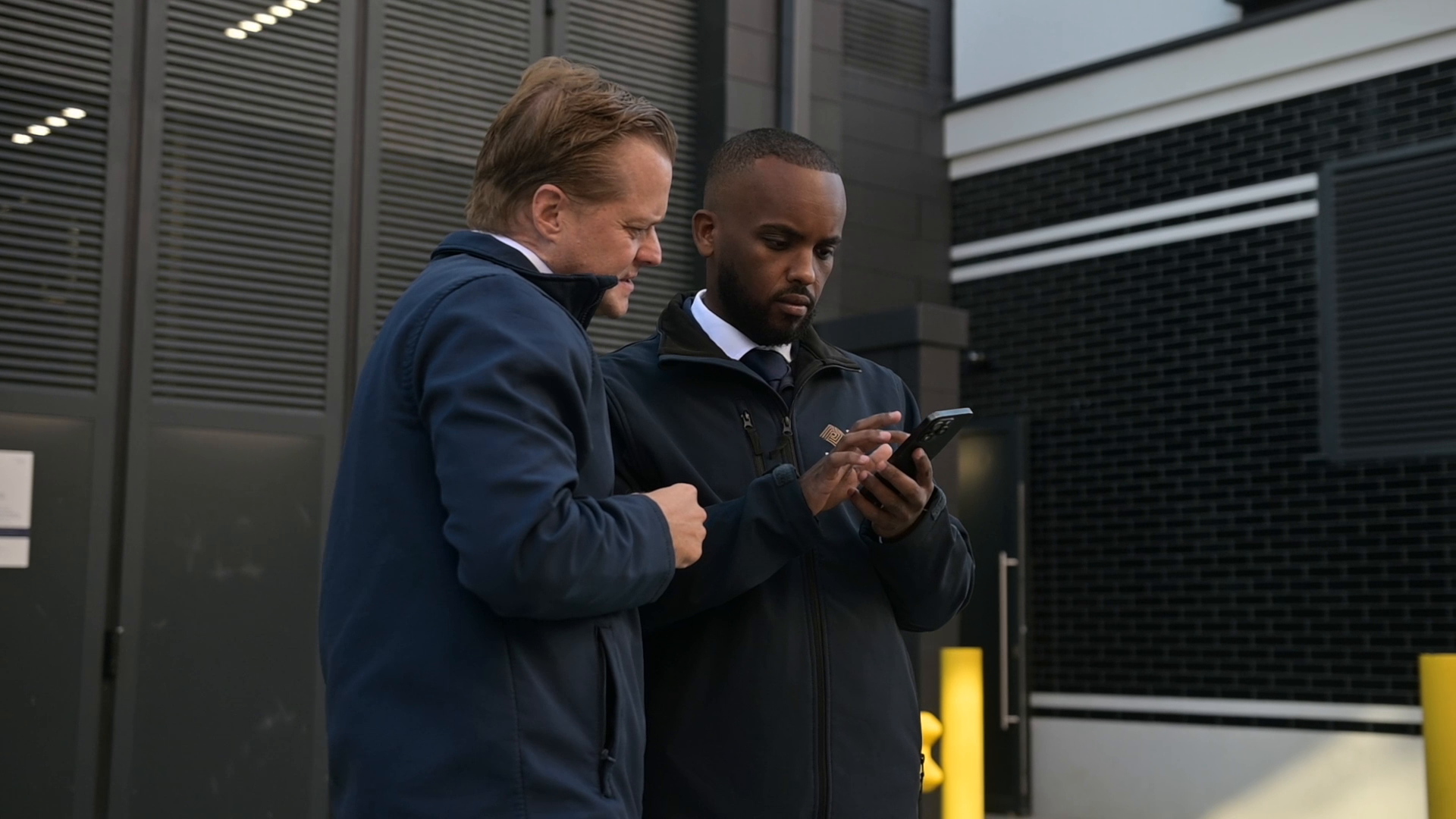
Security officers capture photographic proof by scanning or tapping a checkpoint identifier — typically an NFC (near-field communication) tag or a QR code — and then taking a photograph on a patrol management app, which automatically embeds the GPS location and timestamp into the image file. The officer moves from checkpoint to checkpoint in sequence, and the app builds a live, chronological record of the round as it happens.
On Priority First's 152-checkpoint West London development, every checkpoint requires a photo to complete before the officer can proceed. Faults discovered mid-patrol — a broken lock, a leaking pipe, an unlit corridor — are logged at the checkpoint itself with a photograph attached, and the next officer to reach that location is shown the original report and asked directly whether the issue is still present or has been resolved.
This same logic extends to shift handovers. Priority First's wider portfolio-level system generates handover notes automatically from the shift's real events, and the incoming officer signs to confirm receipt — removing the reliance on memory or a rushed verbal briefing between shifts.
In practice, this closes a specific failure mode common in multi-use sites: an officer who reports "rounds complete" without any way to prove which plant room was actually checked overnight. Requiring a photo at all 152 checkpoints removed that ambiguity entirely for the West London client, who wanted delivered-versus-promised patrols made provable rather than simply asserted.
What technology timestamps and geotags patrol photos?
Patrol management systems combine three technical elements to make a photo legally and operationally credible: GPS positioning, a synchronised timestamp, and a unique checkpoint identifier read via NFC or QR code. The GPS coordinate confirms the officer's physical location, the timestamp confirms when the photo was taken, and the checkpoint tag confirms which specific point on the round was checked — together forming metadata that is far harder to fake than a written log entry.
Modern guard monitoring software links this data automatically to a central dashboard, so a site manager or client can see patrol completion in real time rather than waiting for a paper report the next morning. According to Guard Patrolling (2026), this kind of monitoring software can cut response times by up to 40%, because a missed checkpoint or an unusual gap between scans triggers an alert immediately rather than being discovered retrospectively.
| Verification method | What it proves | Typical weakness |
|---|---|---|
| Paper occurrence book | An officer's written claim of activity | Cannot be independently verified; easy to backfill |
| GPS tracking alone | Officer's location at a point in time | Proves presence, not condition of the checkpoint |
| CCTV logs | Visual record of a fixed area | Limited coverage; storage cost; no context on findings |
| Photographic patrol proof | Location, time and condition of a specific checkpoint | Requires disciplined app use; needs metadata integrity checks |
Priority First's own case data illustrates the scale this reaches in practice: across a 16-building prime estate, officers now complete 250–280 photo-backed patrols per building, all previously unprovable under the paper-based system that preceded it.
Who reviews, stores and audits the photographic patrol records?
Responsibility for reviewing photographic patrol records typically sits with the security contractor day-to-day, while the client retains the right to audit the full record on demand. The contractor's site supervisor checks completed rounds each shift, flags gaps, and escalates anything unresolved, while the client — particularly on larger estates — periodically samples the record to confirm the service matches what was contracted.
This division matters most when a dispute arises. If a claim is made that a patrol was missed, both parties need access to the same underlying data rather than relying on the contractor's word alone. Priority First runs this on a single platform across its full portfolio — patrols, incidents, deliveries, alarm response and shift handovers all sit in one system, giving clients direct visibility rather than a filtered summary.
"Our clients kept asking the same question: you are already in the building day and night, why am I paying someone else to look after it? Combining security with facilities management is not diversification for its own sake — it is one accountable team for the whole building instead of three contractors blaming each other," says Mo Hassan, Managing Director, Priority First. That single-platform accountability is exactly what makes photographic audit trails useful to a client rather than just a contractor's internal record.
What are the common mistakes or weaknesses in photographic patrol proof systems?
The most common weakness in photographic patrol systems is a checkpoint that can be photographed without the officer actually being present at it — for example, an unsecured QR code that can be scanned from a phone photo rather than a physical tag on site. A second common failure is metadata that can be edited after capture, undermining the very timestamp and GPS data the system depends on.
Missed checkpoints are another recurring problem, particularly on large or complex sites where an officer under time pressure skips a distant plant room and hopes it goes unnoticed. A well-designed system prevents this by showing missed checkpoints as visible gaps in the record rather than allowing the round to be marked "complete" regardless.
Staged or generic photographs — a photo taken once and reused, or a photo of the wrong area entirely — are the third major weakness, and they are precisely what checkpoint-specific tagging is designed to prevent. Priority First addresses all three by requiring every checkpoint to carry its own tag, its own photo, and its own timestamp before the round can be marked complete; on its largest portfolio this has produced more than 4,900 photo-backed patrols, each one carrying officer ID, GPS and timestamp together rather than any one element alone.
How much does implementing a photographic patrol verification system cost?
Implementing a photographic patrol verification system typically involves a modest per-officer software licence fee layered on top of standard guarding rates, rather than a large separate capital cost. Because UK guards must be paid at least the National Minimum/Living Wage of £11.44 an hour for those over 21 as of April 2026, per Veritech Security (2026), the technology cost is usually a small fraction of total contract value rather than the dominant line item.
Onboarding speed is often a more relevant factor than upfront cost for businesses weighing up whether to switch providers. Priority First has taken three new sites live within a fortnight, including a ten-checkpoint serviced residence, with the first provable patrol typically achieved within days rather than the weeks of bedding-in that a paper-based handover would otherwise require.
For a business comparing quotes, the more useful question is not "what does the app cost" but "is checkpoint photography already built into the day-rate, or is it billed as an add-on". A contractor already running photographic proof across an existing portfolio can usually deploy it on a new site at no meaningful cost premium, because the system and the officer training already exist.
Your photographic patrol proof checklist
- Confirm every checkpoint on site requires a photo to mark that stage of the patrol complete.
- Check that photos carry GPS location, timestamp and officer ID as standard, not as an optional extra.
- Ask whether missed checkpoints appear as visible gaps in the record or are silently skipped.
- Verify the guarding company holds current SIA licensing for every officer deployed, as required under the Private Security Industry Act 2001.
- Establish who — contractor, client, or both — has direct audit access to the patrol record.
- Set a clear retention period for photographic evidence in the service contract.
- Request a sample patrol report before signing, to judge clarity and completeness.
- Confirm faults logged mid-patrol are tracked through to resolution, not just recorded once.
FAQ
What is photographic proof of security patrols?
Photographic proof of security patrols is a timestamped, geotagged photograph taken by a security officer at each checkpoint during a round, verifying exactly when and where the officer attended. It replaces unverifiable written occurrence books with evidence that can be independently checked.
Is photographic evidence from a security patrol admissible in court?
Photographic patrol evidence can support a legal case, particularly where it demonstrates reasonable security measures were in place. Research covering negligent-security litigation notes that documented evidence is valuable at trial, and a longitudinal review of 1,086 verdicts found 42% of such cases involved assault and battery, per Building Security Services (2026).
How long must photographic patrol evidence be retained in the UK?
UK contracts vary, but security-sector retention norms internationally range from one year up to five years after employment ends, according to Building Security Services (2026), and any retention policy in the UK must also comply with the Data Protection Act 2018 and UK GDPR principles on data minimisation. Businesses should agree a specific retention period in writing with their security provider rather than relying on an assumed default.
Can timestamps and GPS metadata on patrol photos be tampered with?
Basic photo metadata can, in theory, be edited if the underlying system lacks safeguards, which is why reputable patrol management platforms lock metadata at the point of capture and tie it to a physical checkpoint tag. Businesses should ask their security provider specifically how metadata integrity is protected before relying on it as evidence.
What is the difference between proof of presence and proof of service?
Proof of presence confirms an officer was physically at a location, typically via GPS or a checkpoint scan, while proof of service confirms what condition that location was in and what action, if any, was taken. Photographic patrol proof delivers both simultaneously, which is why it is increasingly preferred over GPS tracking alone.
How does photographic patrol evidence help with insurance claims?
Photographic patrol evidence gives insurers a documented history of checks carried out, which can support a claim by demonstrating that reasonable security measures were maintained. A defensible record showing exactly when checkpoints were inspected strengthens a business's position when a loss, theft or incident occurs on site.
How often should a photographic patrol report be delivered to clients?
Most UK commercial contracts specify daily or shift-based reporting as standard, with a consolidated summary provided weekly or monthly for audit purposes. The right frequency depends on site risk and complexity — a construction site or 24/7 residential estate typically needs more frequent reporting than a low-footfall commercial unit.
Securing your site with provable patrols from Priority First
Every problem this article describes — unverifiable occurrence books, disputed patrol completion, gaps discovered only after an incident — is the exact gap Priority First's photographic checkpoint system was built to close. Rather than treating photo evidence as an add-on, Priority First makes it the default standard: every checkpoint on every contracted site requires a photo to complete, and a missed area shows up as a visible gap rather than a silent pass.
Priority First's own portfolio data demonstrates this at scale: 24 sites now run on one platform, with over 4,900 photo-backed patrols recorded, each one carrying officer ID, GPS and timestamp together. As Mukhtar Azimi, a Priority First client, put it: "Priority First has exceeded our expectations in every way. Their full site ownership approach means they take complete responsibility for security operations."
If your business needs a defensible, auditable patrol record — whether for a corporate office, a construction site or a prime residential estate — get in touch with Priority First's Physical Protection / Manned Guarding team for a site assessment and quote.
Related Reading
- 5 Best Practices for Effective Security Patrols on Construction Sites
- Office Security Guards London 2026 | Priority First Security
- 5 Steps to Implement Effective Residential Security Patrols