Facilities Management for Luxury Brands London | 2026



Last updated: 26 August 2026
Facilities management for luxury brands in London means coordinating security, maintenance, cleaning and compliance across the world's most expensive retail streets, where New Bond Street rents hit $2,231 per square foot in 2026. Luxury flagships need one accountable partner who protects both the building and the brand — not a patchwork of contractors.
Key Takeaways
- New Bond Street became the world's most expensive retail destination in 2026, with rents rising 22% year-on-year to $2,231 per square foot, according to Cushman & Wakefield.
- Prime Zone A rents on New Bond Street now command some of the highest per-square-foot rates of any retail street in the world.
- The UK facilities management market is valued at USD 81.58 billion in 2026 and is forecast to reach USD 105.06 billion by 2034, according to Market Data Forecast.
- The UK workplace and facilities management sector contributes £102 billion to the UK economy and employs 1.2 million people — roughly one in every twenty-eight UK workers, according to IWFM's 2026 Market Outlook.
- Priority First's own operational data shows over £1.6 billion in client assets protected across its prime central London portfolio, with 100% of checkpoint completions now carrying a watermarked photo as evidence.
What is facilities management for luxury brands?
Facilities management for luxury brands is the coordinated delivery of security, maintenance, cleaning, compliance and front-of-house services for high-end retail, hospitality and residential properties, structured around the specific reputational and asset-protection demands of premium locations. Unlike standard commercial facilities management, it treats brand presentation and discretion as operational priorities equal to fire safety or cleaning schedules.
A single boutique on Bond Street, Sloane Street or Mount Street typically holds stock, fittings and finishes worth far more per square foot than a comparable commercial unit elsewhere in the UK. That value concentration changes what "essential" facilities management looks like — response times shrink, documentation standards rise and the margin for visible error disappears.
Luxury retail facilities management usually spans four connected functions: hard services (HVAC, electrical, structural upkeep), soft services (cleaning, waste, front-of-house), security (manned guarding, CCTV monitoring, key holding) and compliance (fire risk assessments, health and safety records, insurance evidence). In practice, brands increasingly want these run by one accountable provider rather than four separate suppliers reporting into a store manager who has no facilities training.
Why luxury retail differs from standard commercial FM
Luxury retail premises face constant footfall from tourists and high-net-worth shoppers, high-value stock displayed in open-access environments, and a brand reputation that a single visible maintenance failure or security incident can damage nationally. The commercial sector as a whole captured 34.2% of end-user share in the UK facilities management market in 2026, according to Market Data Forecast — but within that figure, luxury retail carries service-level expectations well above the commercial average.
Why is London's luxury retail sector driving demand for specialist FM?
London's luxury retail streets are now the most expensive in the world, and that scarcity of prime space is pushing brands to demand tighter, more accountable facilities management from every contractor on site. Rising rents mean every square foot must perform, and any downtime from a maintenance fault or security lapse carries a higher cost than it would have five years ago.
New Bond Street overtook Milan's Via Montenapoleone and New York's Upper Fifth Avenue to become the world's most expensive retail destination in 2026, with rents rising 22% year-on-year to $2,231 per square foot, according to Cushman & Wakefield. Zone A rents on the same street now sit among the highest of any retail location globally.
London's luxury district as a whole is rising, not just Bond Street. Oxford Street rents rose 11% and Regent Street rents rose 10%, both recording double-digit increases alongside New Bond Street's 22% growth, according to Cushman & Wakefield via FashionUnited.
Every empty basement plant room, unlogged delivery or unresolved maintenance fault on a street commanding those rents represents lost trading time that a landlord and a brand both notice. That dynamic is why more luxury retailers are moving from ad-hoc contractor relationships to structured, documented facilities management.
The wider UK facilities management market context
The UK facilities management market is estimated at USD 81.58 billion in 2026, projected to grow to USD 105.06 billion by 2034 at a compound annual growth rate of 2.85%, according to Market Data Forecast. Hard services — the physical maintenance of buildings, plant and fabric — account for 55.4% of that market, with commercial premises representing 34.2% of end-user demand, per the same source.
England leads the UK facilities management market, holding around 50% share in 2026 due to its developed commercial, industrial and residential sectors, according to PS Market Research. London's luxury retail corridors — Mayfair, Knightsbridge, Chelsea and the West End — sit at the concentrated centre of that English share.
Demand for facilities management services is also rising across sectors more broadly. More than 38% of respondents to the RICS UK Facilities Management Survey reported increased demand for FM services in both public and private sectors in Q1 2026, with a 37% increase in demand recorded specifically in the education sector, according to RICS via PS Market Research. Luxury retail is following the same upward trajectory, driven by rent pressure and rising brand expectations.
What does facilities management for luxury brands actually cover?
Facilities management for a luxury brand typically covers security, cleaning, maintenance, compliance documentation and front-of-house presentation, delivered under one contract rather than several. The scope is broader than most brands expect when they first engage a provider.
A typical luxury retail or premium residential facilities management contract includes:
- Manned guarding — SIA-licensed officers under the Private Security Industry Act 2001, providing a visible, professional presence at store entrances and stockrooms.
- CCTV monitoring — round-the-clock surveillance feeding a single incident log, so footage, response and outcome sit together rather than across separate systems.
- Key holding and alarm response — 24/7 cover so a triggered alarm out of hours gets a trained physical response, not just a phone call.
- Cleaning and hard services — out-of-hours cleaning, HVAC maintenance and structural upkeep that never disrupts trading hours.
- Fire risk assessment and compliance — statutory duties under the Regulatory Reform (Fire Safety) Order 2005, which places responsibility for fire risk assessment on the "responsible person" for the premises.
- Concierge and front-of-house management — staff who combine a five-star welcome with an underlying security function.
- Construction and fit-out security — protection for plant, materials and access during store refits, which luxury flagships undertake more frequently than standard retail.
In practice: a mixed-use development in West London
A mixed-use development in West London combining retail, residential and public areas illustrates what happens when this scope is left unmanaged. The site ran on 11 officers whose daily occurrence book recorded rounds as "all in order", but nobody could actually prove which plant room had been checked at 3am.
Priority First introduced photographed checkpoint patrols across 152 points spanning retail units, residential areas, service yards and plant rooms — every checkpoint now requires a photo, GPS location and timestamp to complete, and missed areas show as gaps in the record rather than passing silently. Live since February 2026, the site has logged over 540 completed patrols in its first five months, taking photographed checkpoints from zero to 152 and giving the client, for the first time, a provable record of delivered cover rather than an asserted one.
How much does facilities management cost for a luxury boutique in London?
Facilities management costs for a luxury boutique in London vary widely depending on footprint, opening hours, security staffing levels and whether hard services are bundled in. A single-officer daytime presence costs far less than round-the-clock manned guarding plus CCTV monitoring, cleaning and key holding under one contract.
Published, verified pricing benchmarks specific to luxury retail facilities management contracts are scarce, so the ranges below should be treated as illustrative rather than sourced figures.
| Service level | Typical scope | Illustrative monthly range |
|---|---|---|
| Basic compliance package | Fire risk assessment, cleaning, reactive maintenance | £1,500–£3,500 |
| Standard boutique package | Daytime SIA-licensed officer, CCTV monitoring, key holding | £4,000–£9,000 |
| Premium flagship package | 24/7 manned guarding, concierge, full hard/soft FM, alarm response | £10,000–£25,000+ |
| Large mixed-use / multi-site estate | Multiple buildings, dozens of checkpoints, dedicated account management | £280,000+ per year |
The construction, commercial and residential estate in Chelsea and Knightsbridge referenced above — combining key holding, CCTV monitoring, construction security, logistics management and facilities management under one contract — runs at a cost context of circa £280,000 per year. That figure reflects the scale of protecting an active development that carries both trading-premises risk and construction-site risk simultaneously.
Worked scenario: a single-boutique flagship on Bond Street
A flagship boutique trading seven days a week with evening events would typically need a daytime officer, out-of-hours key holding and alarm response, weekly deep cleaning and a scheduled fire risk assessment review. On the illustrative ranges above, that combination usually falls in the £6,000–£12,000 per month band, before any bespoke concierge or VIP client-hosting requirements are added.
Worked scenario: a mixed residential and retail block in Mayfair
A Mayfair building combining ground-floor retail with residential units above typically needs a standing security presence, 24/7 key holding, CCTV monitoring and facilities coordination across shared plant and communal areas. Contracts of this type tend to sit well above a single-boutique package, reflecting the wider footprint and the higher expectation of discretion that Mayfair residents and occupiers carry.
Ways to reduce facilities management costs without cutting cover
Brands can manage costs without reducing protection by bundling security and facilities services under a single provider rather than several separate contracts, which removes duplicated management overhead. Moving from paper-based patrol logs to a single digital platform for security, maintenance and delivery tracking also reduces the admin burden that otherwise sits with store managers.
Alternatives to consider
Some brands opt for CCTV monitoring and periodic patrols instead of a permanently stationed officer, particularly for smaller units with lower footfall. Others use concierge-led front-of-house staff who carry a security function as their primary presence, supplemented by key holding and alarm response out of hours rather than a fully staffed overnight guard.
What security and compliance standards apply to luxury retail in London?
Luxury retail premises in London must meet the same statutory security and fire safety obligations as any commercial property, but the value concentration on site raises the practical bar for how those obligations are met. Every security officer deployed must hold a valid SIA licence, and every premises must have a documented fire risk assessment.
The Security Industry Authority (SIA) licenses all manned guarding personnel under the Private Security Industry Act 2001, and any facilities management provider supplying security staff to a luxury retailer must confirm every officer's licence is current before deployment. The Regulatory Reform (Fire Safety) Order 2005 places a statutory duty on the "responsible person" — typically the employer, building owner or occupier — to carry out and maintain a fire risk assessment, as set out by HSE guidance on fire safety.
The Health and Safety at Work etc. Act 1974 underpins wider workplace safety obligations, covering everything from safe access for delivery contractors to maintenance of plant and equipment. Retailers handling CCTV footage of customers must also observe data protection principles under UK GDPR, overseen by the Information Commissioner's Office (ICO), particularly given how many luxury boutiques monitor high-net-worth clientele on camera.
"Mayfair buildings carry a standard of finish and discretion that most facilities contracts are not built for. Residents and occupiers expect faults fixed before they are noticed, not logged and scheduled, and they expect the same familiar faces handling it. We resource Mayfair work as a standing presence rather than a call-out service, because reputation there is built on quiet competence, not response times." — Mo Hassan, Managing Director, Priority First
Comparing in-house vs outsourced facilities management for luxury retail
Luxury brands typically choose between building an in-house facilities team or outsourcing to a specialist provider, and the trade-off is worth setting out plainly.
| Factor | In-house team | Outsourced FM provider |
|---|---|---|
| Recruitment and SIA licensing burden | Falls entirely on the brand | Managed by the provider |
| Coverage during holidays/sickness | Requires internal cover planning | Built into provider staffing model |
| Documentation and audit trail | Often inconsistent across sites | Standardised across all sites, one platform |
| Cost predictability | Variable, tied to headcount and overtime | Fixed contract value, scoped in advance |
| Speed to scale for new store openings | Slow — hiring and training lead time | Faster — provider mobilises trained staff |
| Single point of accountability | Split across HR, ops and store management | One contract, one accountable partner |
Brands opening multiple flagships in a short window, such as during a major refit cycle, generally find outsourcing faster to mobilise. Priority First has taken new sites live in as little as a fortnight, including a ten-checkpoint serviced residence, against the weeks of "bedding in" that a newly hired in-house team would typically need before its first fully documented patrol.
How does facilities management protect a luxury brand's reputation?
Facilities management protects a luxury brand's reputation by preventing the visible failures — a broken display light, an overflowing bin outside a flagship entrance, an unmonitored blind spot near a stockroom — that undermine the premium experience customers are paying for. Reputational risk in luxury retail is not abstract; it shows up in a single bad photograph or a single theft incident reported by a customer.
Consistent facilities management reduces theft risk through logged CCTV monitoring, controlled key holding and documented incident response rather than relying on staff vigilance alone. It also protects the brand experience by ensuring maintenance issues are caught and resolved before customers or press notice them, rather than logged reactively after a complaint.
A distribution facility in the West Midlands illustrates the same principle applied to a different kind of high-value site. The facility combined high-value stock, constant vehicle movement and a perimeter too large to secure from a gatehouse alone, so Priority First deployed SIA-licensed officers alongside canine units for perimeter deterrence, with every patrol, incident and handover logged on a single platform — checkpoints completed with a photograph, GPS location and timestamp, so delivered cover is provable rather than asserted. The site's director described the service as changing "what security guard should be", noting the team's training, presentation and consistency.
Priority First's own evidence standard
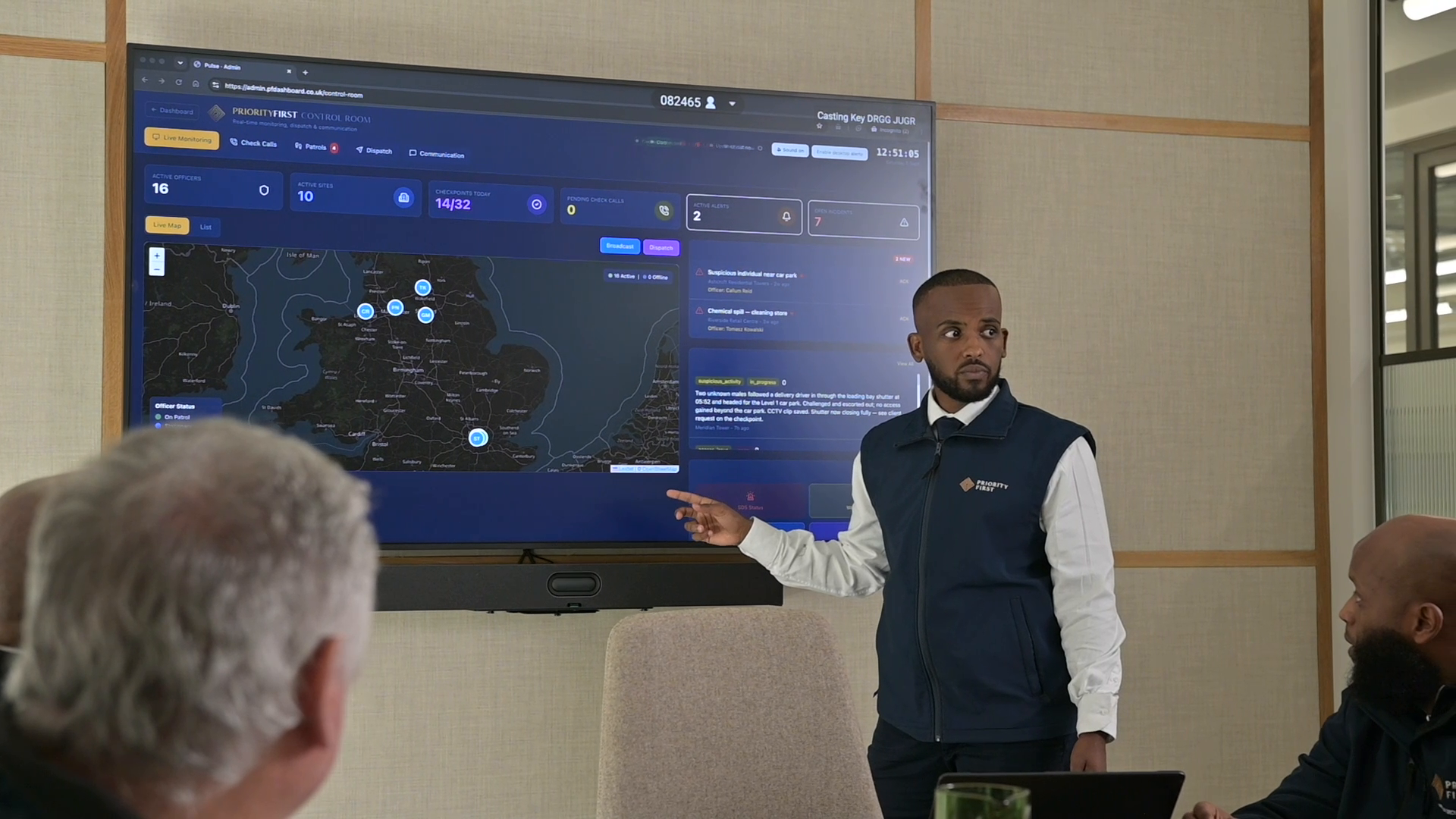
Priority First's operational data shows over 4,900 photo-backed patrols completed across its largest portfolio, every one carrying officer ID, GPS and timestamp. Across a 16-building prime estate, the company records 250 to 280 patrols per building, all photo-backed — cover that was previously unprovable under a paper-based system.
That evidence standard matters most in luxury retail, where a client, insurer or brand head office may ask for proof of exactly when a stockroom was last checked. Priority First currently runs 24 sites on one platform, up from 18 at the previous count, holds 37 documented client contracts on file (28 of them in Chelsea and Knightsbridge), and reports a 5.0-star Google rating from 44 reviews alongside a 100% customer satisfaction rate.
Your luxury retail facilities management checklist
- Confirm every security officer on site holds a current SIA licence under the Private Security Industry Act 2001.
- Commission a documented fire risk assessment under the Regulatory Reform (Fire Safety) Order 2005 and schedule its review date.
- Require photo, GPS and timestamp evidence for every security checkpoint and patrol, not verbal or paper confirmation.
- Bundle security, cleaning, maintenance and key holding under one accountable contract rather than four separate suppliers.
- Set out-of-hours key holding and alarm response terms before an incident occurs, not after.
- Check CCTV monitoring and data retention practices align with UK GDPR and ICO guidance.
- Review delivery and contractor access logs monthly, particularly during any store refit or construction phase.
- Agree a mobilisation timeline with your provider for any new flagship opening, ideally measured in days rather than weeks.
FAQ
What does facilities management involve for luxury retail brands?
Facilities management for luxury retail brands involves security, cleaning, maintenance, compliance and front-of-house services delivered together under one contract. It typically spans SIA-licensed manned guarding, CCTV monitoring, key holding, fire risk assessment compliance and hard services such as HVAC and structural upkeep, all coordinated to protect both the building and the brand's reputation.
How much does facilities management cost for a luxury boutique in London?
Costs vary from roughly £1,500 a month for a basic compliance package to £10,000 or more a month for a 24/7 premium flagship package including full manned guarding and concierge services. Larger mixed-use estates combining retail, residential and construction elements can run into the hundreds of thousands of pounds per year, as seen in a Chelsea and Knightsbridge development costed at circa £280,000 annually.
What are the SIA licensing requirements for security staff in luxury stores?
Every manned security officer deployed to a luxury store must hold a valid Security Industry Authority (SIA) licence under the Private Security Industry Act 2001. Brands and their facilities management provider should verify each officer's licence status before deployment and maintain records confirming this for audit and insurance purposes.
Why is London's New Bond Street the most expensive retail location in the world?
New Bond Street became the world's most expensive retail destination in 2026 after rents rose 22% year-on-year to $2,231 per square foot, overtaking Milan's Via Montenapoleone and New York's Upper Fifth Avenue, according to Cushman & Wakefield. Prime Zone A rents on the street now reach £2,750 per square foot per year.
What fire safety regulations apply to luxury retail premises in London?
Luxury retail premises in London must comply with the Regulatory Reform (Fire Safety) Order 2005, which requires the "responsible person" for a premises to carry out and maintain a documented fire risk assessment. HSE guidance sets out the statutory duties involved, and non-compliance can result in enforcement action against the responsible person, not just the brand.
How do facilities management companies protect brand image in high-end retail?
Facilities management companies protect brand image by catching maintenance faults, cleanliness issues and security gaps before they become visible to customers or press. Documented, photo-verified patrols and rapid alarm response reduce the risk of theft or visible neglect, both of which damage a luxury brand's reputation disproportionately compared with mainstream retail.
What is the difference between hard and soft facilities management services?
Hard facilities management services cover the physical fabric of a building — HVAC, electrical systems, structural maintenance — and accounted for 55.4% of the UK facilities management market in 2026, according to Market Data Forecast. Soft services cover cleaning, security, concierge and front-of-house presentation, which matter disproportionately in luxury retail where customer experience is part of the product.
Which facilities management companies specialise in luxury brands in London?
Several London-based providers focus on prime central London, but specialisation typically shows through documented portfolio experience in areas like Mayfair, Knightsbridge and Chelsea rather than marketing claims alone. Priority First, for example, holds 37 documented client contracts, 28 of them in Chelsea and Knightsbridge, alongside a 5.0-star Google rating from 44 reviews.
Securing your luxury brand's premises with Priority First
Every point in this guide — provable patrols, fast mobilisation, one accountable contract instead of four disconnected suppliers — is what Priority First already runs across prime central London's luxury retail and residential estates. The company's facilities management service sits alongside its manned guarding, CCTV monitoring and key holding teams under a single platform, so a fault or incident logged in a Mayfair boutique or a Knightsbridge residential block is tracked with the same photographed, timestamped evidence standard used across its wider portfolio.
Priority First currently runs 24 sites on one platform and has protected over £1.6 billion in client assets, with new sites — including complex, multi-checkpoint properties — brought live in as little as a fortnight.
If your boutique, flagship or mixed-use development needs facilities management built around discretion, evidence and accountability, get in touch with Priority First's facilities management team for a scoped quote.
Related Reading
- Facilities Management Services London | Priority First 2026
- Facilities Management for Offices London | 2026 Guide
- Commercial Facilities Management London | Priority First

Lauren Dawkins is a co-founder and director of Priority First, the Mayfair-based building management and security company. Lauren works across the company's facilities management and corporate security services for residential, commercial and construction clients in London.
Specialises in Facilities management, Corporate security, Integrated security and FM