Building Management Service for Restaurants | Priority First



Last updated: 27 August 2026
A building management service for restaurants is an outsourced or integrated function that oversees a venue's fabric, equipment, compliance and security under one accountable provider. It matters because 1,275 fires were recorded in England's food and drink premises in 2026/25, and a quarter of businesses hit by a serious fire never reopen, according to UK Fire Risk Assessments.
Key Takeaways
- A building management service for restaurants coordinates maintenance, compliance, energy control and site security under a single provider rather than multiple disconnected contractors.
- Unplanned restaurant maintenance costs 25-30% more than planned maintenance, according to BrandPoint Services (2026).
- 1,275 fires were recorded in food and drink premises across England in 2026/25, and 25% of businesses hit by a serious fire never reopen, per UK Fire Risk Assessments (2026).
- Cooking, refrigeration and lighting account for roughly 68% of a restaurant's total energy costs, according to EnergySense, University of Illinois System (2020).
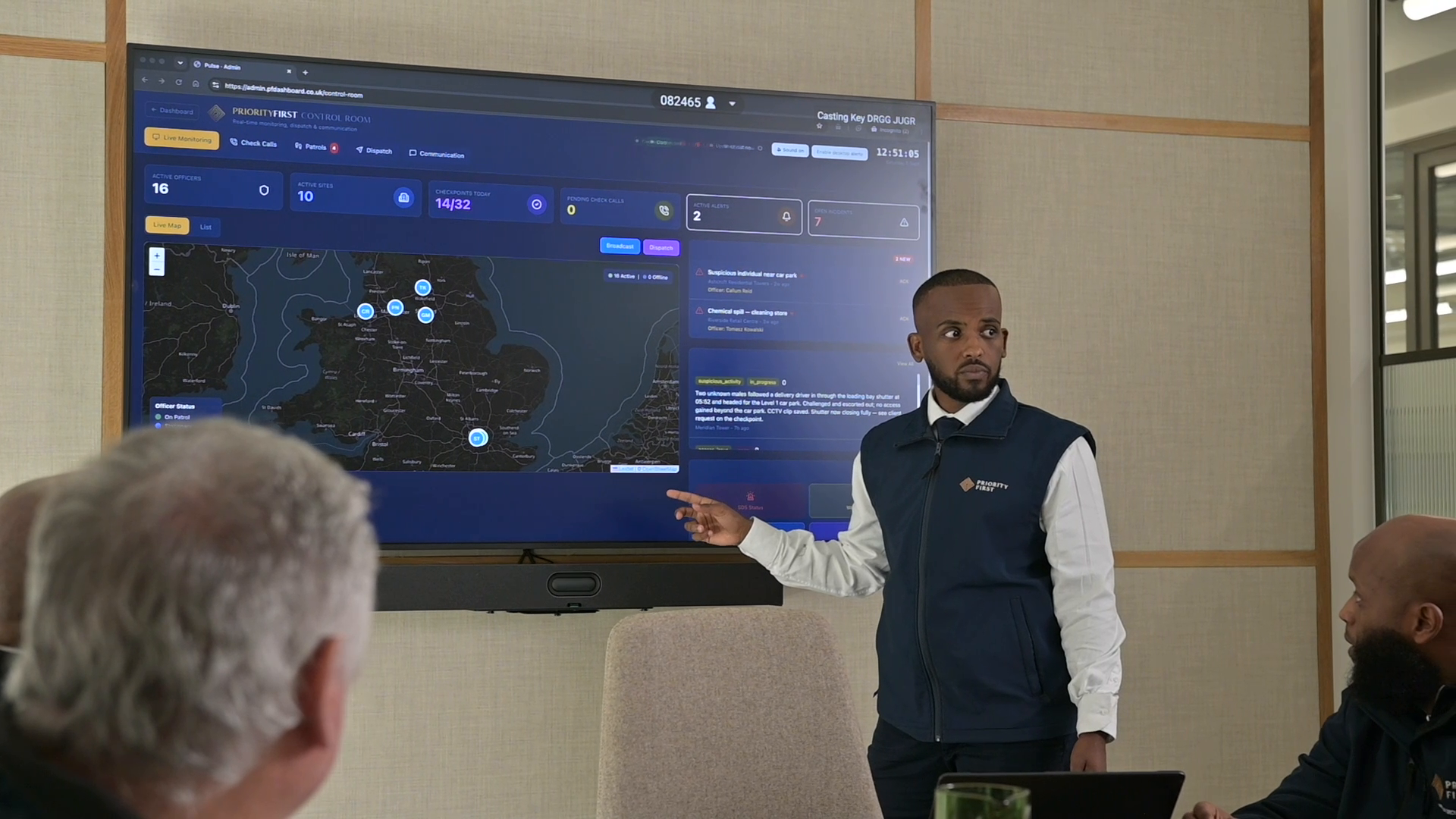
- Priority First operates photo-backed patrols across 24 sites on one platform, giving restaurant and hospitality clients a single accountable record for security and facilities tasks alike.
What is a building management service for restaurants?
A building management service for restaurants is a coordinated facilities function — covering maintenance, compliance, security and energy oversight — delivered by a single provider rather than a fragmented list of separate contractors. It typically bundles hard services (mechanical, electrical, fire and refrigeration systems) with soft services (cleaning, pest control, front-of-house support) and reports everything through one accountable point of contact.
For restaurant operators, this distinction matters commercially as much as operationally. A diner's decision to visit is heavily influenced by reputation: 78% of diners said they're likely to base their choice on a friend's recommendation, according to the Restaurant Success Report cited by CLS Facility Services (2026). A broken extraction fan, a flickering dining room light or a failed walk-in fridge does more than inconvenience staff — it damages the word-of-mouth reputation that drives footfall.
Priority First delivers this model in London and nationwide by combining its Facilities Management service with security operations already running under one platform, so restaurant groups get building upkeep and site protection from a single accountable partner rather than juggling separate suppliers.
Hard services versus soft services in a restaurant context
Hard services cover the physical infrastructure that keeps a kitchen legally operable — extraction systems, gas safety interlocks, refrigeration, HVAC and fire suppression. Soft services cover the day-to-day upkeep that shapes customer perception — cleaning, pest control, waste management and front-of-house presentation. A restaurant building management service typically manages both under one contract, removing the need to coordinate separate specialists for a broken door closer and a failing compressor.
Why does building management matter for restaurant profitability?
Building management directly affects a restaurant's bottom line because equipment failures and reactive repairs cost significantly more than planned upkeep. In the United States, restaurants spend around $28 billion a year on repairs and maintenance, with a further $46 billion lost to downtime, according to Kitchenall (2026). Fryers illustrate the point sharply: 52% of operators said fryers need repair at least once a year, and 47% said nearly half of those fryers are down for at least one day, per Parts Town (2026). Every day a fryer, oven or extraction unit is offline is a day of lost covers, and the maths behind unplanned repairs makes the case for structured maintenance decisive.
Reactive maintenance is expensive by design. Unplanned restaurant maintenance can cost 25-30% more than planned restaurant maintenance, according to BrandPoint Services (2026). This premium reflects emergency call-out charges, expedited parts delivery and the operational disruption of closing a section — or an entire site — at short notice.
A structured building management service replaces this pattern with scheduled servicing, planned parts replacement and a documented maintenance calendar. Restaurant groups running multiple sites benefit particularly, since a single provider can standardise service intervals, contractor vetting and compliance records across every location rather than leaving each site manager to source trades independently.
How does building management reduce fire and safety risk?
Fire risk is one of the most serious operational threats a restaurant faces, and building management services are structured specifically to control it. There were 1,275 fires recorded in food and drink premises across England in the 2026/25 period, and 25% of businesses that experience a serious fire never reopen, according to UK Fire Risk Assessments (2026). Commercial kitchens combine open flame, hot oil, extraction ductwork and high footfall, making them one of the highest-risk categories under UK fire legislation.
The core legal obligation sits with the Regulatory Reform (Fire Safety) Order 2005, which requires every commercial premises — restaurants included — to hold a suitable and sufficient fire risk assessment carried out by a "responsible person," usually the operator or landlord. This duty covers extraction cleaning, fire door maintenance, emergency lighting testing and staff fire training, and enforcement sits with local fire and rescue authorities such as Buckinghamshire Fire & Rescue Service, whose guidance on commercial kitchen fire safety covers equipment maintenance, cleaning regimes and staff training obligations.
A building management service embeds these obligations into a recurring schedule rather than leaving them to memory. Extraction ductwork is cleaned on a set frequency, fire suppression systems in canopies are serviced under manufacturer guidance, and records are kept centrally so a Fire Risk Assessment review or insurer audit can be evidenced instantly.
"An empty building deteriorates faster than most owners expect — squatting, metal theft, water damage nobody reports because nobody is there. Void property protection is about maintaining a visible pulse: inspections, alarm response and evidence the building is watched. The cost of that pulse is small against reinstating a stripped building." — Mo Hassan, Managing Director, Priority First
The same principle of a "visible pulse" applies directly to trading restaurants overnight, when kitchens are unoccupied but extraction systems, refrigeration and gas lines remain live. Priority First's Key Holding & Alarm Response service extends this monitoring beyond trading hours, giving operators a rapid, trained response if an alarm activates when the premises are closed.
How does building management protect a restaurant's compliance rating?
A restaurant's Food Hygiene Rating reflects the state of its premises as much as its kitchen practices, and building management directly influences both. Across 485,459 UK establishments currently holding a numeric Food Hygiene Rating, the average is 4.65 out of 5, with 78.2% holding the top rating of 5, according to Forkto's analysis of Food Standards Agency data (2026). Achieving and maintaining that top band depends heavily on the physical condition of the building — clean surfaces, working refrigeration, pest-free storage and functioning ventilation.
The Food Standards Agency (FSA) administers the Food Hygiene Rating Scheme (FHRS) in England, Wales and Northern Ireland, and inspectors score premises against structural condition, cleanliness and confidence in management as much as food handling itself. The FSA's FHRS Open Data Catalogue publishes these ratings publicly, meaning a poor score is visible to every prospective diner searching online before booking.
A building management service reduces the risk of a downgrade by keeping the fabric of the premises consistently audit-ready. Priority First's Building Audit & Risk Assessments service structures this proactively, identifying wear, damage or compliance gaps before an environmental health officer's routine visit finds them.
Employers also carry a general duty under the Health and Safety at Work etc. Act 1974, enforced by the Health and Safety Executive (HSE), to ensure the health, safety and welfare of staff and visitors — a duty that extends to safe flooring, ventilation and equipment maintenance in commercial kitchens.
How does building management cut restaurant energy costs?
Energy is one of the largest controllable costs in restaurant operations, and building management services target it directly through equipment scheduling and preventive servicing. In the United States, restaurants spend an average of $3.77 per square foot on electricity and $1.57 per square foot on natural gas annually, with 3-5% of total operating costs spent on energy, according to EnergySense, University of Illinois System (2020). Cooking, refrigeration and lighting together represent approximately 68% of total restaurant energy costs, while smart use of kitchen equipment alone can save an estimated 7% of energy consumption, per the same EnergySense research.
These figures come from US data, but the underlying pattern applies equally to UK kitchens, where energy pricing is regulated by Ofgem and commercial tariffs have risen sharply in recent years. A building management provider can schedule refrigeration servicing to maintain compressor efficiency, calibrate HVAC systems to avoid overcooling dining areas, and ensure extraction fans run only when needed rather than continuously.
Planned versus reactive maintenance: a cost comparison
| Approach | Typical characteristics | Cost impact |
|---|---|---|
| Planned (preventive) maintenance | Scheduled servicing, parts replaced before failure, documented compliance records | Lower overall cost; predictable budgeting |
| Reactive (unplanned) maintenance | Emergency call-outs, unplanned closures, expedited parts | Costs 25-30% more than planned maintenance (BrandPoint Services, 2026) |
| In-house facilities team | Direct control, but limited specialist coverage out-of-hours | Higher fixed staffing cost; gaps in emergency response |
| Outsourced building management service | Single accountable provider, 24/7 alarm and key holding response, centralised records | Variable by contract; reduces downtime and compliance risk |
In-house facilities team or outsourced building management: which suits a restaurant?
Restaurant operators generally choose between building an in-house facilities function or outsourcing to a specialist provider, and the right choice depends on site count and risk exposure. A single independent restaurant may manage with an in-house handyman and a handful of trade contacts, but multi-site groups face a coordination problem — every additional site multiplies the number of contractors, contracts and compliance records to track.
Outsourcing to a building management service consolidates this into one accountable relationship. Priority First's own operational data illustrates the scale this can reach: the company runs 24 sites on one platform, with over 4,900 photo-backed patrols completed, each carrying officer ID, GPS and a timestamp. That same platform structure — one system, one accountable record — applies equally to facilities tasks as it does to security patrols, giving restaurant groups a single point of visibility across every site rather than a fragmented paper trail.
A relevant example of this consolidation in practice comes from a commercial site in the West Midlands, where a large distribution facility combined high-value stock, constant vehicle movement and a perimeter too large to secure from a gatehouse alone. Priority First deployed manned security, canine units and facilities management together, with maintenance tasks tracked on the same platform as security checkpoints — giving the client one accountable record for the whole building rather than separate systems for safety and upkeep. The client's director described the experience directly: "I had the pleasure of working with Priority First Security and I have to say, their team is incredibly friendly and helpful... The owner Mo takes pride in his business and is always looking to the future of what's coming to improve the level of service we receive."
The same logic applies to a multi-site restaurant group weighing up whether to add a second in-house maintenance hire or bring in a single external provider who already manages security, key holding and facilities under one contract.
Your building management service for restaurants checklist
- Confirm your fire risk assessment is current under the Regulatory Reform (Fire Safety) Order 2005.
- Schedule extraction ductwork cleaning at a frequency matched to cooking volume, not a fixed annual date.
- Set preventive servicing intervals for fryers, refrigeration and HVAC before failure rates climb.
- Keep a single, centralised maintenance and compliance record accessible ahead of any environmental health or fire authority inspection.
- Arrange 24/7 key holding and alarm response for out-of-hours incidents involving live gas, refrigeration or electrical systems.
- Review energy usage patterns for cooking, refrigeration and lighting, which together drive roughly 68% of total energy costs.
- Audit the building's physical condition regularly ahead of your Food Hygiene Rating inspection, not only after a low score.
- Decide whether an in-house team or a single outsourced provider better matches your number of sites and risk exposure.
FAQ
What is a building management service for restaurants?
A building management service for restaurants is a coordinated facilities function covering maintenance, compliance, security and energy oversight, delivered by one accountable provider. It typically combines hard services like refrigeration and extraction maintenance with soft services like cleaning and pest control, replacing multiple disconnected contractors with a single point of contact.
What does a facilities management company do for restaurants?
A facilities management company handles the physical upkeep and compliance of a restaurant building, including equipment servicing, fire safety maintenance, cleaning coordination and site audits. Priority First delivers this alongside security, key holding and CCTV monitoring, giving restaurant clients one accountable partner for both building condition and site protection.
How much does restaurant facilities management cost?
Costs vary significantly by site size, equipment age and whether services are bundled with security or contracted separately, so there is no single UK-wide figure. Operators should compare planned maintenance costs against the 25-30% premium that unplanned, reactive maintenance carries, according to BrandPoint Services (2026), when budgeting for a contract.
What is included in restaurant preventive maintenance?
Restaurant preventive maintenance typically includes scheduled servicing of fryers, refrigeration units, extraction systems, HVAC and gas safety interlocks before they fail. Parts Town research found 52% of operators reported fryers needing repair at least once a year, with 47% reporting significant downtime when they failed, underlining why scheduled servicing matters (Parts Town, 2026).
Why is facilities management important for restaurants?
Facilities management is important for restaurants because equipment failures, fire incidents and compliance gaps directly threaten trading continuity and reputation. With 1,275 fires recorded in England's food and drink premises in 2026/25 and 25% of businesses hit by a serious fire never reopening, structured building management directly reduces existential risk (UK Fire Risk Assessments, 2026).
What are the fire safety requirements for commercial kitchens in the UK?
UK commercial kitchens must comply with the Regulatory Reform (Fire Safety) Order 2005, which requires a suitable and sufficient fire risk assessment carried out by a responsible person. This covers extraction cleaning, fire suppression servicing, emergency lighting testing and staff fire training, with enforcement carried out by local fire and rescue authorities.
How does building management affect a restaurant's food hygiene rating?
Building condition directly affects Food Hygiene Rating scores, since inspectors assess structural condition and cleanliness alongside food handling practices. Across 485,459 UK establishments with a numeric rating, the average currently stands at 4.65 out of 5, with 78.2% achieving the top score of 5, according to Forkto's analysis of FSA data (2026).
Securing and maintaining your restaurant with Priority First
Every risk this article covers — fire safety gaps, equipment downtime, out-of-hours incidents and compliance shortfalls — stems from the same root problem: fragmented oversight across a building nobody watches consistently. Priority First addresses this by combining Facilities Management with security operations on a single accountable platform, so a restaurant's maintenance schedule, compliance records and overnight protection sit in one place rather than scattered across separate suppliers.
Priority First's own operational standard makes this concrete: every site the company manages runs on a platform where checkpoints require a photograph to complete, and missed areas show as gaps in the record rather than passing silently — the same evidential discipline that applies to facilities tasks tracked alongside security on multi-service contracts like the West Midlands distribution site described above.
If your restaurant group is weighing up in-house maintenance against a single accountable provider, get in touch with Priority First for a conversation about how integrated building management and security could work across your sites.
Related Reading
- Facilities Management Services London | Priority First 2026
- Hard Facilities Management Services: Complete 2026 Guide
- Facilities Management Services Knightsbridge | Priority First

Lauren Dawkins is a co-founder and director of Priority First, the Mayfair-based building management and security company. Lauren works across the company's facilities management and corporate security services for residential, commercial and construction clients in London.
Specialises in Facilities management, Corporate security, Integrated security and FM