10 Key Duties of a Residential Security Officer for Construction Sites


Last updated: 7 September 2026
Quick Answer
A residential security officer for construction sites handles ten core duties: patrols, access control, CCTV surveillance, emergency response, resident protection, incident reporting, training and certification, communication and conflict resolution, and legal compliance. Construction theft costs UK businesses over £1m a week, and Priority First has secured over £1.6bn in client assets while maintaining a 100% customer satisfaction rate.
Key Takeaways
- Construction theft costs UK businesses over £1m a week, making on-site security a financial as well as safety priority.
- Priority First has secured over £1.6bn in client assets and holds a 5.0-star rating from 44 Google reviews.
- Priority First deployed an SIA-licensed officer to a Covent Garden break-in within 2 hours of the first call — quote agreed on the call at 12:30, officer on site by 14:30.
- A residential security officer's ten core duties span patrols, access control, surveillance, emergency response, reporting, training, communication and legal compliance.
- Priority First delivers manned security, keyholding, alarmed response, CCTV monitoring and construction site security across prime central London, West London, the West Midlands and Bedfordshire.
Introduction
The safety of residential areas and construction sites increasingly depends on the vigilant presence of trained security personnel, particularly where building works raise the risk of theft, trespass and site accidents. Construction theft costs UK businesses over £1m a week, a figure that underscores security as a core operational function rather than an optional extra — one that directly affects a project's finances, timeline and reputation.
Neglecting site security can lead to real consequences: stolen plant and materials, delayed handovers, and reputational damage with clients and neighbours. The lesson for developers, managing agents and residents' associations is the same: security needs planning and budget from day one, not as an afterthought once losses have already occurred.
Priority First is a London-based security and facilities management company that secures construction sites, commercial buildings and premium residential properties across prime central London, West London, the West Midlands and Bedfordshire. Priority First has secured over £1.6bn in client assets and holds a 100% customer satisfaction rate, positioning the company as a practical option for developers and property managers needing accountable, provable site security. Investing in security measures early, before an incident occurs, is consistently cheaper than dealing with the aftermath of theft or damage.
What Is a Residential Security Officer?
A residential security officer is an SIA-licensed individual — holding a licence issued under the Private Security Industry Act 2001, the legislation that regulates the UK's private security industry — who protects residential and mixed-use construction sites, occupied buildings and their occupants through patrols, access control, surveillance and incident response. The role differs from general manned guarding in its focus on communities: officers are expected to be visible, approachable points of contact for residents as well as a deterrent to intruders and thieves.
On construction sites specifically, a residential security officer typically covers the perimeter, plant and materials compound, and any occupied or part-occupied blocks nearby. Every officer supplied by Priority First is individually SIA-licensed, which is a legal requirement for security operatives working in the UK, and duties are usually set out in a site-specific assignment instruction agreed with the client before deployment.
Priority First Security Services: Tailored Residential Security Solutions
Priority First provides residential and construction site security tailored to the physical layout, occupancy status and risk profile of each property, rather than a single standard package. The company's approach combines trained, SIA-licensed personnel with monitoring technology, built around five core principles: loyalty, adaptability, discretion, professionalism and a client-focused perspective.
A dedicated on-site security presence is widely understood within the industry to deter opportunistic criminal activity, and effective residential and construction site protection generally rests on three foundations: physical measures (patrols, fencing, lighting), technical safeguards (CCTV, alarms, access control) and intelligence (visitor logs, incident history, risk assessments). This layered approach protects both the physical site and the ability of residents or contractors to go about their day without disruption.
Technology plays an increasing role in this layered model. Surveillance systems, including CCTV monitoring, help officers detect and respond to unusual activity faster than patrols alone. Combining trained personnel with this kind of monitoring — the kind of setup described in Priority First's manned guarding services — allows a security team to react to incidents quickly rather than simply record them after the fact. Through customised protection solutions, Priority First aims to secure both the physical site and the peace of mind of residents living nearby.
Property Patrols: How Do Regular Rounds Improve Site Safety?
Regular property patrols are a residential security officer's most visible duty: consistent rounds of the site and its perimeter that deter criminal activity and let officers spot and respond to problems before they escalate. The visible presence of a uniformed officer on a construction site or residential estate is widely regarded within the security industry as a meaningful deterrent to opportunistic intruders, simply because it increases the perceived risk of being seen or caught.
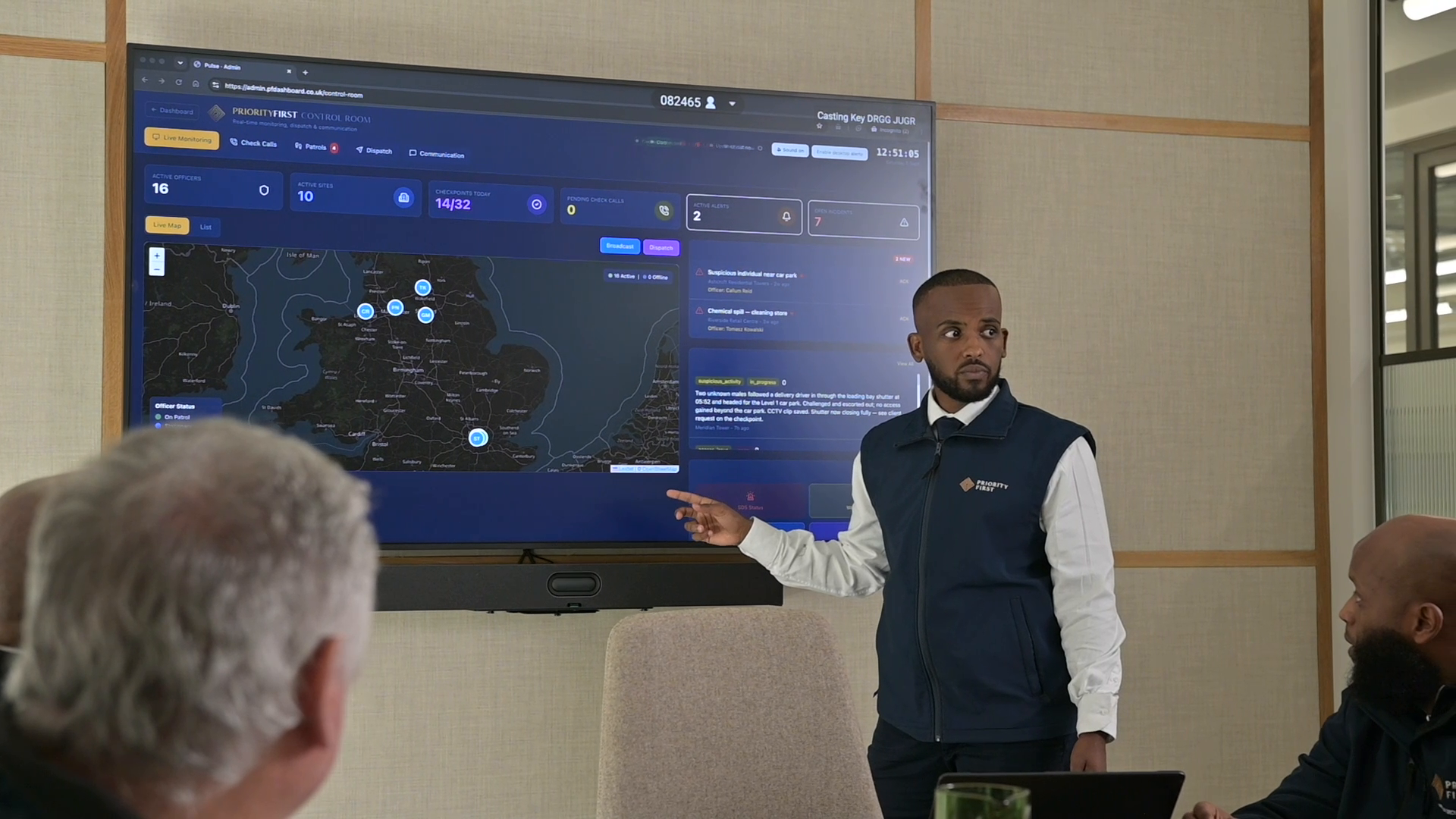
A documented patrol record matters as much as the patrol itself. Priority First's evidence standard requires every checkpoint to be completed with a photo — missed areas show up as gaps in the record rather than passing silently. Across Priority First's largest portfolio, the company has completed more than 4,900 photo-backed patrols, each carrying officer ID, GPS location and a timestamp, and on one 16-building prime London estate, officers complete 250–280 patrols per building, all photo-backed, in checks that were previously unprovable to the client.
Given that construction theft costs UK businesses over £1m a week, a patrol record that can prove exactly where and when an officer checked a site is a meaningful safeguard, not just a paperwork exercise. It gives property owners and insurers verifiable evidence rather than a verbal assurance that "the site was checked."
Access Control: Managing Entry and Exit for Enhanced Security
Access control is the process by which a residential security officer verifies who is entering and leaving a site, restricting entry to authorised contractors, residents and visitors only. On a construction site this typically means signing in delivery drivers and trades, checking identification against a pre-approved list, and logging arrival and departure times; on an occupied residential building it extends to visitor management and parcel or delivery handling.
Electronic access systems — keycard entry, fobs and biometric scanners — are increasingly used alongside manual checks because they generate a timestamped record of who accessed a site and when, which supports both security monitoring and post-incident investigation. Priority First applies the same evidence-first standard to logistics as it does to patrols: 100% of deliveries are now photographed and signed out, replacing paper logs that were harder to audit or produce as evidence after the fact.
Good practice for entry and exit points includes regularly reviewing access control systems and permissions, keeping personnel current on the technology in use, and making sure entry points are properly lit and monitored, particularly during evening deliveries or shift changes common on active construction sites. A proactive approach to access management, paired with discretion around resident and client information, reduces the risk of unauthorised entry without adding unnecessary friction for legitimate visitors. Readers weighing up providers more broadly may find it useful to compare options in this guide to security guard services in the UK.
Surveillance Monitoring: Keeping a Watchful Eye on the Premises
CCTV (closed-circuit television) monitoring gives a residential security officer continuous visibility over a site, allowing suspicious activity to be identified and acted on faster than patrols alone can manage. On a construction site, cameras typically cover the perimeter, compound and any high-value plant or materials storage; on a residential building, coverage usually extends to entrances, communal areas and delivery points.
Real-time monitoring is what separates modern CCTV from a passive recording system: officers receive alerts as an event happens and can access live feeds remotely, meaning a response can begin before an intruder has left the site. As of 2026, ongoing developments in analytics-assisted monitoring continue to improve how quickly unusual activity is flagged to a control room or an officer on the ground, though the fundamentals — clear coverage of vulnerable areas, reliable recording and a monitored response — remain the core of an effective system.
Well-specified CCTV on a residential or construction site should offer clear image quality and cover blind spots that patrols alone might miss, supporting both crime detection and any neighbourhood watch arrangements already in place locally. Paired with photo-backed patrol evidence, CCTV gives property owners two independent sources of proof about what happened and when.
Emergency Response: Acting Swiftly in Crisis Situations
Emergency response is a residential security officer's ability to act immediately and correctly when a medical incident, fire, break-in or other crisis occurs on site. Training typically covers first aid, evacuation procedures and liaison with the emergency services, so that an officer's first actions — assessing the situation, calling for help, and directing people to safety — happen without delay.
Priority First's own emergency deployment record illustrates how quickly a response can be organised when required: after a break-in at a Covent Garden site was reported overnight, the client called at 12:30, a quote was agreed on the same call, and an SIA-licensed operative was on site by 14:30 — a two-hour turnaround from first contact to a deployed officer. That kind of speed depends on having established emergency protocols and a bench of inducted, available officers rather than starting from scratch once a call comes in.
Good practice for managing a crisis on a residential or construction site includes maintaining clear communication channels between officers, site management and emergency services; running regular emergency drills; and making sure every officer knows the site's evacuation routes and emergency protocols before an incident happens, not during one. Preparedness of this kind is what reduces panic and confusion when a genuine emergency does occur, and it is one reason ongoing training features so heavily in how security providers structure their officer development.
Protection of Residents: Prioritising Safety and Well-Being
Protecting residents is a residential security officer's core duty on any occupied or part-occupied site: officers are trained to be approachable, responsive to community concerns, and visibly present in a way that reassures the people living there. On a construction site adjacent to occupied homes, this also means managing noise, dust and access disruption in a way that keeps residents informed rather than simply enforcing rules on them.
A uniformed officer who is a consistent, recognisable presence tends to build a level of trust with residents that goes beyond simple deterrence — people are more likely to report concerns, ask questions, or flag suspicious activity to someone they recognise. This is one reason Priority First pairs manned guarding with services like keyholding, alarm response and CCTV monitoring: a resident's sense of safety comes from a combination of visible presence and a provable, responsive system behind it.
The commercial case for resident protection is straightforward: buildings and developments with a well-managed security presence are generally more attractive to prospective residents and buyers, who prefer to invest in areas perceived as safe. Priority First's documented client base includes 37 contracts on file, 28 of them in Chelsea and Knightsbridge, reflecting sustained demand for this kind of residential security in prime central London.
Report Writing: Documenting Incidents for Accountability
Report writing is the process by which a residential security officer records incidents, observations and actions taken during a shift, creating a factual record that supports accountability, legal defence and future risk assessment. A good incident report answers who, what, where, when and what action was taken — vague or missing detail undermines its value if the report is ever needed as evidence.
Without accurate, contemporaneous records, a site operator or managing agent can struggle to defend a legal claim, identify a pattern of repeated incidents, or demonstrate to an insurer that the site was properly managed. This is the same principle behind Priority First's photo-backed checkpoint standard: on one mixed-use development, the company moved from zero photographed checkpoints to 152, with 100% of checkpoint completions now carrying a watermarked photo, precisely because a verbal assurance that "everything was fine" is not the same as a recorded, timestamped fact.
Meticulous documentation is not simply a compliance exercise; it is what allows a client to see, after the event, exactly what happened and when — which is what report writing and photo-backed patrol evidence are both trying to achieve.
Training and Certification: Equipping Officers for Success
Training and certification are what qualify a residential security officer to work legally and competently in the UK, starting with the SIA licence required under the Private Security Industry Act 2001 and extending into ongoing skills development in emergency response, conflict resolution and site-specific procedures. Certification validates an officer's competence and gives clients a baseline assurance of what an officer is trained to handle.
Ongoing professional development matters because site conditions, technology and risks change: an officer trained on a quiet residential estate needs different day-to-day skills from one covering an active construction site with heavy vehicle movements and multiple contractors on site. Priority First inducts officers specifically for the sites they cover — seven officers were inducted to cover a single prime London site, for example — reflecting the principle that generic training is not the same as site-specific readiness.
Skipping ongoing training carries real financial, operational and reputational risk: an under-prepared officer is less able to prevent an incident, respond correctly when one occurs, or produce the kind of evidence a client needs afterwards. Investing in training before problems arise remains cheaper than dealing with the consequences of an officer who was not ready.
Communication and Conflict Resolution: Managing Interactions Effectively
Communication and conflict resolution are core skills for a residential security officer, who is often the first point of contact for residents, visitors and contractors and must be able to de-escalate tension before it becomes a formal incident. Active listening — genuinely understanding a resident's or visitor's concern before responding — and empathy are the two techniques most consistently associated with successful de-escalation in security and customer-facing roles.
Clear communication also means being able to explain site rules, access procedures or safety requirements in plain language that a resident or delivery driver can immediately understand, reducing the friction that leads to disputes in the first place. At Priority First, the concierge and front-of-house team combine customer service training with the safety protocols expected of a residential security officer, allowing the same person to manage access control and deliver a good resident experience rather than treating the two as separate functions. Readers assessing wider provider options may also find Priority First's manned guarding guide for central London useful for comparing service scope.
Security is not simply a cost line in this context — a well-handled interaction protects the client relationship as much as it protects the site itself.
Legal Responsibilities: Ensuring Compliance and Accountability
Legal compliance requires a residential security officer to understand the laws that govern their conduct, including the powers they do and do not have, and the rights of the people they interact with on site. The core legal framework in the UK is the Private Security Industry Act 2001, which established the Security Industry Authority (SIA) as the regulator responsible for licensing individual security operatives.
Without a solid grasp of these responsibilities, an officer risks acting outside their authority — for example, in how they handle a suspected trespasser or a dispute with a resident — which can expose both the officer and the client to legal and reputational risk. Regular training on legal updates, thorough documentation of every incident, and strict adherence to protocols that respect residents' rights are the practical measures that keep a site compliant.
Investing in legal training is not simply about ticking a compliance box: it is what allows an officer to act correctly and confidently in a genuinely difficult situation, protecting themselves, the client and the residents or contractors they are responsible for.
Your Residential Security Officer Checklist
Use this checklist when briefing or auditing security cover for a residential or construction site:
- Confirm every officer holds a current SIA licence under the Private Security Industry Act 2001 before deployment.
- Agree a patrol schedule and require photo-backed evidence (officer ID, GPS, timestamp) for every checkpoint.
- Set out access control procedures in writing, including ID checks, visitor logs and delivery sign-out.
- Specify CCTV coverage of the perimeter, compound, entrances and any high-value storage areas.
- Establish emergency response protocols, including evacuation routes and direct liaison contacts for the emergency services.
- Require incident reports for every notable event, with who, what, where, when and action taken.
- Check that officers receive site-specific induction, not just generic SIA training, before starting a shift.
- Review legal and compliance training records periodically, alongside patrol and incident data.
Conclusion
The role of a residential security officer extends well beyond simple surveillance, encompassing patrols, access control, surveillance monitoring, emergency response, resident protection, report writing, training, communication and legal compliance. Each duty works alongside the others: a patrol without a documented record is hard to prove, and access control without trained personnel behind it is only as strong as the person checking the gate.
Given that construction theft costs UK businesses over £1m a week, treating site security as a planned, budgeted function — rather than a reaction to a loss that has already happened — remains the more defensible position for developers, managing agents and residents' associations alike. Engaging a provider that can demonstrate its work with verifiable, photo-backed evidence, rather than assurances alone, gives property owners a stronger basis for decisions on both risk and cost.
Get Provable Security Cover From Priority First
Construction sites and residential developments in prime central London face a specific version of the security problem this article has covered: contractors, deliveries and residents all moving through the same site, with real financial exposure if theft or an incident goes unmanaged. Priority First addresses this by combining SIA-licensed manned guarding, keyholding, alarm response, CCTV monitoring and construction site security under one accountable provider, rather than splitting patrols, access control and monitoring across separate suppliers.
As a concrete example of how quickly Priority First can respond when something goes wrong: after a Covent Garden site was broken into overnight, the client's call at 12:30 led to a quote agreed on the same call and an SIA-licensed operative on site by 14:30 — a two-hour turnaround from first contact to deployment.
If you manage a construction site or residential development and want security cover that produces a provable record rather than a verbal assurance, get in touch with Priority First for a quote tailored to your site.
Frequently Asked Questions
What services does Priority First provide for residential and construction site security?
Priority First provides tailored security combining SIA-licensed manned guarding, keyholding, alarm response, CCTV monitoring and construction site security. The company's approach integrates trained personnel with monitoring technology, built on five principles: loyalty, adaptability, discretion, professionalism and a client-focused perspective.
What core principles guide Priority First's approach to residential security?
Priority First's approach rests on five core principles: loyalty, adaptability, discretion, professionalism and a client-focused perspective. These principles shape how officers are trained and how sites are covered day to day.
How does having a dedicated security team affect residential safety?
A dedicated, visible security team is widely regarded as a deterrent to criminal activity on residential and construction sites, since a consistent officer presence increases the perceived risk of being seen or caught. It also gives residents a recognisable point of contact for concerns.
What are the foundational pillars of effective residential security?
Effective residential and construction site security rests on three foundations: physical measures (patrols, fencing, lighting), technical safeguards (CCTV, alarms, access control) and intelligence (visitor logs, incident history, risk data). No single element is sufficient on its own.
How does technology support residential and construction site security?
Surveillance technology, including CCTV monitoring and photo-backed patrol systems, improves an officer's ability to detect and respond to incidents quickly rather than only recording them after the fact. Priority First applies a photo-backed evidence standard to both patrols and deliveries across its sites.
What do residential security officers do during regular property patrols?
Officers conduct consistent rounds of the site to deter criminal activity and identify problems before they escalate, ideally with photo-backed evidence of each checkpoint. Priority First has completed over 4,900 photo-backed patrols across its largest portfolio, each with officer ID, GPS and a timestamp.
What are a residential security officer's responsibilities around access control?
Access control responsibilities include verifying identification, maintaining visitor and delivery logs, and operating electronic access systems where installed. Priority First now photographs and signs out 100% of deliveries on the sites it covers, replacing paper logs.
How do electronic access systems improve residential site security?
Electronic access systems such as keycard entry and biometric scanners create a timestamped record of who enters and exits a site, supporting both day-to-day monitoring and any post-incident investigation. They work alongside, not instead of, a trained officer checking access in person.
What practices improve the effectiveness of access control on a site?
Regularly reviewing access control systems and permissions, keeping personnel current on the technology in use, and ensuring entry points are properly lit and monitored all improve access control effectiveness. These checks matter particularly around shift changes and evening deliveries on active construction sites.