Commercial Building Concierge Services: What's Included (2026)


Last updated: 22 August 2026
A commercial building concierge service should include front-of-house reception, visitor and access management, security integration, parcel and mail handling, tenant liaison, emergency response protocols and reporting technology. Properties combining concierge duties with SIA-licensed security see nearly 60% fewer unauthorised access incidents than sites relying on traditional security measures alone, according to New England Security (2026).
Key Takeaways
- A well-specified commercial concierge service combines reception, visitor management, security liaison and emergency response under one accountable role.
- Properties using integrated concierge security approaches experience nearly 60% fewer unauthorised access incidents than those relying solely on traditional security, per New England Security (2026).
- More than 80% of office landlords report an uptick in lease renewals as enhanced tenant experience becomes standard practice, according to the 2026 VTS Global Landlord Report.
- Priority First's own operational data shows 4,900+ photo-backed patrols completed across its largest portfolio, each timestamped with officer ID and GPS.
- Roughly 35-45% of commercial properties still rely on paper visitor logs that give no real-time host notification or auditable trail, per FacilityOS / iFactory (2026).
What Is a Commercial Building Concierge Service?
A commercial building concierge service is a front-of-house function that manages the human and operational touchpoints of a building — greeting visitors, controlling access, coordinating deliveries and liaising with tenants — while working alongside security teams to protect the premises. It sits at the intersection of hospitality and protection, distinct from a receptionist role because it typically carries wider responsibility for building security, incident escalation and out-of-hours cover.
In prime central London, where commercial and residential buildings sit cheek by jowl in areas like Mayfair, Chelsea and Knightsbridge, concierge staff are often the first and most consistent point of contact for tenants, landlords and visitors alike. A concierge does more than answer a phone or sign for a parcel — the role increasingly demands trained judgement about who should and shouldn't be granted access.
Corporate concierge services account for 35% of the global concierge market revenue, driven largely by corporate travel arrangements and employee benefit schemes, according to the WorldMetrics.org Concierge Industry Statistics Report (2026). The same report notes the U.S. concierge services market was valued at $4.2 billion in 2021, with growth expected at a compound annual rate of 7.1% through 2026 — a trajectory reflected in the UK's own commercial property sector as landlords compete on tenant experience.
What Core Duties Should Be Included in a Concierge Specification?
A commercial concierge specification should include reception and greeting, visitor sign-in and verification, access control liaison, mail and parcel handling, tenant communication, and basic emergency response duties, all delivered to a documented service standard. These duties form the operational backbone of the role, and each should be written into the service level agreement (SLA) rather than left to informal practice.
Without a clear specification, buildings risk inconsistent cover, gaps in accountability, and disputes over what "concierge" was actually meant to deliver.
Reception and Visitor Management
Every concierge specification should define how visitors are greeted, logged and verified before entry.
Industry research indicates 35-45% of commercial properties still rely on paper visitor logs that provide no real-time host notification, identity verification, or auditable trail, according to FacilityOS / iFactory (2026). A modern specification should replace this with digital sign-in, photo ID capture where appropriate, and automatic host notification — closing the gap that paper logs leave open.
Mail, Parcels and Deliveries
Deliveries are a routine but high-risk touchpoint, since unmanaged parcel handling creates both theft exposure and liability disputes over missing items.
Priority First's operational data across managed sites shows 100% of deliveries photographed and signed out, replacing a paper log entirely. This standard means every parcel movement carries a timestamped, photographed record — removing ambiguity when a tenant queries a missing delivery.
Tenant and Building Liaison
A concierge specification should also cover day-to-day liaison between tenants, building management and contractors, including logging maintenance requests and escalating repeat issues.
This liaison function works best when it's tied to the same platform used for security reporting, so a recurring fault — a broken door closer, a faulty intercom — surfaces as a pattern rather than a one-off complaint each time.
How Does Concierge Integrate With Building Security?
Concierge and security integration means the same front-of-house team handles hospitality duties and physical access control together, rather than operating as two separate, uncoordinated functions. This integration matters because a concierge desk that isn't security-aware becomes a soft point in an otherwise well-protected building.
Properties using this integrated model see nearly 60% fewer unauthorised access incidents compared to sites using traditional security measures alone, according to New England Security (2026). The logic is straightforward: a concierge trained in access control procedures catches tailgating, unregistered visitors and social engineering attempts that a purely administrative receptionist would miss.
78% of corporate concierge clients are employees with job levels from mid-management to C-suite, according to a 2023 Gartner survey cited by WorldMetrics.org (2023). This matters for security specification, because senior staff and visiting executives often require discreet handling — verification and access control that doesn't feel like an obstacle course, but still holds the line.
"A concierge is the first impression your building makes, every single day. Anyone can check a visitor list. The standard we hold is that residents and guests are greeted by name, problems are owned rather than reported upwards, and security is done so smoothly it reads as service." — Mo Hassan, Managing Director, Priority First
Priority First's approach reflects this directly. Every checkpoint on a managed patrol requires a photograph to complete, so a missed area shows up as a gap in the record rather than passing silently — the same evidential discipline that should underpin any concierge-security specification.
SIA Licensing and Legal Requirements
Security-facing concierge staff who carry out manned guarding duties, such as patrolling or responding to incidents, generally require an SIA licence — a badge issued under the Private Security Industry Act 2001 by the Security Industry Authority (SIA), the statutory regulator for the UK's private security sector. Employers must also comply with the Health and Safety at Work etc. Act 1974, which sets the baseline duty of care for staff and visitors on any commercial premises.
Buildings should confirm whether their front-of-house provider licenses staff appropriately for the duties assigned, since a concierge purely handling reception may not need an SIA badge, but one carrying out access control enforcement or responding to alarms typically will.
What Technology Should a Modern Concierge Service Use?
A modern concierge service should use a visitor management system, integrated CCTV monitoring, digital access control, and a reporting platform that logs incidents, deliveries and maintenance requests in one place. Technology closes the gap that manual, paper-based processes leave open, and it gives building owners a verifiable record rather than a verbal assurance.
| Technology | Purpose | Typical benefit |
|---|---|---|
| Visitor management system | Digital sign-in, ID capture, host alerts | Replaces paper logs lacking an auditable trail |
| CCTV monitoring | Round-the-clock remote surveillance | Escalation support and evidential footage |
| Access control integration | Fob, keycard or biometric entry linked to concierge desk | Reduces tailgating and unauthorised access |
| Incident/patrol reporting platform | Photo, GPS and timestamp on each checkpoint | Converts patrols into provable, auditable events |
| Key holding and alarm response | 24/7 keyholder attends triggered alarms | Removes reliance on tenant or landlord attendance |
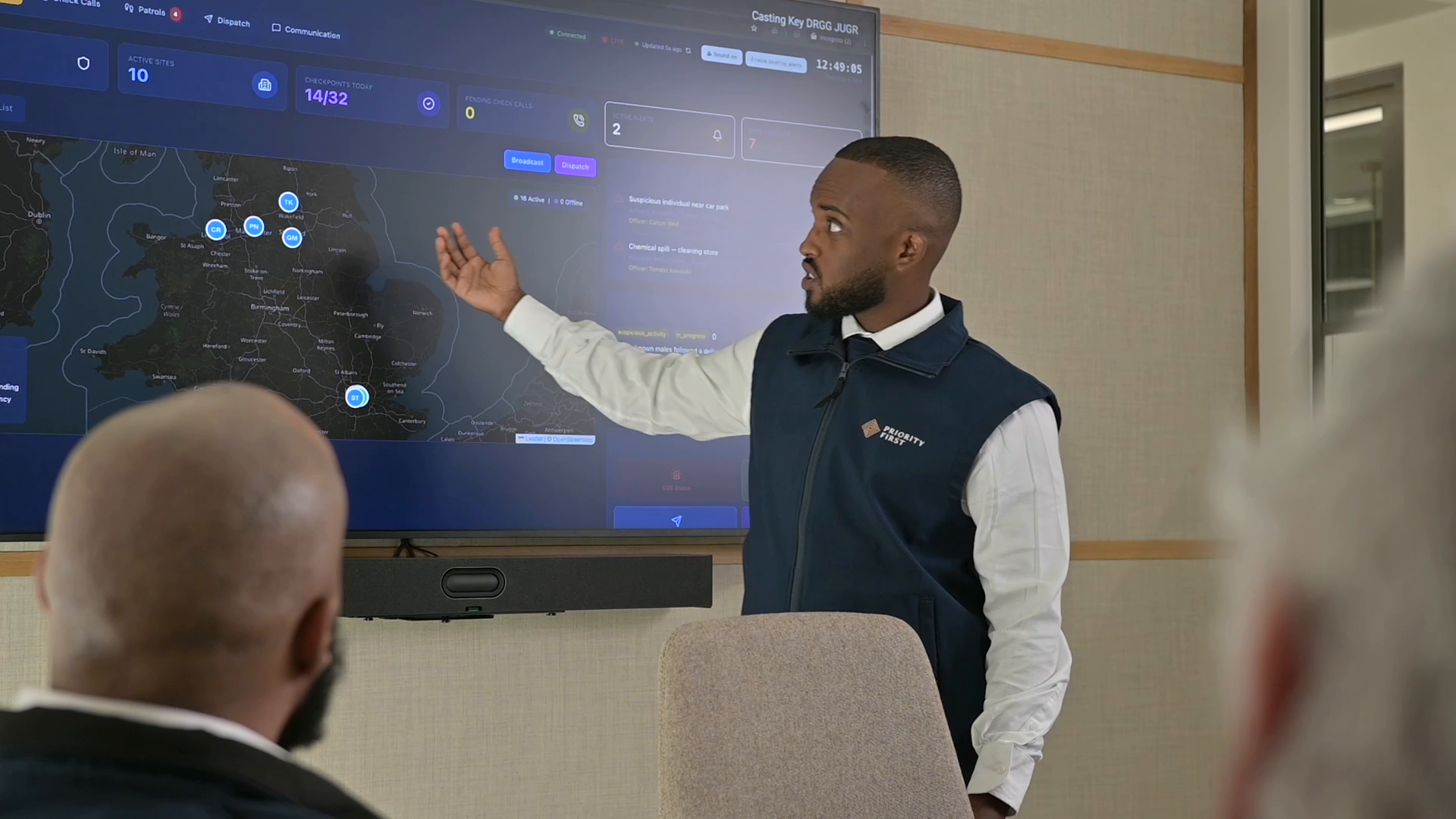
Priority First runs this kind of platform across its portfolio, with 24 sites now managed on one system, up from 18 at the previous count. Across those sites, 4,900+ photo-backed patrols have been completed, each carrying officer ID, GPS and a timestamp — turning "the concierge did their rounds" into a record a client can actually check.
In Practice: A 16-Building Prime Estate
A prestige residential estate in central London — spanning mansion blocks, retail-residential parades and a private courtyard, 16 buildings in total — faced a familiar problem: one paper logbook per building meant patrols quietly went missing, with no way to compare buildings or verify delivered cover without ringing the office.
The estate asked a direct question: can you prove every building gets its patrols, every night? Priority First set each building up as its own site with its own checkpoints, producing a per-building evidence trail rather than one vague "round complete" note.
Live since March 2026, the estate has recorded 4,100+ patrols completed, running at 250-280 patrols per building — all photo-backed, a standard that was previously unprovable. Checkpoint completions carrying a watermarked photo moved from 0% to 100%, and repeat problems now surface automatically as recurring findings, so a failing door gets fixed once, properly.
Should Concierge and Security Be One Role or Two?
Combining concierge and security into a single trained role suits most commercial and mixed-use buildings, while separating them may still suit very large sites with distinct front-of-house and perimeter security needs. The right answer depends on building type, footfall, and the risk profile of the site.
| Model | Best suited to | Trade-off |
|---|---|---|
| Combined concierge-security role | Offices, mixed-use, mid-size residential | One accountable point of contact; requires SIA-licensed, dual-trained staff |
| Separate concierge and security teams | Large campuses, high-footfall retail, industrial sites | Clearer specialisation; more handover points and potential communication gaps |
| Concierge with security liaison only | Small offices, low-risk single-tenant buildings | Lower cost; relies on external security response for incidents |
A distribution facility in the West Midlands illustrates the separate-team model well: high-value stock, constant vehicle movement and a perimeter too large to secure from a gatehouse alone meant Priority First deployed SIA-licensed officers alongside canine units across the full perimeter, with facilities and maintenance tasks tracked on the same platform as security — one accountable record for the whole building, even where concierge and perimeter security are distinct functions.
For most commercial office buildings, though, the combined model is more cost-effective and delivers better continuity, since the same trained individual handles both the welcome and the watch.
What Does a Commercial Concierge Service Cost in the UK?
Commercial concierge costs in the UK vary by coverage hours, staffing levels and whether security duties are integrated, with most buildings paying for either single-shift daytime cover or full 24/7 rotation. Pricing should always be transparent about what's included — hours, headcount, technology and reporting — rather than a single opaque day rate.
- Daytime-only cover (one concierge, typical office hours): suits low-footfall offices with limited out-of-hours risk.
- Extended cover (two shifts, early morning to evening): suits mixed-use buildings with retail or residential elements.
- 24/7 rotation (three or four shifts, SIA-licensed where security duties apply): suits high-value commercial assets, prime residential estates and buildings with constant visitor traffic.
"When a quote is dramatically cheaper than the rest, the saving has come from somewhere — usually the officer's pay, their training, or the vetting behind them. Tired, underpaid officers on your site are a risk you have paid to acquire. Value in this industry means knowing exactly what your money buys." — Mo Hassan, Managing Director, Priority First
Ways to Manage Concierge Costs Without Cutting Corners
Buildings can reduce concierge costs sensibly by right-sizing coverage hours to actual footfall, combining concierge with facilities management under one contract, and using technology to reduce the headcount needed for equivalent coverage.
- Audit actual visitor and delivery volumes before specifying headcount.
- Combine concierge, security and facilities management under a single accountable provider to cut duplicate administration.
- Use photo-backed patrol and visitor management technology to reduce reliance on manual logging staff.
- Review contracts annually against footfall changes rather than renewing on autopilot.
Why Does Concierge Quality Affect Tenant Retention?
Concierge quality affects tenant retention because front-of-house experience is now a measurable factor in lease renewal decisions and building valuation. Landlords who once treated concierge as a cost centre increasingly see it as a retention tool.
More than 80% of office landlords report an uptick in lease renewals as enhanced tenant experience becomes the norm, according to the 2026 VTS Global Landlord Report. Highly amenitized office buildings with 10 or more tagged amenities have gained 23.3 million square feet of net absorption since the onset of the pandemic, according to JLL / World Property Journal (2026).
Tenant satisfaction surveys back this up directly. In Crown Realty's 2026/2026 tenant survey of 6,000 commercial building occupants, 79% expressed satisfaction with on-site offerings in amenity-rich, "commute worthy" buildings, per the Crown Realty Partners Tenant Survey 2026. Concierge quality is rarely the sole driver of these figures, but it's consistently cited as a visible, daily touchpoint that shapes overall building perception.
Onboarding new sites without disruption matters just as much as day-to-day quality. When three new buildings — including a 10-checkpoint serviced residence in central London — were added to Priority First's portfolio in July 2026, all three went live within days, with checkpoint mapping, officer induction and photographed patrols running from night one. Mobilisation is where security and concierge contracts traditionally wobble, through TUPE complications, lost site knowledge and weeks of bedding in — avoiding that wobble is itself a retention factor, since tenants notice disruption far more than they notice smooth handovers.
Your Commercial Concierge Service Checklist
- Define reception, visitor sign-in and verification duties explicitly in the SLA.
- Confirm every front-of-house staff member's SIA licence status where security duties apply.
- Replace paper visitor logs with a digital visitor management system offering real-time host alerts.
- Require photographed, timestamped records for deliveries, patrols and checkpoint completions.
- Integrate concierge reporting with facilities management and maintenance logging on one platform.
- Set out 24/7 key holding and alarm response arrangements, even if daytime concierge cover is limited.
- Review coverage hours annually against actual footfall and incident data.
- Choose combined concierge-security roles for most buildings; reserve separate teams for large, high-risk sites.
FAQ
What should a commercial building concierge service include?
A commercial building concierge service should include reception and visitor management, mail and parcel handling, access control liaison, tenant communication, emergency response protocols and reporting technology. The strongest specifications also integrate security duties, so the concierge desk actively protects the building rather than simply administering it.
What is the difference between a concierge and a security guard?
A concierge focuses primarily on hospitality, reception and tenant liaison, while a security guard focuses on access control, patrols and incident response, though the two roles increasingly overlap. Many commercial buildings now specify a combined, SIA-licensed concierge-security role to avoid gaps between the two functions.
How much does a commercial building concierge service cost in the UK?
Cost depends on coverage hours, headcount and whether security duties are integrated, ranging from single daytime shifts for low-footfall offices to full 24/7 rotations for high-value or prime residential buildings. Buildings should ask for a transparent breakdown of hours, staffing and technology rather than accepting an unexplained flat rate.
Does a concierge service actually improve building security?
Yes — properties using integrated concierge security approaches experience nearly 60% fewer unauthorised access incidents than those relying solely on traditional security measures, according to New England Security (2026). A security-aware concierge catches tailgating and unregistered visitors that a purely administrative receptionist typically misses.
What technology should a modern concierge service use?
A modern concierge service should use a digital visitor management system, CCTV monitoring, access control integration and a photo-backed reporting platform for patrols and deliveries. This replaces paper logs, which still account for 35-45% of commercial properties according to FacilityOS / iFactory (2026), and gives building owners an auditable record instead of a verbal assurance.
Is 24/7 concierge coverage necessary for every commercial building?
No — 24/7 coverage suits high-value assets, mixed-use buildings and prime residential estates, while lower-footfall offices may only need daytime cover paired with out-of-hours key holding and alarm response. The right coverage model depends on footfall, asset value and the building's risk profile rather than a one-size-fits-all rule.
What qualifications or training should concierge staff have?
Concierge staff carrying out security-facing duties, such as access control enforcement or incident response, generally need an SIA licence issued under the Private Security Industry Act 2001. Staff should also be inducted on site-specific checkpoints, prior incidents and emergency procedures — Priority First inducts officers with full site history and photographed patrol packs from day one.
Securing Your Building's Front of House With Priority First
The concierge desk is where hospitality and security meet, and getting the specification wrong creates gaps that show up as unauthorised access, unlogged deliveries or unhappy tenants. Priority First's Concierge & Front of House Management service combines a five-star welcome with genuine building security, backed by the same photo-backed, GPS-timestamped reporting platform used across its wider portfolio.
With 37 documented client contracts on file — 28 of them across Chelsea and Knightsbridge — and a 5.0-star rating from 44 Google reviews, Priority First has built its reputation on making concierge cover provable rather than assumed. As one client, James Burmingham, put it: "the monitoring service has been top-notch—quick responses, clear communication, and the peace of mind we've been looking for."
If your building's front-of-house arrangements need a genuine security upgrade, get in touch with Priority First for a specification review and a quote tailored to your site.
Related Reading
- Corporate Security Company UK: 2026 Guide for Business
- Corporate Security Services London | Priority First 2026
- Corporate Security London 2026: Expert Protection Services |