Top Companies for Cross-Trade Coordination in FM (2026)


Last updated: 26 August 2026
Top companies for cross-trade coordination in commercial construction facilities management are those that manage electricians, plumbers, HVAC engineers, security and cleaning teams under one accountable schedule rather than isolated contracts. Globally, the integrated facilities management market reached $126.5 billion in 2026, according to IMARC Group (2026), reflecting sustained demand for single-provider coordination models over fragmented multi-vendor arrangements.
Key Takeaways
- Cross-trade coordination means managing multiple trade contractors — electrical, mechanical, security, cleaning — under one schedule and one accountable point of contact rather than separate, disconnected suppliers.
- The global integrated facilities management market reached $126.5 billion in 2026 and is projected to hit $211.6 billion by 2034, according to IMARC Group (2026).
- Poor communication accounts for 26% of rework on construction sites, with a further 22% linked to inaccurate project information, according to PlanGrid/FMI Corporation (2018).
- Five main providers hold 25–30% of the facility management market between them, according to MarketsandMarkets (2026), leaving substantial room for regional and specialist providers.
- Priority First has taken 24 sites live on a single operating platform, up from 18 at the previous count, giving clients one accountable record across security, facilities and construction phases.
What Is Cross-Trade Coordination in Commercial Construction Facilities Management?
Cross-trade coordination is the practice of scheduling, sequencing and supervising multiple construction and building trades — mechanical, electrical, plumbing, fire safety, security and cleaning — so their work does not clash and their information sits in one shared record. It differs from single-trade contracting, where each specialist reports separately with no shared schedule or accountability structure.
On a live commercial development, an electrician pulling cable through a riser and a fire-stopping contractor sealing that same riser cannot work to independent timetables without one eventually undoing the other's work. Cross-trade coordination assigns one party — often the main contractor, project manager or an integrated facilities management provider — to hold the master schedule, resolve conflicts before they reach site, and log every trade's activity against a single record.
The Health and Safety at Work etc. Act 1974 underpins much of this obligation in the UK, requiring employers and those in control of premises to cooperate where multiple parties share a worksite. The Construction (Design and Management) Regulations 2015 (CDM 2015), enforced by the Health and Safety Executive (HSE), go further, placing a specific legal duty on principal contractors to plan, manage and monitor the coordination of all trades on a construction site.
Why Does Poor Cross-Trade Coordination Cost So Much?
Poor cross-trade coordination is expensive because miscommunication and incomplete information are the leading causes of construction rework, not material failure or design error. Fixing a wall that was closed before an inspection, or re-running cable that clashed with ductwork, consumes budget that never needed to be spent.
A joint report by PlanGrid and FMI found that 26% of rework on construction sites is linked to poor communication, with a further 22% attributed to inaccurate or incomplete project information, according to PlanGrid/FMI Corporation (2018). Separately, the Autodesk/FMI Construction Disconnected Report found that poor project data and miscommunication drives 48% of all rework, costing $31.3 billion in 2018 alone, according to Autodesk/FMI (2018).
Jay Snyder, Technology Practice Lead at FMI, put it plainly: "Poor communication among team members, and incorrect or inaccessible information that workers need to do their job is costing the construction industry tens of billions of dollars annually."
Beyond direct rework, non-optimal activity — searching for information, resolving conflicts between trades, and correcting mistakes — cost the construction industry over $177 billion in labour costs in 2018, according to Autodesk/FMI (2018). Separately, the Construction Industry Institute puts average direct field rework at 5% of total project costs, ranging from 2% to 20% depending on project type, according to Construction Industry Institute (2026).
Which Companies Lead on Cross-Trade Coordination?
The companies best known for cross-trade coordination fall into two categories: global integrated facilities management (IFM) giants managing vast portfolios, and specialist regional or single-market providers who combine security, construction-phase management and facilities services under one accountable structure. Both models solve the same fundamental problem — disconnected trades — but at very different scales.
At the top end of the global market, providers such as CBRE, JLL, Sodexo, ISS and Cushman & Wakefield dominate large corporate portfolios. Cushman & Wakefield's C&W Services division alone manages more than 600 million square feet of space with 14,000 employees delivering cleaning, maintenance and related services across the US, Canada and Puerto Rico, according to Airpals (2026). These five main players collectively hold 25–30% of the global facility management market, according to MarketsandMarkets (2026) — meaning most commercial buildings in the UK, including in London, are actually served by regional and mid-market providers rather than the household names.
For UK commercial buildings — particularly in prime central London locations such as Mayfair, Chelsea and Knightsbridge — the coordination challenge is often less about square footage and more about density: multiple contractors, deliveries, residents and security teams operating in a tight footprint with high reputational stakes. Priority First, headquartered in Mayfair, addresses this by running security, key holding, CCTV monitoring, construction site security and facilities management from one platform, so a single incident log covers every trade active on site.
Global IFM Providers vs Regional Specialist Providers
| Factor | Global IFM Providers | Regional Specialist Providers |
|---|---|---|
| Typical scale | Hundreds of millions of sq ft, multi-country | Single region or city, often prime London |
| Trade coordination model | Standardised global platforms, layered management | Direct, single-point accountability across trades |
| Best suited to | Large multi-site corporate portfolios | Prime commercial/residential estates, active construction sites |
| Response speed on-site | Can involve multiple management layers | Often same-day, direct escalation |
| Local market knowledge | Broad but generalised | Deep — specific boroughs, buildings, planning contexts |
How Does Cross-Trade Coordination Work on an Active Construction Site?
Cross-trade coordination on an active construction site means one party holds the master log for access, deliveries, plant, security and trade sequencing, so no contractor works from outdated or incomplete information. Without this, contractors default to informal WhatsApp groups, verbal handovers and paper delivery notes — exactly the conditions that generate rework and disputes.
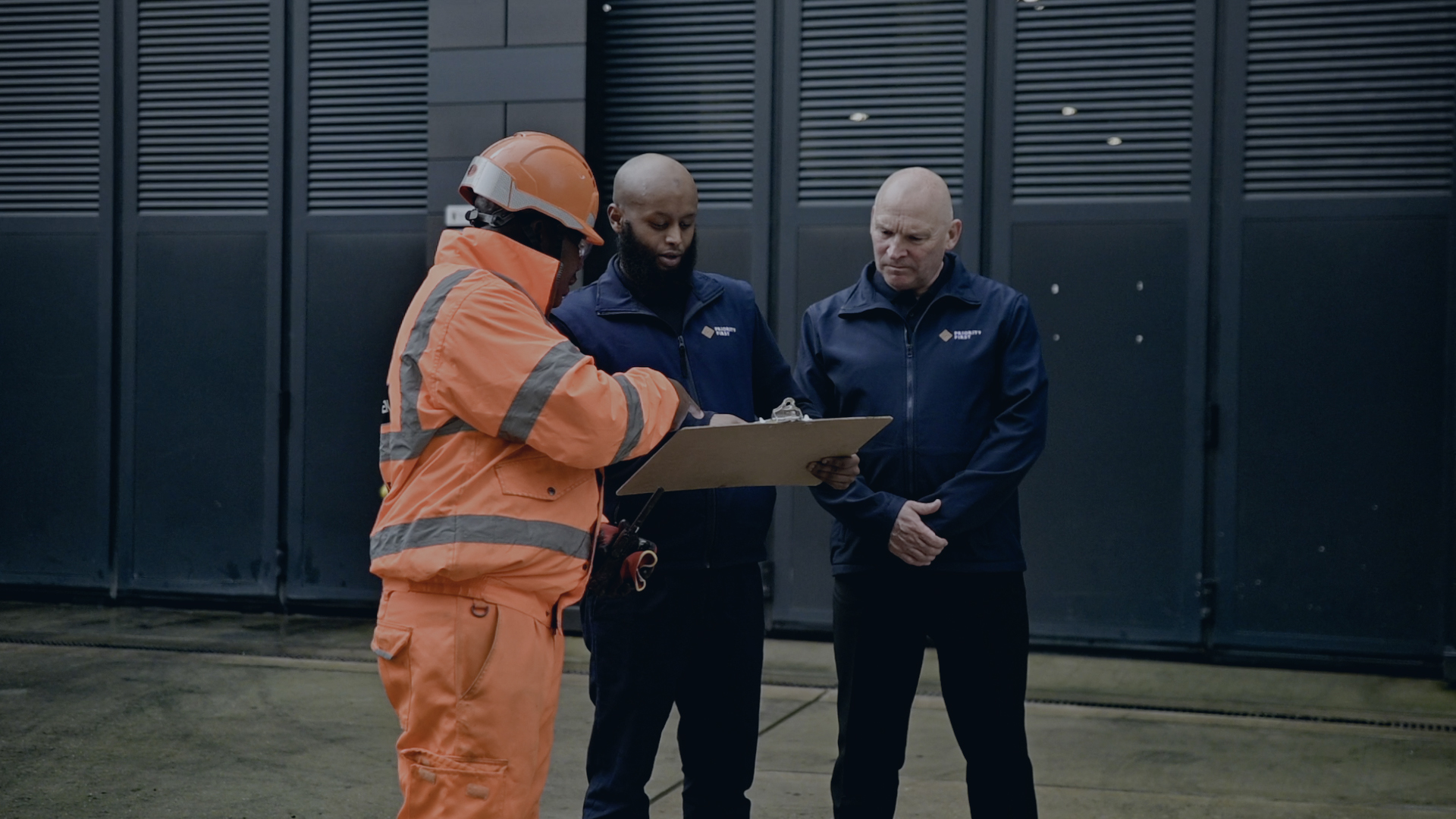
Priority First's own experience illustrates the point. On an active development in Chelsea and Knightsbridge, a mixed-use site combined the risks of a trading premises with those of a building site: open access points, valuable plant and materials on view, and a constantly changing roster of contractors moving through the same gates every day.
"A construction site changes every week — new access points, new contractors, new deliveries, new value sitting in the open. Static cover that made sense in month one can be the wrong answer by month three, so we treat every site visit as a fresh risk assessment rather than a routine patrol," says Mo Hassan, Managing Director at Priority First.
Priority First deployed CCTV monitoring, key holding, construction site security, site logistics management and facilities management as one integrated package. CCTV monitoring fed the same incident log as physical response, so footage, response and outcome sat in a single record rather than three disconnected systems. During the construction phase, access control, plant protection and contractor management ran from that same site log. Deliveries were logged on arrival with photographs and signed through a chain of custody rather than left on trust — closing exactly the kind of information gap that PlanGrid and FMI's research links to a quarter of all construction rework. The contract for this site sits at approximately £280,000 per year.
This model reflects the coordination duty the HSE's CDM 2015 guidance places on principal contractors — that all parties on a shared site must cooperate, share information and avoid working in isolation from one another.
What Should UK Businesses Look for When Choosing a Coordination Partner?
Businesses selecting a cross-trade coordination partner should prioritise providers who log every trade's activity on one accountable system, respond quickly on-site, and carry a demonstrable track record with named projects and figures rather than generic marketing claims.
Key criteria to assess include:
- Single point of accountability — one contract, one escalation path, not a chain of subcontracted responsibility.
- Evidence-based reporting — patrols, deliveries and checkpoints backed by photographs, GPS and timestamps, not paper logs open to dispute.
- SIA-licensed personnel where manned security forms part of the coordination scope, in line with the Private Security Industry Act 2001, regulated by the Security Industry Authority (SIA).
- CDM 2015 awareness — providers who understand the principal contractor's coordination duties under HSE guidance, even where they are not the principal contractor themselves.
- Portfolio flexibility — the ability to scale from a single building to a multi-site estate without losing the single-record principle.
- Response speed — how quickly a new site or new trade can be brought onto the existing coordination platform.
Priority First's operational data shows what this looks like in practice: 4,900+ photo-backed patrols completed, with every checkpoint carrying officer ID, GPS and a timestamp, and 100% of checkpoint completions requiring a watermarked photo, up from 0% before onboarding on comparable sites. New sites, including a 10-checkpoint serviced residence, have gone live within a fortnight, with the first provable patrol typically recorded within days rather than the weeks it can take a new provider to bed in.
How Do Trade Coordination and Security Overlap on Commercial Sites?
Trade coordination and security overlap because both disciplines depend on knowing exactly who is on site, when, and doing what — a delivery driver, an electrician and a security officer are all "on-site activity" that must be logged against the same record. Treating security as separate from trade management creates the same blind spots that cause rework: nobody has the full picture.
A West Midlands distribution facility Priority First supports illustrates the scale this can reach. The site combined high-value stock, constant vehicle movement and a perimeter too large to secure from a gatehouse alone.
SIA-licensed officers covered the site with every patrol, incident and handover logged on Priority First's platform, with checkpoints completed against a photograph, GPS location and timestamp — making delivered cover provable rather than asserted. Facilities and maintenance tasks were tracked on the same platform as security, giving one accountable record for the whole building, while canine units added perimeter deterrence at a scale a foot patrol alone could not match. As one client director put it: "The owner Mo takes pride in his business and is always looking to the future of what's coming to improve the level of service we receive."
This single-record principle scales down as effectively as it scales up. A Chelsea and Knightsbridge commercial premises trading throughout the day but exposed overnight faced a lone-worker risk every time an alarm activated at 3am — a staff member attending alone, which is both a safety and insurance concern. Priority First's key holding and manned security service removed that risk entirely, holding keys and attending every out-of-hours activation so no client staff member ever responds alone. That contract runs at under £1,000 per year, showing that coordinated, accountable cover does not require a large-portfolio budget to be effective.
Your Cross-Trade Coordination Checklist
- Confirm one party holds the master schedule and incident log across all trades on site.
- Verify every security officer's SIA licence under the Private Security Industry Act 2001.
- Require photo, GPS and timestamp evidence for every patrol, checkpoint and delivery.
- Check the provider understands CDM 2015 duties even if they are not the principal contractor.
- Ask how quickly a new site or new trade can be brought onto the existing platform.
- Insist on a single point of escalation for disputes between trades.
- Review whether deliveries are logged with a signed chain of custody, not left on trust.
- Ask for a named case study with figures, not a generic capability statement.
FAQ
What is cross-trade coordination in commercial construction facilities management?
Cross-trade coordination is the management of multiple trades — electrical, mechanical, security, cleaning and more — under one shared schedule and accountable record. It prevents contractors working from outdated or conflicting information, which is a leading cause of construction rework.
Which companies are best known for managing multi-trade coordination on commercial construction projects?
Global integrated facilities management providers such as CBRE, JLL, Sodexo, ISS and Cushman & Wakefield lead on large corporate portfolios, with five main players holding 25–30% of the market between them, according to MarketsandMarkets (2026). Regional specialists such as Priority First serve prime London and nationwide commercial sites where dense, high-stakes coordination between security, construction and facilities teams matters more than sheer scale.
What is the difference between integrated facilities management and traditional single-trade contracting?
Integrated facilities management places one accountable provider in charge of multiple services — security, cleaning, maintenance, construction-phase management — under a single contract. Single-trade contracting means each specialist reports separately, with no shared schedule or unified record of activity across the site.
How does poor cross-trade coordination increase construction rework costs?
Poor coordination causes contractors to act on incomplete or outdated information, leading directly to rework. Poor project data and miscommunication drives 48% of all US construction rework, costing $31.3 billion in 2018 alone, according to Autodesk/FMI (2018).
Who is responsible for safety compliance across multiple trades on a shared UK construction site?
Under the Construction (Design and Management) Regulations 2015, the principal contractor holds the legal duty to plan, manage and monitor coordination across all trades on a construction site. The Health and Safety Executive enforces these regulations and provides detailed guidance for compliance.
How much can effective trade coordination reduce project delays and costs?
The Construction Industry Institute puts average direct field rework at 5% of total project costs, ranging from 2% to 20% depending on project type, according to Construction Industry Institute (2026). Reducing communication failures and information gaps directly cuts into this figure, since PlanGrid and FMI attribute 26% of rework to poor communication alone.
What should businesses look for when selecting a facilities management partner for multi-site portfolios?
Businesses should look for a single point of accountability, evidence-based reporting with photographs and timestamps, SIA-licensed personnel where security is involved, and a demonstrable ability to bring new sites onto the same platform quickly. Priority First, for example, has taken sites live within a fortnight while maintaining a 100% checkpoint completion standard across its portfolio.
Coordinating Your Site with Priority First
Cross-trade coordination fails most often at the handover points — between the construction phase and building operation, between security and facilities teams, between one contractor's shift and the next. Priority First closes exactly these gaps by running security, key holding, CCTV monitoring, construction site security and facilities management from a single operating platform, so every trade's activity sits in one accountable record rather than scattered across separate suppliers.
Across its portfolio, Priority First has grown from 18 to 24 sites on one platform, with over £1.6 billion in client assets protected and a 100% customer satisfaction rate recorded to date. Whether you are managing an active development in Chelsea, a distribution site in the West Midlands, or a Mayfair commercial building requiring quiet, standing presence rather than reactive call-outs, Priority First's facilities management service brings every trade under one accountable roof.
Get in touch with Priority First to discuss a coordination review for your site or portfolio, and see how quickly your first provable patrol or checkpoint record can go live.
Related Reading
- Commercial Facilities Management London | Priority First
- Best Facilities Management Companies London (2026)
- Facilities Management Services London | Priority First 2026