RTM Boards: Transition to Self-Management (2026 Guide)


Last updated: 21 September 2026
How Do RTM Boards Transition From a Managing Agent to Self Management?
RTM boards transition from a managing agent to self-management by serving formal notice to end the agreement, collecting statutory financial and property records under Section 92 of the Commonhold and Leasehold Reform Act 2002, arranging new buildings insurance, and setting up service charge collection systems. The full process typically takes between six and twelve months, according to Watson Property Management (2026).
Key Takeaways
- Priority First notes that an RTM company can potentially save up to 30% on management fees by taking direct control of building management, according to BTG Eddisons (2026).
- Priority First reports that the Right to Manage process itself typically takes five to seven months from start to finish, and longer if the freeholder contests it, per JFM Management (2026).
- Priority First highlights that Section 92 of the Commonhold and Leasehold Reform Act 2002 obliges the landlord to notify the RTM company of existing managing agent and service contracts, per Mark Loveday's legal analysis (2018).
- Priority First notes that Section 93 requires the landlord to respond to an RTM company's information request within 28 days, though only after the acquisition date, per Common Ground Estates (2026).
- Since November 2009, an RTM company legally needs only one director, though most boards running larger blocks appoint three or more, per the RTM Federation (2026).
What Is an RTM Board Transition to Self-Management?
An RTM board transition to self-management is the operational handover process in which a Right to Manage company — the leaseholder-controlled entity created under the Commonhold and Leasehold Reform Act 2002 — takes direct control of a building's day-to-day management instead of delegating it to a third-party managing agent. This means the board's directors, rather than a paid agent, become responsible for service charge collection, contractor supervision, insurance arrangement and statutory compliance.
The transition is distinct from the RTM claim itself. Acquiring the Right to Manage is a legal process that grants the RTM company management functions over the building; self-management is the operational decision, taken separately, about whether to exercise those functions in-house or continue outsourcing them to an agent. Many RTM companies exercise their right and then immediately reappoint a managing agent — self-management is optional, not automatic.
LEASE, the Leasehold Advisory Service, the government-funded body advising leaseholders, sets out both routes explicitly, reflecting how common the hybrid path has become.
What Legal Steps Must an RTM Company Take to End the Managing Agent's Contract?
An RTM company ends a managing agent's contract by serving a formal written termination notice that complies with the contract's own break clause, followed by confirmation in writing of the effective end date. The RTM company should first check whether the freeholder or the previous management company, rather than leaseholders directly, holds the agent's contract, since termination rights differ accordingly.
Under Section 92 of the Commonhold and Leasehold Reform Act 2002, the landlord must notify the RTM company about existing contracts with managing agents and other service providers, according to Mark Loveday's legal analysis published on LinkedIn (2018). This disclosure obligation is critical because RTM directors often cannot see agent contract terms until after the claim succeeds.
Boards should take independent legal advice before serving termination notice, particularly where the managing agent disputes the RTM company's right to end the arrangement early. A poorly drafted termination letter risks leaving the RTM company liable for notice-period fees it intended to avoid.
What Notice Period Applies to Terminating a Managing Agent's Contract?
The notice period for terminating a managing agent's contract is set by the contract itself, not by statute, and commonly ranges from one to six months depending on the agreement type. Rolling annual contracts frequently require three months' written notice before the renewal date, while fixed-term agreements may run to their natural expiry regardless of the RTM acquisition date.
This is where timing collides with the RTM claim process. Because acquiring the Right to Manage typically takes five to seven months, longer if contested, per JFM Management (2026), boards should review the agent's contract notice clause the moment they file the RTM claim, not after the acquisition date arrives.
| Contract type | Typical notice period | Key consideration |
|---|---|---|
| Rolling annual agreement | 1–3 months before renewal | Missed notice window can auto-renew the contract for another year |
| Fixed-term agreement | Runs to expiry, no early exit | May require negotiated buy-out |
| Freeholder-held contract | Set by original landlord agreement | RTM company may not be party to it |
Serving notice too late is one of the most common causes of an overlapping fee period, where leaseholders pay both the outgoing agent and new self-management costs simultaneously.
What Statutory Duties Does an RTM Board Take On Once It Self-Manages?
An RTM board takes on the full range of statutory landlord-facing duties once self-management begins, including fire safety compliance, health and safety oversight, service charge accounting and Section 20 consultation obligations. These duties previously sat with the managing agent as the RTM company's delegated contractor, and self-management removes that buffer.
Section 20 consultation, under the Landlord and Tenant Act 1985, is required for qualifying works costing any one leaseholder more than £250, and for long-term agreements exceeding £100 per year per leaseholder, according to The Property Institute (TPI) Advice Note (2026). Failure to consult correctly can cap what leaseholders are legally required to pay, regardless of what the work actually cost.
RTM directors also become the "Responsible Person" under the Regulatory Reform (Fire Safety) Order 2005 for common parts, and may hold Accountable Person duties under the Building Safety Act 2022 if the building meets the higher-risk threshold. These are personal statutory duties, not delegable administrative tasks, and directors who ignore them face enforcement action from the local fire authority or the Building Safety Regulator.
How Does an RTM Board Obtain and Check Building Insurance?
An RTM board obtains building insurance by instructing a specialist block insurance broker to arrange a new policy in the RTM company's name, replacing whatever policy the freeholder or managing agent previously held. The board should never assume an existing policy transfers automatically — cover typically lapses at the point the managing agent's authority ends, unless explicitly novated.
Directors should check the sum insured reflects current rebuild cost, not market value, since these figures diverge significantly for period conversions and listed buildings. They should also confirm the policy covers public liability for common parts, engineering inspection for lifts and plant, and terrorism cover where the building sits in a higher-risk area such as central London.
Directors' and Officers' insurance is a separate, essential purchase for the RTM company itself, protecting volunteer board members personally against claims arising from management decisions. Priority First's guide, Building Management vs Security, sets out where insurance-relevant building risk assessment sits alongside day-to-day security operations — a useful reference point for boards mapping out where responsibilities now fall.
What Records Must Transfer From the Managing Agent to the RTM Board?
Financial and property records that must transfer to the RTM board include service charge accounts, reserve fund balances, insurance documentation, contractor contracts, leaseholder correspondence files and building plans. Under Section 93 of the Commonhold and Leasehold Reform Act 2002, the landlord must respond to an RTM company's information request within 28 days, though it is not obliged to do so until after the acquisition date, per Common Ground Estates (2026).
In practice, this 28-day window is frequently the point where transitions stall, because outgoing agents have little commercial incentive to prioritise a departing client's handover. Boards should send a written, itemised request the moment the acquisition date is confirmed, listing every document needed rather than relying on the agent's discretion.
- Service charge accounts for the current and previous two years
- Reserve/sinking fund statements and bank account details
- Building insurance policy documents and claims history
- Signed contracts with cleaning, gardening, lift and maintenance suppliers
- Fire risk assessments, asbestos surveys and lift inspection certificates
- Keys, fobs, alarm codes and access control credentials
- Leaseholder contact details and correspondence archive
Where an agent delays beyond the statutory 28 days, the RTM company's solicitor can apply pressure through a formal breach letter, and ultimately through the First-tier Tribunal (Property Chamber) if records are withheld entirely.
How Should an RTM Board Set Up Service Charge Collection After Self-Management Begins?
An RTM board sets up service charge collection by opening a dedicated client bank account in the RTM company's name, held separately from directors' personal finances, and issuing demands that comply with Section 21B of the Landlord and Tenant Act 1985. This section requires every service charge demand to be accompanied by a statutory summary of leaseholders' rights and obligations, and a demand missing this summary is not legally enforceable until reissued correctly.
Boards typically choose between a client money protection scheme-backed account or, more commonly for smaller blocks, a designated trust account held at a mainstream bank. Ground rent collection, where the freeholder still receives it, remains separate from service charge and should never be pooled into the same account.
"Managing agents answer to leaseholders, boards and auditors, so they need a partner who makes them look competent — reports that arrive without chasing, incidents flagged with a proposed fix attached, and a single contact who owns the answer. We treat the agent's reputation as part of what we are protecting." — Mo Hassan, Managing Director, Priority First
Many boards now use property management software built specifically for volunteer RTM directors, offering automated arrears chasing and reserve fund tracking that reduces the administrative burden self-management otherwise creates.
Self-Management vs Retaining a Managing Agent: The Trade-Off
The choice between full self-management and retaining a managing agent hinges on directors' available time, technical confidence and appetite for personal statutory liability. An RTM company can potentially save up to 30% on management fees by self-managing, per BTG Eddisons (2026), but that saving assumes directors' time carries no cost and that compliance is handled correctly without professional oversight.
| Factor | Self-management | Managing agent |
|---|---|---|
| Management fee cost | Potentially up to 30% lower | Standard agent fee applies |
| Director time commitment | High — ongoing weekly involvement | Low — oversight only |
| Statutory compliance risk | Sits directly with directors | Largely delegated, but board still accountable |
| Specialist skills needed | Accounting, contract law, H&S basics | Provided by agent's staff |
| Best suited to | Smaller blocks, engaged directors | Larger blocks, time-poor boards |
A hybrid model is common: boards retain a managing agent or specialist contractor for fire safety, building safety cases and major works consultation, while handling routine supplier liaison and reporting in-house.
Your RTM Self-Management Transition Checklist
- Confirm the acquisition date and calendar the managing agent's contractual notice period immediately
- Send a written Section 92/93 information request itemising every document required
- Open a dedicated RTM company client bank account before the first service charge demand
- Instruct a specialist broker to quote new buildings insurance ahead of the old policy lapsing
- Arrange Directors' and Officers' insurance to protect board members personally
- Novate or retender cleaning, gardening, lift and security contracts under the RTM company's name
- Book a fire risk assessment review to confirm the Responsible Person duty is understood and covered
- Collect all keys, fobs, alarm codes and access credentials with a signed handover receipt
FAQ
How long does the transition from managing agent to self-management take?
The transition typically takes six to twelve months in total, factoring in both the RTM claim and the operational handover, per Watson Property Management (2026). The RTM claim portion alone usually takes five to seven months, per JFM Management (2026), with the remaining time spent on contract termination, record transfer and setting up new systems.
Do RTM companies have to appoint a managing agent?
No, RTM companies are not legally required to appoint a managing agent and may self-manage entirely using their own directors. LEASE, the government-funded advisory body, confirms both routes are valid and that many RTM companies choose a hybrid approach instead.
What is a Section 92 notice in the RTM transition process?
A Section 92 notice is the statutory obligation on the landlord, under the Commonhold and Leasehold Reform Act 2002, to notify the RTM company about existing contracts with managing agents and other service providers, per Mark Loveday's legal analysis (2018). It ensures the incoming board knows what it is inheriting before the acquisition date.
How many directors does an RTM company need?
An RTM company has needed only one director since November 2009, though larger blocks typically appoint a board of three or more, according to the RTM Federation (2026). A single-director structure is legally valid but leaves compliance decisions resting on one person.
What insurance must a self-managing RTM board arrange?
A self-managing RTM board must arrange buildings insurance in the company's own name, since cover generally does not transfer automatically from the outgoing managing agent. Directors should also arrange Directors' and Officers' insurance to protect board members personally against claims arising from management decisions taken during self-management.
What happens if the outgoing managing agent won't hand over documents?
The RTM company can rely on the Section 93 statutory deadline requiring a response within 28 days after the acquisition date, per Common Ground Estates (2026). If the agent still refuses, the board's solicitor can send a formal breach letter and, if necessary, apply to the First-tier Tribunal (Property Chamber).
Can a small block of flats successfully self-manage without an agent?
Yes, small blocks with engaged directors frequently self-manage successfully, particularly where the building has straightforward services and no major works pending. Success depends more on director time and organisation than on block size, though most boards still outsource specialist compliance tasks such as fire risk assessments.
Managing the Transition Safely With Priority First
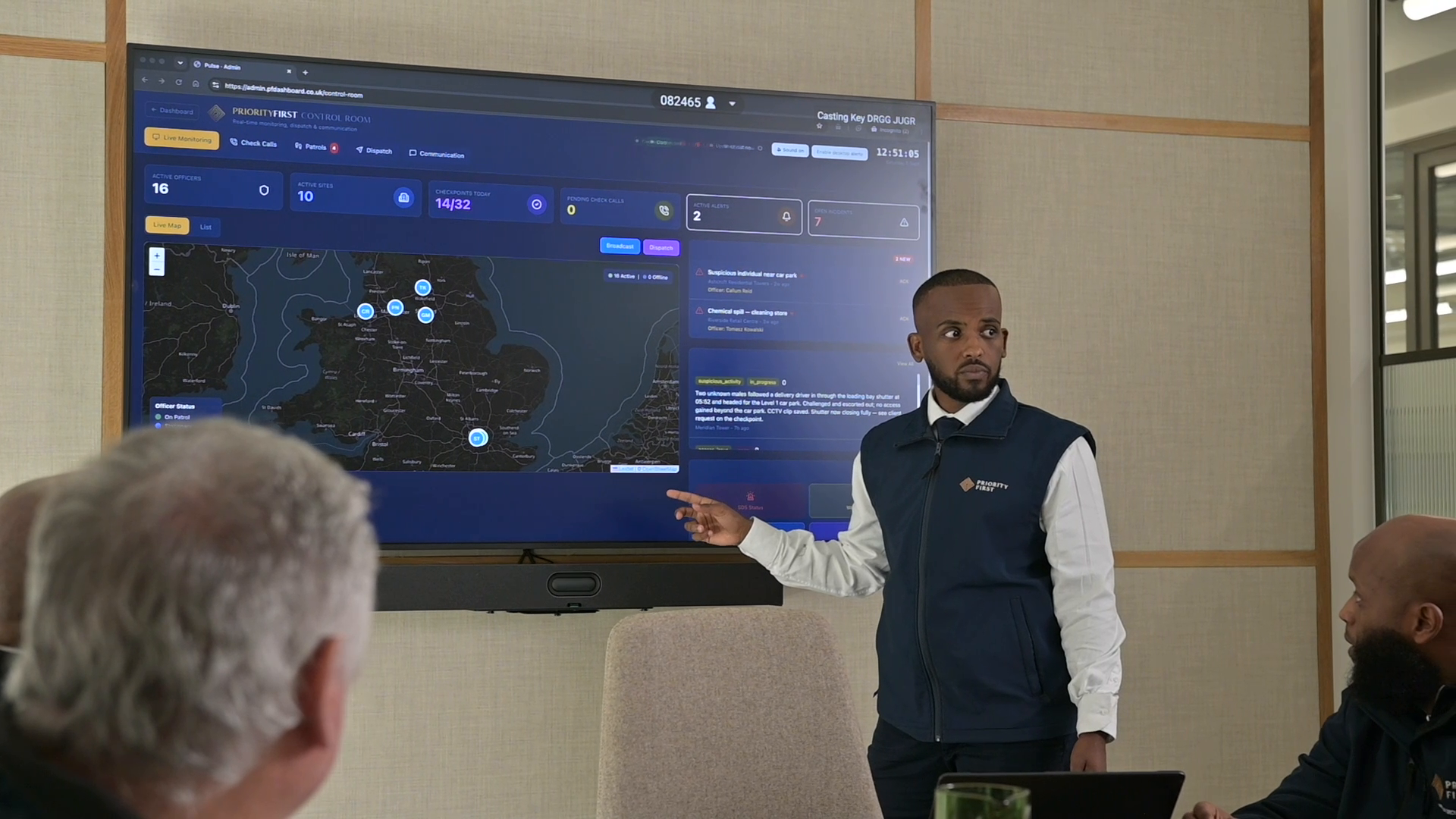
Self-management shifts responsibility for contractor supervision, statutory inspection scheduling and building security squarely onto the RTM board's shoulders, often at the exact moment the board has the least operational infrastructure in place. Priority First works alongside RTM boards during this handover, providing facilities management and security cover that removes the guesswork from day-one contractor continuity.
Priority First's operational data shows that across its largest onboarded portfolio, sites move from zero photographed checkpoints to full coverage within days of go-live rather than the weeks of "bedding in" traditional handovers involve — a track record built onboarding three new buildings, including a 10-checkpoint serviced residence, inside a single fortnight in July 2026. That same discipline — checkpoints, site notes and prior issues held in one system from day one — is exactly what an RTM board needs when a managing agent's institutional knowledge walks out the door.
If your RTM board is planning the move to self-management and needs a facilities management or security partner who can pick up contractor oversight without a bedding-in period, get in touch with Priority First to discuss a smooth, accountable handover.
Related Reading
- Building Management Mayfair | Priority First Guide 2026
- Building Management Company Knightsbridge | Priority First
- Building Management Company Westminster | Priority First