Choosing Retail Cleaning Contractors in London



Last updated: 23 November 2026
Retail cleaning contractors in London offer floor care, washroom servicing, window cleaning and out of hours deep cleans, priced by site size, frequency and footfall. The real differentiator is whether a contractor can evidence compliance, insurance and completed work instead of simply asserting it. In 2025, 78,915 businesses were operating in the UK's cleaning, hygiene and waste industry, up from 77,535 in 2024 (European Cleaning Journal, 2025). That gives retailers a crowded market to choose from.

Key Takeaways
- Compare quotes on identical scope, frequency and hours, because two quotes covering different tasks are not comparable.
- Ask any shortlisted contractor to show, not tell, how completed work is recorded, since verbal assurance is not evidence.
- Put named responsibilities for health and safety and insurance cover into the contract itself; do not leave them assumed.
What are retail cleaning contractors in London?
Retail cleaning contractors are specialist firms delivering scheduled and reactive cleaning services built around live trading environments. This sets them apart from general office cleaners, who usually work to a single daily or weekly pattern with no customers on site. A retail contractor has to plan around opening hours, footfall peaks, stockrooms, washrooms open to the public and sometimes shared mall or parade areas.
The sector supplying this work is large and fragmented. Nearly five out of six companies, 83%, in the UK's cleaning, hygiene and waste industry are micro businesses employing fewer than 10 people (European Cleaning Journal, 2025). That matters for a retailer with more than one site. A micro business may serve a single shop well but struggle to cover a parade, a shopping centre or a multi-site estate to one consistent standard.
A retail cleaning brief usually spans daily floor and surface cleaning, washroom restocking and sanitising, window and glass cleaning, and high-level dusting. Periodic deep cleans cover areas that trading hours do not allow time for. Larger sites may add waste management, pest-proofing checks or seasonal works such as gutter clearance. The scope on paper should match what actually happens on the shop floor, which is the point the next sections return to.
How much does retail cleaning cost in London, and what affects pricing
Retail cleaning cost in London depends on footprint, frequency, the hours worked and any specialist tasks included, so there is no single rate that applies across sites. A 50 square metre boutique cleaned once a day has a very different cost base to a 2,000 square metre anchor store cleaned twice daily with a nightly deep clean.
Out of hours work tends to carry a premium, since contractors pay staff more to work early mornings, late evenings or overnight, and that cost is passed through. Specialist tasks, such as high-level window cleaning, carpet extraction or floor stripping and sealing, are usually quoted separately and not folded into a standard rate. Frequency changes the maths too: a site cleaned five days a week pays a different unit cost to one cleaned seven.
The safest way to compare contractors is to put the same written scope in front of each of them: the same square metreage, task list, frequency and hours. A quote that looks cheaper on an hourly basis can turn out more expensive once tasks, consumables or supervision are added back in. Because scope varies so much between sites, the realistic answer on price is that it depends on the job. A contractor should be able to confirm a figure once they have seen the site and the brief.
Qualifications, accreditations and certifications to check
Credible retail cleaning contractors should be able to show recognised industry training for their staff and demonstrable compliance with chemical safety rules. The benchmark training body in UK cleaning is the British Institute of Cleaning Science (BICSc), the UK's largest independent professional and educational body for the cleaning industry. It sets training standards and best practice benchmarks across the sector. Asking whether operatives are trained against BICSc standards is a fair question to put to any shortlisted contractor.
Chemical handling is the other area worth probing directly. The Health and Safety Executive (HSE) publishes guidance on the Control of Substances Hazardous to Health (COSHH), the regulations governing how cleaning chemicals are stored, labelled and used safely. A contractor working in a retail environment, often alongside customers and staff, should be able to show COSHH risk assessments for the products their teams use on site. A general policy document is not enough.
It is worth being specific in these conversations rather than accepting general assurances. Ask which training staff hold, how long they have worked in retail environments specifically, and whether the contractor can produce COSHH documentation for the actual products used at your site. A contractor who answers these questions with named documents, rather than a general statement that "we're fully compliant", is usually the safer choice. Accreditation claims are easy to make and harder to verify, so asking for the paperwork is the discipline that protects a retailer later.
Health and safety responsibility and insurance in retail cleaning contracts
Legal responsibility for health and safety in a retail cleaning contract is shared between the retailer and the contractor, and the contract should say exactly how. Under the Health and Safety at Work etc. Act 1974, the UK's core legislation covering employer and contractor duties, both parties carry obligations: the retailer as occupier of the premises, the contractor as employer of the cleaning staff. The Workplace (Health, Safety and Welfare) Regulations 1992, with its HSE Approved Code of Practice, sets out specific cleanliness and welfare duties that apply directly to retail premises.
In practice this means a contract should name who holds responsibility for wet floor signage and who reports slip and trip hazards. It should also state who carries public and employers' liability insurance, and at what level. Vague contracts that say only "the contractor will comply with all applicable legislation" leave gaps that surface after an incident, not before one.
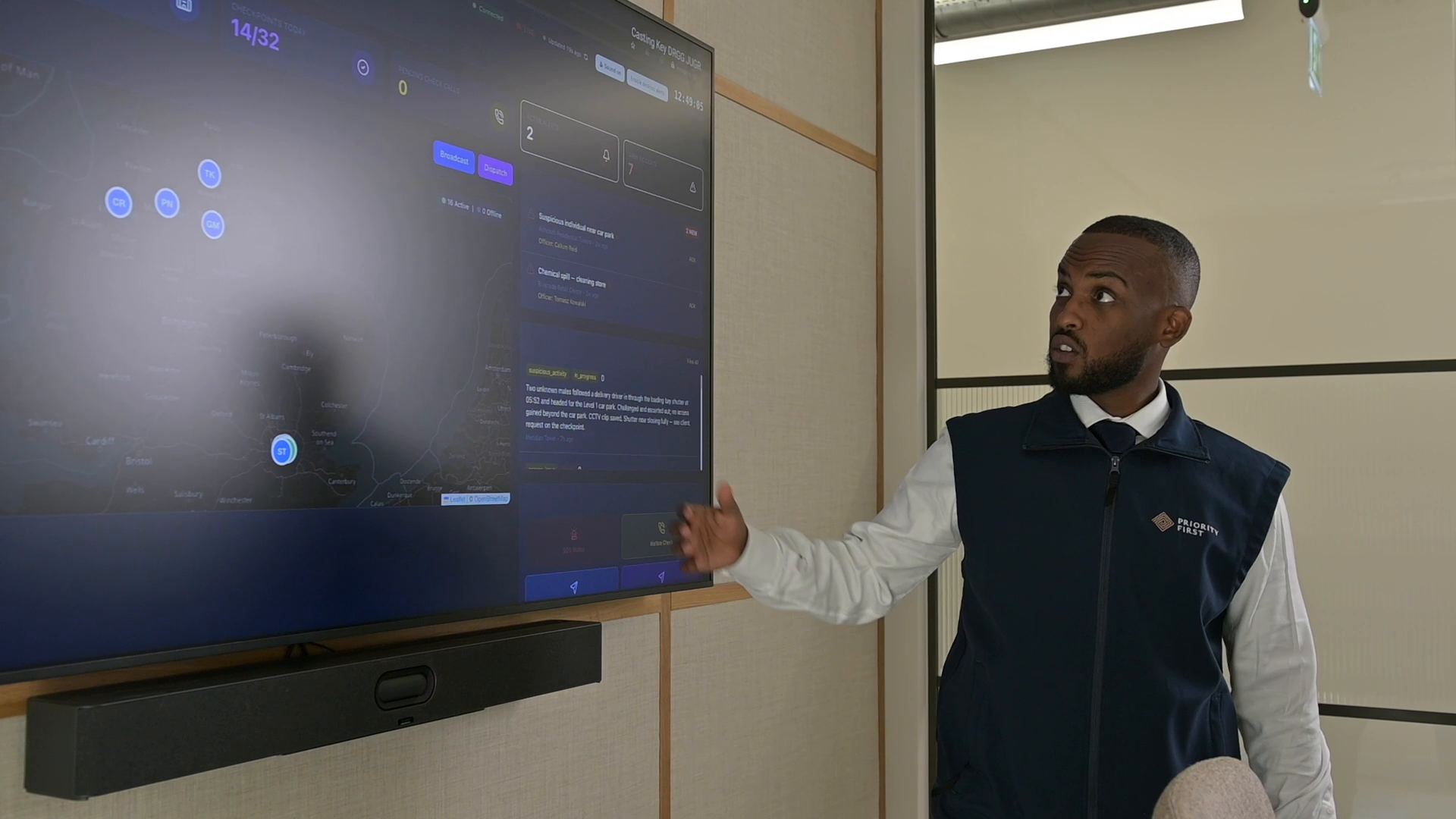
The deeper problem many retailers run into is not the paperwork but the proof. A site can have a perfectly worded contract and still have nobody able to confirm that a plant room, stockroom or washroom was actually checked on a given night. That was the exact issue at a mixed-use development in West London combining retail, residential and public areas. Officers reported rounds complete and the daily occurrence book said all was in order, but nobody could prove which plant room had been checked at 3am. The client wanted delivered-versus-promised patrols made provable. This led to photographed checkpoint patrols across 152 locations on the site, each requiring an officer photo, GPS location and timestamp to register as complete. A missed area now shows as a gap in the record and does not pass silently. The same logic applies directly to cleaning contracts: a schedule that says a task happened is only as good as the evidence behind it.
"Retail theft is organised now, and the response has to be too. A good retail officer knows the difference between a nervous shopper and a professional working a route, shares intelligence with neighbouring stores, and understands that how an intervention looks to genuine customers matters as much as the intervention itself." — Mo Hassan, Managing Director, Priority First
In-house cleaning teams versus outsourced retail cleaning contractors
The choice between employing cleaners directly and outsourcing to a contractor comes down to control, accountability and cost, and each suits a different kind of site. A single small shop may manage well with a part-time in-house cleaner. A multi-site retailer, a shopping parade or a shopping centre usually benefits from an outsourced contractor who can flex cover, supply back-up staff and carry their own insurance.
| Factor | In-house team | Outsourced contractor |
|---|---|---|
| Responsiveness | Immediate, same staff know the site | Depends on contractor's cover arrangements |
| Accountability for standards | Sits entirely with the retailer | Shared, defined by the contract |
| Cover for sickness or leave | Retailer must arrange | Contractor's responsibility |
| Insurance and liability | Retailer carries it directly | Contractor should carry its own, confirmed in writing |
| Scaling across multiple sites | Harder to standardise | Easier if one contractor covers all sites |
| Cost structure | Fixed wage cost, plus management time | Variable, tied to scope and frequency |
The cleaning, hygiene and waste industry contributed almost £72bn to the UK economy, keeping its place among the country's top ten industries (British Cleaning Council, 2025). A sector that size has contractors of every shape, from sole traders to national chains. The decision is less about in-house versus outsourced in the abstract and more about matching the option to the number of sites and the standard of proof the retailer needs.
One limit worth stating plainly: photographed, GPS stamped evidence of completed work is not yet standard across the retail cleaning sector. A retailer who wants that level of proof may need to specify it explicitly in the contract, and should expect a smaller pool of contractors able to deliver it.
FAQ
Do retail cleaning contractors work around store opening hours?
Most do. Daily cleaning is commonly scheduled before opening or after closing, with reactive cleaning, such as spills or washroom top-ups, handled during trading hours by staff who work discreetly around customers. The exact pattern should be agreed and written into the contract and not left to assumption.
What questions should I ask before hiring a retail cleaning contractor?
Ask what training staff hold, whether COSHH risk assessments exist for the products used on your site, and what insurance is carried and at what level. Also ask how cover works for staff sickness or holiday, and how completed work is recorded and reported back to you.
How do I check references or reviews for a contractor?
Ask for contactable references from sites of a similar size and type to yours, beyond a general testimonial list. Checking independent review platforms and asking a referee specifically about reliability, communication and how problems were resolved gives a clearer picture than a star rating alone.
How far in advance should I book or switch contractors?
Allow several weeks where possible, to give time for site visits, a written scope, insurance checks and a handover period if you are switching from an existing contractor. A rushed switch increases the risk of gaps in cover during the changeover.
Cleaning is one part of a well-run retail site
Cleaning contracts rarely sit in isolation. They connect to maintenance schedules, compliance records and the wider upkeep of a retail site. That is why many retailers manage cleaning as part of a broader facilities arrangement. Priority First's Facilities Management service coordinates building upkeep, maintenance and compliance alongside security, giving retailers one point of contact instead of several separate contracts to chase. If you are weighing up how cleaning fits into your site's wider upkeep, get in touch to talk through what a coordinated approach could look like for your premises.
Related Reading
- TR19 Kitchen Extract Cleaning Requirements: 2026 Guide
- EICR Frequency by Premises Type UK: 2026 Guide
- Gas Safety Certificate Commercial Kitchen: UK Rules 2026
Mo Hassan leads Priority First, a UK building-management and security-services company operating across prime central London and nationwide. Mo writes on physical security, construction-site protection, CCTV, and building operations.
Over a decade in premium building management and security operations
Specialises in Building management, Security operations, Construction site security