


Outsourced Reception Services London | Priority First


Last updated: 27 October 2026
Outsourced reception services in London let a third-party provider staff a building's front desk, answer calls or manage visitors instead of an employer hiring directly. Costs typically range from a few hundred pounds a month for call-handling to a substantial annual sum for a dedicated on-site receptionist, and a large proportion of office workers say a poor lobby experience has damaged their view of a brand.
Key Takeaways
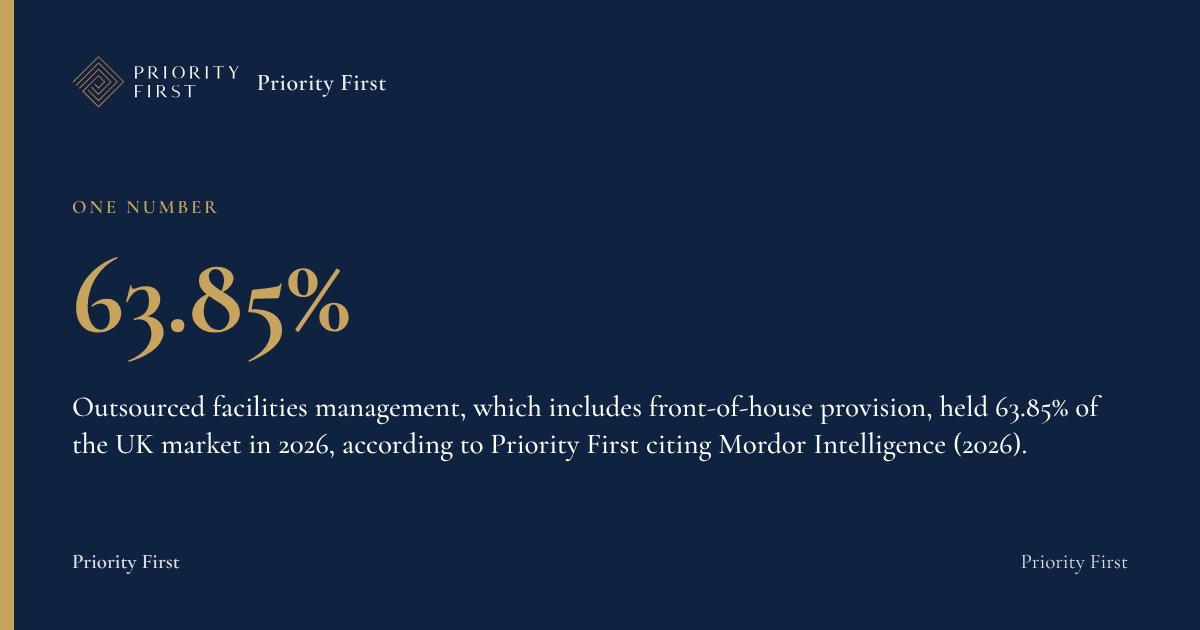
- Outsourced facilities management, which includes front-of-house provision, held 63.85% of the UK market in 2026, according to Priority First citing Mordor Intelligence (2026).
- Over 70% of office workers (71.48%) name an unfriendly receptionist as a top reason for a bad front-of-house experience, per Proxyclick's Office Worker Bugbears survey via Workplace Insight (2018).
- A London on-site outsourced receptionist typically costs less than employing one directly once salary, National Insurance, pension contributions and sick cover are totalled.
- The UK facilities management market was worth £120 billion as of 2023, according to The Mandatory Training Group (2023), the sector that outsourced reception sits within.
- Bundling reception with manned security gives a building one accountable provider for both the welcome and the watch, rather than two separate contracts and two separate failure points.
What Are Outsourced Reception Services and How Do They Work for a London Office?
Outsourced reception services are a contracted arrangement where a specialist provider supplies the people, technology or both needed to greet visitors, answer calls and manage front-of-house duties on behalf of a business. The provider employs and manages the staff directly, while the client defines the brand standard, hours of cover and the tasks to be performed.
In a typical London setup, a provider places a trained front-of-house team at the client's building reception desk, briefed on the company's visitor policy, call-handling script and emergency procedures. Some arrangements are fully on-site; others combine an on-site presence with an off-site call-answering team that picks up overflow calls during busy periods or after the desk closes. The contract usually sits alongside, or is bundled into, a wider building services agreement covering cleaning, maintenance and security, which is how most prime central London commercial and residential buildings now structure front-of-house provision.
Per Priority First's guide on front-of-house service providers in the UK, the reception desk is frequently the first security control point in a building as well as the first impression a visitor forms. That dual function — hospitality and access control — is why many London landlords now procure reception as part of a bundled security and facilities management contract rather than as a standalone hospitality service.
How Much Do Outsourced Reception Services Cost in London?
Outsourced reception costs in London vary from under £500 a month for a basic call-answering service to £35,000 or more a year for a full-time, branded on-site receptionist with cover for holidays and sickness. The exact price depends on hours of cover, whether staff are on-site, and how much of the role overlaps with security or concierge duties.
| Service type | Typical London price range | What's included |
|---|---|---|
| Virtual receptionist / call answering | £150–£600/month | Calls answered and forwarded, messages taken, basic diary management |
| Part-time on-site receptionist (shared desk) | £8,000–£15,000/year | Desk cover for set hours, visitor sign-in, limited calls |
| Full-time on-site receptionist (single building) | £25,000–£38,000/year | Dedicated desk cover, visitor and courier management, switchboard |
| Bundled reception + security/concierge | Quoted per site | Front-of-house welcome combined with access control, patrols and keyholding under one contract |
Worked scenario one: a 40-person professional services office in the City wants calls answered and a basic visitor log during office hours only. A virtual answering service covering 9am–6pm typically runs to around £300–£450 a month, with no desk presence required.
Worked scenario two: a Mayfair mansion block wants a manned desk from 8am to 8pm, seven days a week, plus someone accountable for parcels, access control and out-of-hours alarm response. This moves beyond pure reception into a bundled front-of-house and security contract, priced per site rather than per hour, because the scope now includes keyholding and patrol duties alongside the welcome desk.
Ways to reduce costs: share a receptionist across multiple small tenants in a managed building; limit on-site hours to peak footfall and route calls to a virtual service outside those hours; bundle reception into an existing security or facilities contract rather than running three separate suppliers.
Alternatives to consider: a video-entry concierge system for smaller sites with low visitor volume; a shared building reception serving several tenants in one block; or CCTV monitoring combined with an intercom for sites where a staffed desk isn't justified by footfall.
Virtual Receptionist vs Live Answering Service vs On-Site Outsourced Receptionist
A virtual receptionist is a remote worker or automated system that answers calls under a company's name without any physical presence at the building. A live answering service is similar but typically describes a call centre team handling higher volumes, often for multiple clients at once, with scripted responses and call transfer.
An on-site outsourced receptionist, by contrast, physically staffs the front desk, greets visitors face-to-face, manages deliveries and often doubles as the first point of access control for the building. The right choice depends on footfall: a business with few visitors but high call volume needs a virtual or live answering service, while a building with regular visitors, deliveries and security needs benefits from an on-site presence.
| Feature | Virtual receptionist | Live answering service | On-site outsourced receptionist |
|---|---|---|---|
| Physical presence | None | None | Yes, desk-based |
| Best for | Low-footfall offices | High call volume, multiple clients | Buildings with regular visitors/deliveries |
| Typical London cost | £150–£600/month | £200–£800/month | £8,000–£38,000/year |
| Security role | None | None | Can combine with access control |
| Setup time | Days | Days | 1–4 weeks typically |
Many prime central London buildings end up combining more than one model: a virtual service for overflow calls, with an on-site team handling the desk during business hours.
What Tasks Can an Outsourced Receptionist Handle Versus In-House Staff?
An outsourced receptionist can typically handle call answering, visitor sign-in, courier and delivery logging, diary coordination and basic building access control, while strategic or confidential tasks usually stay with in-house staff. The split depends on how much the provider is briefed and trusted with company-specific information.
Tasks commonly delegated to an outsourced reception team include:
- Answering and screening incoming calls under the company's name
- Greeting and signing in visitors, contractors and couriers
- Managing meeting room bookings and basic diary coordination
- Logging deliveries and parcels, including photographic proof of receipt
- Monitoring entry points and raising access-control concerns
- Providing a concierge-style welcome for residential or mixed-use buildings
Tasks that typically remain in-house include handling sensitive HR enquiries, managing board-level diaries, and any task requiring detailed, ongoing knowledge of internal projects. Priority First's concierge and front-of-house management service is built around this overlap — combining a five-star welcome with the access-control and security awareness a building's front desk also needs to provide.
In a Bedfordshire care home with 96 units, Priority First deployed SIA-licensed officers after the client needed proof that every area of the building was patrolled and documented, rather than simply assumed to be covered. Every patrol, incident and handover was logged with a photograph, GPS location and timestamp on Priority First's platform, delivering over 1,000 photo-backed patrols and onboarding across multiple sites within a fortnight. The same logic — provable cover rather than asserted cover — applies directly to reception and front-of-house functions, where a visitor log or delivery record is only as useful as the evidence behind it.
Who Is Legally Responsible for Data Protection When a Third Party Handles Calls and Visitors?
The client business remains legally responsible for data protection under UK GDPR and the Data Protection Act 2018, even when a third-party provider handles calls, visitor sign-in or message-taking on its behalf. The provider acts as a "data processor", while the client company is the "data controller" — the party that decides why and how personal data is used, and that carries the primary legal liability to the Information Commissioner's Office (ICO).
This means any contract with an outsourced reception provider should include a data processing agreement setting out exactly what visitor and caller data is collected, how long it is retained, and who can access it. Visitor management systems that log names, companies, photographs and arrival times are personal data processing activities in their own right, and should be covered explicitly in the contract rather than assumed to be standard practice.
Confidentiality clauses matter just as much for front-of-house staff as for any other outsourced function, because a receptionist routinely hears names, meeting subjects and sometimes commercially sensitive information in passing. Before signing, a business should confirm the provider's staff vetting process, whether non-disclosure obligations extend to front-of-house teams, and how incident or breach reporting works if something goes wrong.
Outsourced Reception vs In-House Receptionist: Cost and Quality Compared
The in-house vs outsourced decision usually comes down to whether a business wants full day-to-day control at a higher fixed cost, or flexible, provider-managed cover at a lower and more predictable one. An in-house receptionist carries a base salary plus employer's National Insurance, pension auto-enrolment contributions, holiday pay and the cost of sourcing and training cover during sickness or annual leave.
An outsourced provider absorbs all of that overhead and typically guarantees continuous cover, since the desk is never left unstaffed when one individual is off sick. The trade-off is slightly less day-to-day personal continuity, since staff may rotate between sites, although most reputable providers assign a consistent primary team to each client building.
Quality is where perception matters most. 40% of office workers say their perception of a brand has been negatively affected by a poor lobby or reception experience, and over half (53.78%) name a lacklustre welcome specifically as the problem, according to the same Proxyclick survey via Workplace Insight (2018). A professionally managed outsourced team, trained specifically in front-of-house standards, often outperforms an ad hoc in-house hire precisely because hospitality and access control are the provider's core specialism rather than a secondary duty bolted onto another role.
The trade-off in one line: in-house gives maximum day-to-day control at higher fixed cost and single points of failure; outsourced gives guaranteed cover and specialist training at a lower, predictable cost with slightly less daily continuity.
As Mo Hassan, Managing Director of Priority First, puts it in the context of prime central London security: "Prime central London compresses everything — high-value residents, retail, construction and visitors sharing the same few streets. The threats are professional and patient, and the response has to be discreet enough for a neighbourhood where nobody wants to see it. Local knowledge is not a nice-to-have here; it is the job." The same discretion applies to reception staff working the desk of a Mayfair or Knightsbridge building, who are often the first filter between a public street and a private, high-value environment.
What to Check Before Signing a Contract With a London Reception Service Provider
Checking a provider's credentials before signing protects a business from poor cover, unclear liability and hidden costs once the contract is live. The checklist below covers the points a London business should confirm during procurement.
- Confirm whether front-of-house staff also require SIA (Security Industry Authority) licensing if the role includes any access-control or security function, under the Private Security Industry Act 2001.
- Request a sample service level agreement (SLA) setting out call answer rates, response times and escalation procedures.
- Ask for references from existing London clients, ideally in a similar building type (commercial office, mixed-use, residential block).
- Clarify who holds data controller responsibility for visitor and caller records under UK GDPR.
- Check how holiday and sickness cover is handled, and whether the desk is ever left unstaffed.
- Establish whether the provider can bundle reception with security, keyholding or facilities management under one contract and one point of accountability.
- Confirm notice periods, exit clauses and what happens to visitor data if the contract ends.
The Business Services Association (BSA), the UK's leading trade body for outsourced service providers, is a useful reference point when assessing whether a provider follows recognised procurement standards.
Your outsourced reception services checklist
- Define exact hours of cover needed before requesting quotes
- Decide whether the role needs SIA licensing due to access-control duties
- Request a written SLA covering call answer rates and escalation times
- Confirm a data processing agreement is in place for visitor and caller records
- Ask whether reception can be bundled with security, concierge or keyholding services
- Check holiday, sickness and out-of-hours cover arrangements
- Verify references from comparable London buildings before signing
FAQ
What exactly are outsourced reception services?
Outsourced reception services are a contracted arrangement where a specialist company supplies and manages the staff or technology needed to answer calls, greet visitors and run a front desk, rather than the client business employing receptionists directly. The provider handles recruitment, training, cover and often the technology, while the client sets the standards and hours required.
How much does an outsourced receptionist cost in London?
Costs range from around £150–£600 a month for a virtual call-answering service to £25,000–£38,000 a year for a full-time, on-site receptionist covering a single London building. Bundled contracts that combine reception with security or concierge duties are typically priced per site rather than by the hour.
Do outsourced receptionists need SIA licensing in the UK?
A receptionist needs SIA licensing only if their role includes a licensable security function, such as controlling access or acting as a security guard, under the Private Security Industry Act 2001. Pure hospitality and call-answering duties generally fall outside SIA licensing requirements, but any blended front-of-house and security role should be checked against current SIA guidance.
Is outsourced reception suitable for small businesses, or only large corporates?
Outsourced reception suits both small businesses and large corporates, because providers typically offer scalable packages from a few hours a week to full-time, multi-site cover. A small startup might only need a virtual answering service, while a large corporate office or residential estate may need a full-time, branded on-site team.
Who is responsible for data protection when reception is outsourced?
The client business remains the data controller and carries primary legal responsibility under UK GDPR and the Data Protection Act 2018, even though the outsourced provider processes calls and visitor data on its behalf. A data processing agreement should set out retention periods, access controls and breach reporting responsibilities.
How quickly can an outsourced reception service be set up?
Setup timescales typically range from a few days for a virtual answering service to two to four weeks for a fully trained on-site team integrated with existing phone systems and calendars. Priority First has onboarded new sites — including a 10-checkpoint serviced residence — and gone live within a fortnight, with the first provable patrol or cover typically achieved within days rather than weeks.
Can reception be bundled with security services in London?
Reception can be bundled with manned security, keyholding and facilities management under a single contract, giving a building one accountable provider instead of several separate suppliers. This is increasingly common in prime central London commercial and residential buildings, where the front desk also functions as the first access-control point.
Bundling Reception With Security: Where Priority First Fits
Priority First treats the reception desk as more than a hospitality function, because in most London buildings it is also the first line of access control and the first point of contact for an incident. That's why Priority First's Concierge & Front of House Management service combines a professional welcome with the SIA-licensed security awareness a building actually needs, under one accountable contract rather than two separate suppliers.
In a West London mansion block, Priority First combined manned security with keyholding so residents never faced an out-of-hours alarm or access issue alone, with every patrol and handover logged by photograph, GPS and timestamp on Priority First's platform. Priority First currently protects sites across prime central London, including Chelsea, Knightsbridge and Mayfair, alongside contracts in the West Midlands and Bedfordshire, and has documented 37 client contracts on file as of August 2026.
If your London building or office needs front-of-house cover that also strengthens building security, get in touch with Priority First for a tailored quote covering reception, access control and out-of-hours response under one contract.
Related Reading
- Security Risk Assessment Services London | Priority First
- Reception Management Services London: Options & Costs
- Hotel Security Services London | Priority First 2026


