Hospital & Care Home Security: A 2026 UK Guide


Last updated: 17 November 2026
Improving security in a hospital or care facility means combining a documented risk assessment, SIA-licensed (Security Industry Authority) manned guarding, access control and staff training into one accountable plan, rather than buying cameras or badges in isolation. Nurses already face a risk of workplace violence 16 times higher than other sectors, according to Pinkerton, making structured, provable security measures essential rather than optional.
Key Takeaways
- Healthcare workers account for 73% of all nonfatal workplace injuries and illnesses caused by violence, according to Pinkerton, citing US Bureau of Labor Statistics data (2024).
- A 2024 survey by National Nurses United found that 81.6% of responding nurses had experienced at least one type of workplace violence within the previous year, reported via Pinkerton.
- Workplace violence rose 30% across all healthcare facility types between 2011 and 2021/2022, per the PMC trends in workplace violence study.
- Disorderly conduct is the most common criminal offence recorded in hospitals, at 52.2 incidents per 100 beds, according to an IAHSSF survey of 192 US hospitals, reported via Pinkerton.
- Documented, photo-backed patrols turn a care home's security cover from a claim into a record, as demonstrated across Priority First's own site deployments.

What Does "Hospital and Care Facility Security" Mean in a UK Context?
Hospital and care facility security is the combination of physical measures, trained personnel and management systems that protect patients, staff, visitors and assets within a healthcare environment while preserving clinical access and dignity. It covers everything from perimeter fencing and CCTV (closed-circuit television) to lone-worker alarms and visitor sign-in procedures.
In the UK, this sits under a web of statutory duty rather than a single hospital-security law. The Health and Safety at Work etc. Act 1974 places a general duty on every employer, including NHS trusts and private care providers, to ensure so far as reasonably practicable the health, safety and welfare of employees and anyone affected by their work. The Care Quality Commission (CQC) regulates safety standards in care homes and independent healthcare providers in England under the Health and Social Care Act 2008, and inspectors routinely check whether a home has adequate safeguarding, access control and incident-reporting arrangements.
The Health and Safety Executive (HSE) publishes specific guidance on lone working, referenced in NHS trust policies such as South East Coast Ambulance Service's lone worker policy, which sets out how staff working without direct supervision should be protected. Unlike the US Occupational Safety and Health Administration (OSHA), which issues dedicated healthcare workplace violence guidelines, the UK relies on a combination of HSE duties, CQC inspection and NHS England's own security management standards, inherited from the former NHS Protect function.
Who Is Responsible for Security Within a Hospital or Care Facility?
Responsibility for hospital and care facility security sits jointly with the registered manager or hospital board, who hold ultimate accountability under CQC registration, and the operational security function that delivers day-to-day protection. NHS trusts typically appoint a Local Security Management Specialist to coordinate anti-violence and anti-theft work, while private hospitals and care homes more often contract this function out.
A registered care home manager carries personal accountability to the CQC for safeguarding and incident reporting. Trustees or directors of a private hospital group hold corporate liability under the Health and Safety at Work etc. Act 1974, which can extend to the Corporate Manslaughter and Corporate Homicide Act 2007 in the most serious failures. Day-to-day delivery, though, is usually split between in-house staff and an external contractor providing SIA-licensed security officers under the Private Security Industry Act 2001.
Priority First's work with a 96-unit care home in Bedfordshire illustrates why that split matters. Care staff carry a 24-hour duty of care to residents, but they cannot simultaneously be the security presence at the door, so the home needed dedicated cover that never lapses alongside clinical staff rather than instead of them. Priority First deployed SIA-licensed officers to cover door control and night-time incidents, with every patrol, incident and handover logged on its platform, so checkpoints are completed with a photograph, GPS location and timestamp. The result was provable rather than asserted cover: patrols completed and photo-backed passed 1,000 within weeks of go-live, with the site onboarded inside a fortnight.
What Are the Most Common Security Risks in Hospitals and Care Homes?
The most common security risks facing hospitals and care homes are violence against staff, unauthorised access, theft of drugs or equipment, and lone-working incidents, with violence now the dominant and fastest-growing threat. Healthcare workers account for 73% of all nonfatal workplace injuries and illnesses attributable to violence, according to Pinkerton, citing US Bureau of Labor Statistics data (2024), and the trend line is worsening rather than stabilising.
Workplace violence across all healthcare facility types rose 30% between 2011 and 2021/2022, according to the PMC trends in workplace violence study. The Healthcare Crime Survey conducted by the International Association for Healthcare Security and Safety Foundation (IAHSSF) in 2019 recorded assault rates against healthcare workers rising from 9.3 incidents per 100 beds in 2016 to 11.7 in 2018 — the highest rate recorded since 2012. Disorderly conduct remains the single most frequent criminal offence inside hospitals, at 52.2 incidents per 100 beds across the 192 US hospitals surveyed, according to IAHSSF via Pinkerton.
Beyond violence, UK facilities typically carry four further risk categories:
- Unauthorised access, particularly into maternity, paediatric and medicines storage areas, where tailgating through unlocked fire doors is a recurring failure point.
- Theft of controlled drugs and equipment, which NHS trusts are required to manage under Misuse of Drugs Regulations 2001 storage rules.
- Lone-working exposure, especially for night staff, community nurses and single-handed carers, covered by HSE guidance such as INDG73.
- Infant or resident abduction risk, which is rare but drives the design of maternity ward access control and dementia-safe perimeter security in care homes.
A weapons-screening initiative at a US hospital system illustrates the scale of what unscreened access can let through: 12 random bag checks across three hospitals identified 318 weapons, including 65 guns and 218 knives, according to Ballad Health, via the Greeneville Sun (2026). UK facilities rarely run metal-detector screening, but the figure underlines why visitor and bag checks matter even in lower-risk environments.
How Do You Conduct a Security Risk Assessment for a Healthcare Facility?
A security risk assessment for a hospital or care facility is a structured review that identifies assets, threats and vulnerabilities, then ranks them by likelihood and impact so resources go where risk is highest. Russell Colling, cited in a Joint Commission publication on hospital security planning, put it plainly: "Each hospital or institution must determine for itself how to protect the environment, and that is accomplished by doing a risk assessment."
In practice, a competent assessment for a UK facility works through five stages:
- Map the site — every entrance, fire exit, car park, loading bay and internal zone (pharmacy, maternity, mortuary, records store).
- Identify assets and vulnerable groups — controlled drugs, cash, IT equipment, and residents or patients with dementia, mobility limitations or safeguarding flags.
- Record historic incidents — near-misses, thefts, assaults and access breaches logged over the past 12–24 months.
- Score each risk — likelihood against severity, using a simple red/amber/green matrix that non-security managers can act on.
- Set a remediation plan — physical fixes, procedural changes and staff training, each with an owner and a date.
Priority First's Building Audit & Risk Assessments service applies this structure to healthcare and care-home sites, producing a written plan the registered manager can present to CQC inspectors on request. The company's published Building Security Audit: Self-Assessment checklist is a free, structured starting point any facility manager can run before commissioning a full external audit.
What Physical Security Measures Should a Hospital or Care Home Install?
Physical security measures for hospitals and care homes centre on four layers: perimeter control, access control, surveillance and alarm response, each reinforcing the others rather than operating as a standalone fix. No single system compensates for weaknesses in the others — a camera that nobody monitors is not a deterrent.
| Measure | Typical application | Primary risk addressed |
|---|---|---|
| Perimeter fencing and lighting | Car parks, service yards, grounds boundaries | Unauthorised after-hours access |
| Electronic access control (fob/keypad) | Wards, pharmacy, records, plant rooms | Tailgating, drug and equipment theft |
| CCTV with monitored feeds | Entrances, corridors, car parks | Evidence gathering, deterrence |
| Visitor management system | Main reception, maternity, paediatrics | Unauthorised access, abduction risk |
| Lone-worker alarms | Night staff, community visits, single-handed care | Staff assault, delayed response |
| Manned guarding with photo-backed patrols | Reception, perimeter, overnight cover | All of the above, with an auditable record |
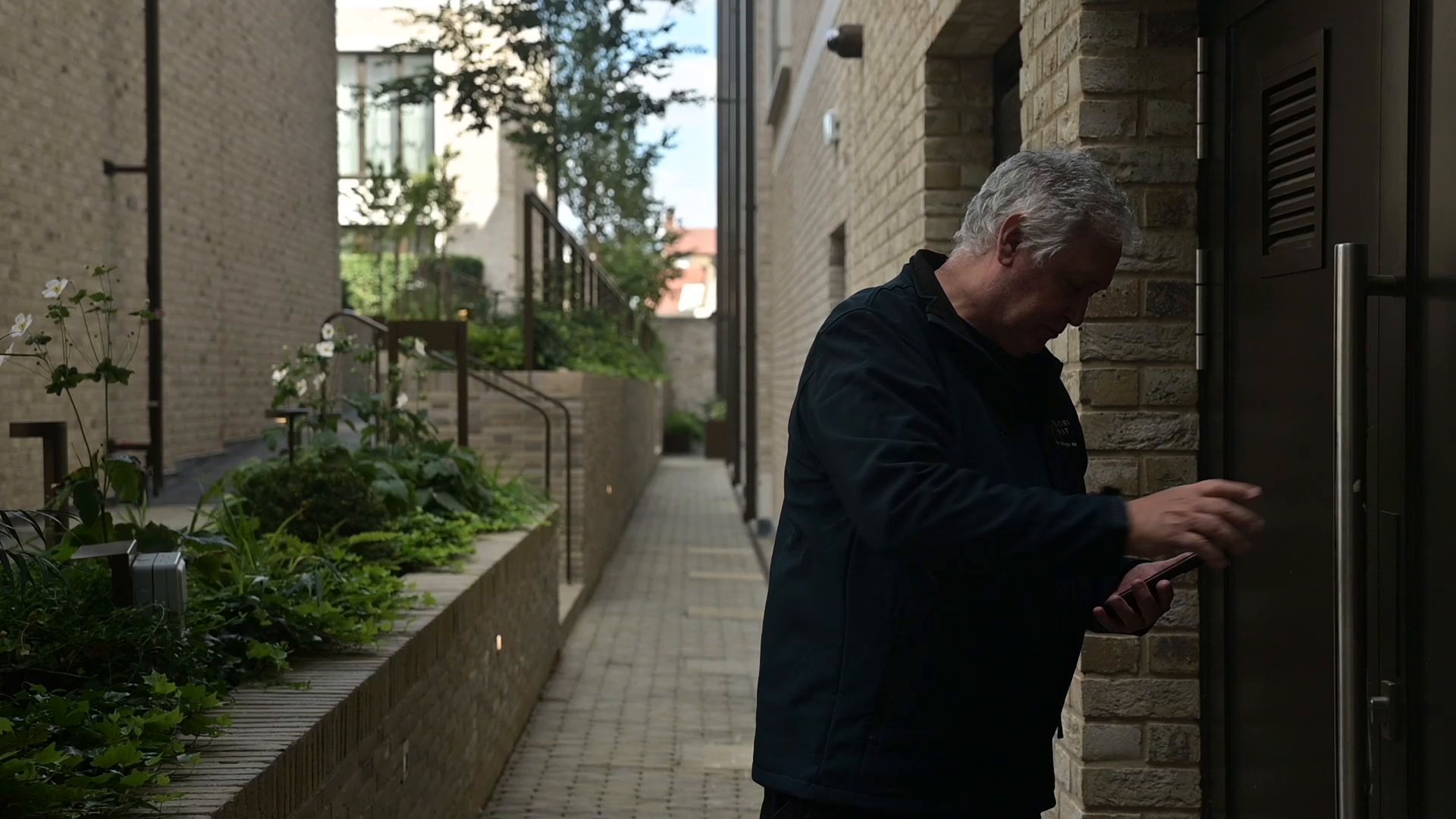
Priority First's work across a mixed-use West London development, comprising retail, residential and public areas, shows why the photo-backed element matters as much as the hardware itself. Before onboarding, officers reported rounds complete and the daily occurrence book simply read "all in order," but nobody could prove which plant room had actually been checked at 3am. Priority First introduced 152 photographed checkpoints across retail units, residential cores, service yards and plant rooms, each requiring an officer's photo, GPS location and timestamp to complete; a missed area now shows as a gap in the record rather than passing silently. Since going live in February 2026, the site has logged over 540 patrols in five months across 11 officers on one system — the same model of provable cover Priority First applies to healthcare and care-home sites.
How Much Does a Security Upgrade Cost, and How Long Does It Take?
A UK hospital or care home security upgrade typically ranges from a few thousand pounds for a single-site access control and CCTV refresh to six figures for a multi-building NHS trust rollout, with most mid-size care homes landing in a lower-to-mid four-figure monthly range once manned guarding is included. Costs scale primarily with the number of entrances, the hours of cover required and whether guarding is static or mobile.
Illustrative ranges for a typical UK care home or small hospital site:
| Element | Illustrative monthly range | Notes |
|---|---|---|
| CCTV monitoring (remote, 24/7) | Low-to-mid hundreds £ | Scales with camera count |
| SIA-licensed static guarding (single officer, nights) | Low thousands £ | Scales with hours and officer count |
| Access control system (install + maintenance) | One-off install cost, low-to-mid thousands £ | Ongoing maintenance separate |
| Key holding and alarm response | Low hundreds £ | Often bundled with guarding |
| Full security management review | One-off fee, varies by site size | Priced per assessment |
These figures are illustrative ranges only, not quotes from any published study, and actual pricing depends on site size, risk profile and hours of cover. On timeline, a focused risk assessment typically takes one to two weeks for a single-site care home; a full physical security rollout, including access control installation, follows in four to eight weeks depending on procurement lead times. Priority First's own onboarding data shows new sites can be taken live inside a fortnight, including a 10-checkpoint serviced residence, with the time to the first provable patrol on a new site measured in days rather than the weeks of bedding-in it replaces.
Outsourced guarding versus an in-house security team
Many care homes and smaller hospitals weigh up building an in-house security team against contracting an SIA-licensed provider. An in-house team offers familiarity with the site but carries full recruitment, training, licensing and rota-cover risk; an outsourced contractor like Priority First carries that administrative burden, supplies licensed officers at short notice, and bundles reporting technology that most in-house teams would otherwise have to buy separately.
What Staff Training and Procedures Improve Hospital Security?
Staff training for hospital and care-home security covers de-escalation technique, lone-working protocol and incident reporting, and it matters because the people on shift are the first line of defence long before any alarm sounds. A 2024 survey by National Nurses United found 81.6% of responding nurses had experienced at least one type of workplace violence within the previous year, according to Pinkerton, which makes frontline preparedness as important as any camera or lock.
OSHA's guidance states plainly: "One of the best protections healthcare employers can offer their workers is to establish a zero-tolerance policy toward workplace violence." A practical UK training programme should cover:
- Conflict de-escalation, teaching staff to recognise early warning signs and defuse situations verbally before they escalate.
- Lone-working protocols, following HSE guidance such as INDG73, including check-in schedules and personal alarms.
- Incident reporting procedures, ensuring every assault, near-miss or unauthorised access attempt is logged consistently, not just the serious ones.
- Induction for new security officers, confirming SIA licence validity and site-specific protocol before an officer starts a shift.
Priority First inducted seven officers to cover a single prime site, building site-specific knowledge into each officer's induction before deployment begins. As Mo Hassan, Managing Director of Priority First, puts it in the context of hospitality environments: "Hospitality security is the discipline of protecting people who must never feel policed — it takes a particular temperament, and we recruit for it specifically." The same principle applies directly to care and healthcare settings, where residents and patients must feel cared for, not surveilled.
Your Hospital and Care Facility Security Checklist
- Commission a written security risk assessment covering every entrance, ward and storage area.
- Confirm every security officer's SIA licence before they start a shift.
- Install electronic access control on pharmacy, records and plant room doors.
- Fit monitored CCTV across entrances, corridors and car parks, with footage retained per ICO (Information Commissioner's Office) data-protection guidance.
- Set up a visitor sign-in system for maternity, paediatric and dementia-care areas.
- Issue lone-worker alarms to night staff and single-handed carers.
- Require photo-backed patrol checkpoints so cover is provable, not asserted.
- Train all frontline staff in de-escalation and incident reporting at induction and annually thereafter.
FAQ
How can hospitals improve security without disrupting patient care?
Hospitals improve security without disrupting care by layering measures so clinical areas stay accessible to authorised staff while restricting entry points for the public. Electronic access control on sensitive doors, paired with a welcoming staffed reception rather than a locked-down perimeter, lets clinicians move freely while unauthorised visitors are filtered at a single, well-managed point.
What are the essential physical security measures for hospitals?
Essential physical security measures include perimeter fencing and lighting, electronic access control on wards and pharmacy areas, monitored CCTV, a visitor management system, and lone-worker alarms for staff working without direct supervision. Manned guarding with photo-backed patrols adds an auditable layer that verifies these systems are actually being checked, not just installed.
How can hospitals manage visitor access effectively?
Hospitals manage visitor access effectively by requiring sign-in at a single staffed reception point, issuing time-limited visitor badges, and restricting unescorted access to maternity, paediatric and high-dependency wards. A manned reception presence, rather than an unstaffed kiosk, allows staff to apply judgement that an automated system cannot.
What training is essential for hospital security staff?
Essential training for hospital security staff covers conflict de-escalation, lone-working protocol, incident reporting procedures and site-specific induction. SIA-licensed officers must hold a valid licence under the Private Security Industry Act 2001 before starting any shift, and ongoing refresher training keeps de-escalation skills current against rising incident rates.
Does the UK have a workplace violence standard specifically for healthcare, like OSHA's in the US?
The UK has no single dedicated healthcare workplace violence standard equivalent to OSHA's healthcare guidelines. Instead, duties are drawn from the Health and Safety at Work etc. Act 1974, HSE lone-working guidance, and CQC safeguarding requirements, which together place equivalent obligations on NHS trusts and private providers.
How can care homes reduce the risk of unauthorised access or resident abduction?
Care homes reduce unauthorised access risk through electronic door control, dementia-safe perimeter fencing, and a documented visitor sign-in process at the main entrance. Pairing these physical measures with manned overnight cover, as deployed at Priority First's 96-unit Bedfordshire care home project, closes the gap that occurs when clinical staff cannot also hold the door.
How long does a comprehensive hospital security upgrade take to implement?
A comprehensive upgrade typically takes one to two weeks for risk assessment, followed by four to eight weeks for installation of access control and CCTV, depending on procurement lead times. Manned guarding cover can be mobilised far faster — Priority First has taken new sites live inside a fortnight, including a 10-checkpoint serviced residence.
Securing Your Hospital or Care Facility with Priority First
Hospitals and care homes carry a duty of care that clinical staff alone cannot discharge, which is exactly the gap Priority First's manned guarding, access control support and photo-backed patrol reporting is built to close. Whether the challenge is an unlocked fire door, an unmonitored car park, or a night shift with no verifiable cover, the fix starts with a structured risk assessment rather than another piece of hardware.
Priority First's SIA-licensed officers already provide 24-hour, photo-backed cover at a 96-unit care home in Bedfordshire, with every checkpoint completed to a timestamped, GPS-verified standard rather than a paper occurrence book. The same reporting platform runs across 24 sites and more than 4,900 photo-backed patrols, giving facility managers a provable record they can hand to a CQC inspector or hospital board on request.
If your hospital or care facility needs a security review, overnight guarding cover, or a full Building Audit & Risk Assessment, get in touch with Priority First to discuss a site visit and a tailored quote.
Related Reading
- Commercial EICR Frequency: How Often You Need One
- What Is MEES? Office EPC C 2027 Rule Explained
- Office Cleaning Cost Per Hour in London 2026
Mo Hassan leads Priority First, a UK building-management and security-services company operating across prime central London and nationwide. Mo writes on physical security, construction-site protection, CCTV, and building operations.
Over a decade in premium building management and security operations
Specialises in Building management, Security operations, Construction site security