Enhance Construction Safety with 5 Key Security AI Tools

Last updated: 7 September 2026
Quick answer: AI security tools improve construction site safety through four core functions — automated CCTV (closed-circuit television) surveillance, predictive risk analytics, real-time alerts and PPE (personal protective equipment) compliance monitoring — reducing reliance on manual checks and closing gaps that let theft and unsafe behaviour go undetected. Construction theft costs UK businesses more than £1m a week, making these tools a financial priority as well as a safety one.
Key Takeaways
- Construction theft costs UK businesses more than £1m a week, making site security a direct financial issue, not just a compliance one.
- AI security tools on construction sites typically fall into five categories: smart cameras, drones, environmental sensors, predictive analytics software, and AI-driven access control.
- Effective AI adoption follows six steps: evaluate current measures, select suitable tools, plan integration, pilot test, deploy fully, then monitor and adjust continuously.
- An industry survey found that 81% of professionals have only basic or moderate AI knowledge, and 46% cite a lack of formal training as a barrier to using AI tools effectively, pointing to a genuine skills gap in the sector.
- Non-compliance with data protection rules, such as UK GDPR (General Data Protection Regulation) requirements enforced by the ICO (Information Commissioner's Office), can carry significant financial penalties, reinforcing the case for automated, auditable compliance monitoring.
- Priority First's photo-verification standard has taken checkpoint completions on one mixed-use development from 0% carrying a watermarked photo to 100%, producing 152 photographed checkpoints where none existed before.
Introduction
AI is reshaping the construction industry by changing how safety and security are managed on job sites. Advanced technologies now give construction managers tools that enhance monitoring, predict potential risks, and support compliance with safety regulations enforced by the Health and Safety Executive (HSE), the UK's workplace safety regulator. As these tools become standard practice in 2026, a critical question emerges: how can construction professionals effectively deploy AI to protect their sites and build a genuine culture of safety among workers?
Ignoring this question carries real consequences. The costs associated with inadequate safety measures can be substantial, affecting finances, operational efficiency and reputation. Construction theft alone costs UK businesses over £1m a week, underscoring the need for robust security measures on every active site.
This article explores five categories of AI security tools that can materially improve construction safety, along with how to integrate them, train staff to use them, and measure whether they're working. Early investment in these technologies is a strategic move towards long-term operational resilience, not merely a protective measure.
What Is Construction Security AI?
Construction security AI is a category of software and hardware systems that apply machine learning and computer vision to site surveillance, access control and risk detection, automating tasks that were previously handled by manual patrols and paper logs. These systems do not replace human security personnel outright; instead, they process camera feeds, sensor data and historical incident records to flag anomalies, predict risks and enforce compliance rules faster and more consistently than manual monitoring alone.
Construction security AI covers a spread of distinct technologies — from AI-enhanced CCTV analytics to drone-based aerial inspection and automated access control — each addressing a different part of the site security picture. Understanding this range matters because no single tool covers every risk: a smart camera system will not detect a gas leak, and a drone will not manage who passes through a site gate. The sections below break down how each function works and where it fits into an overall security AI strategy.
What Role Does AI Play in Construction Site Security?
AI reshapes construction site safety by automating monitoring, analysing large volumes of operational data, and delivering real-time insights that would take human teams far longer to compile manually. This is a direct response to the security challenges the construction industry faces, from theft and vandalism to unsafe worker behaviour, not simply a technology upgrade. The core functions fall into four areas: automated surveillance, predictive analytics, real-time alerts and compliance monitoring, each discussed below.
Automated Surveillance: AI systems analyse video feeds from CCTV cameras to detect unauthorised access or unsafe behaviours. This reduces the need for constant human oversight, supporting more consistent monitoring and minimising the risk of missed incidents caused by human error or fatigue.
Predictive Analytics: By analysing historical data, AI can flag patterns that suggest a heightened risk of security breaches or safety incidents, allowing site managers to take proactive measures before problems occur. This capability matters because industry reporting has noted a pattern of construction firms experiencing cyberattacks in recent years, a risk that extends beyond physical security into connected site systems.
Real-time Alerts: AI tools send instant notifications to site managers when anomalies are detected, whether that's an unrecognised vehicle at a gate or a worker in a restricted zone. Timely alerts allow minor issues to be addressed before they escalate into major incidents.
Compliance Monitoring: AI supports adherence to safety protocols, including PPE compliance, by analysing worker behaviour and equipment usage. Beyond safety outcomes, this matters because breaches of data protection obligations under UK GDPR can result in significant penalties from the ICO, so any AI system processing worker images or biometric data needs to be deployed with compliance in mind from the outset.
Understanding these functions helps stakeholders see how security AI can reduce risks across a site rather than simply reacting to incidents after they happen. For firms managing high-value London developments, the same principle — verifiable, real-time evidence rather than assumptions — underpins services like close protection in Central London, where documented, timestamped activity is what makes a security operation defensible.
Which AI Tools Deliver the Biggest Safety Gains?
Five categories of AI tool account for most of the practical safety gains seen on construction sites today: smart cameras, drones, environmental sensors, predictive analytics software and access control systems. Each targets a different risk, so most sites benefit from combining several tools rather than relying on just one.
- Smart Cameras: These monitor site activity, detect unsafe behaviours, and support compliance with safety regulations by alerting supervisors in real time if workers are not wearing appropriate PPE.
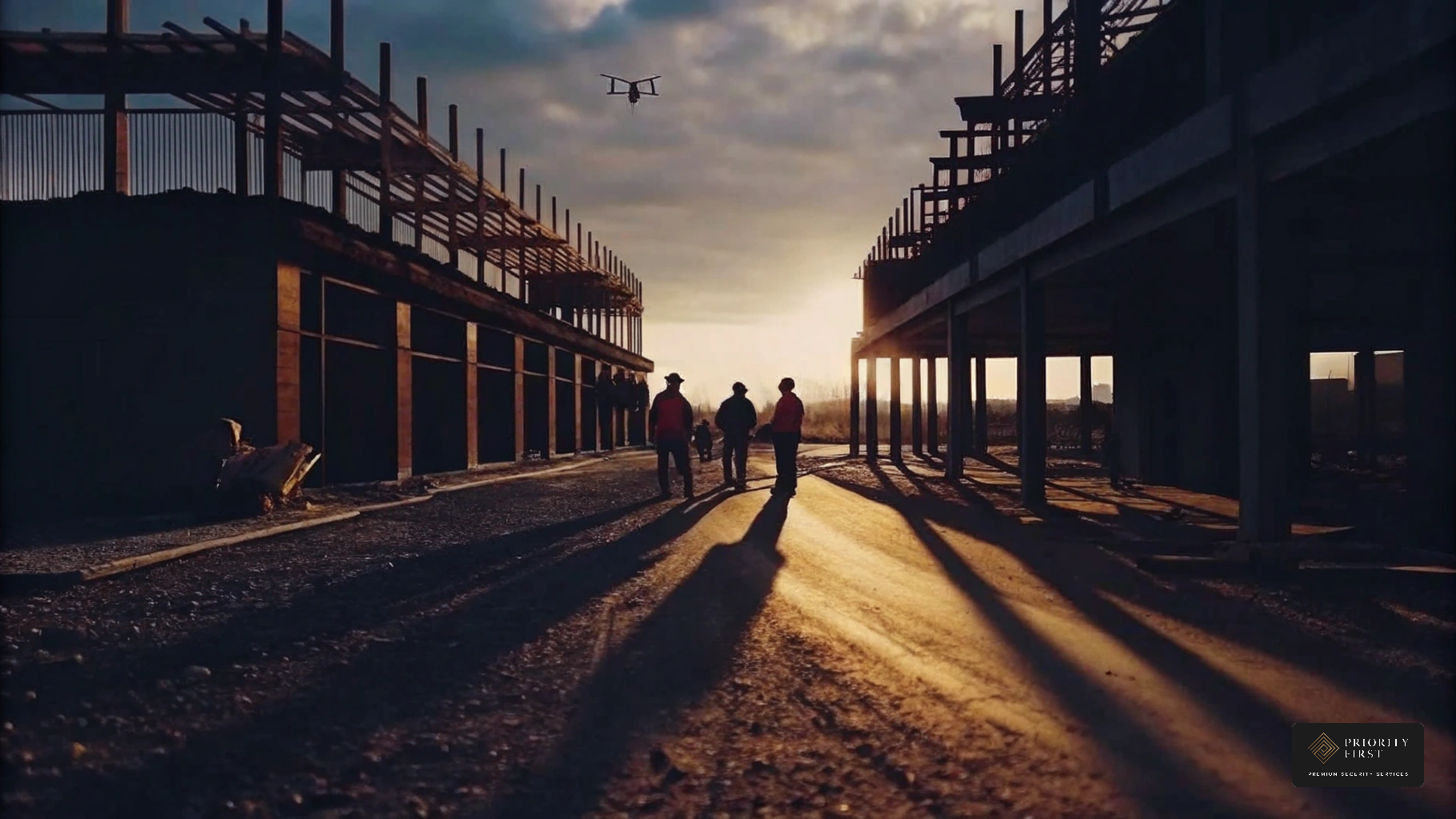
- Drones: Fitted with AI-powered imaging, drones carry out aerial inspections of building sites, identifying hazards such as unstable structures or blocked access routes that are hard to spot from ground level.
- AI-Powered Sensors: These detect environmental changes such as gas leaks or early signs of structural weakness, providing warnings before conditions become dangerous.
- Predictive Analytics Software: This software examines historical incident and access data to flag patterns associated with elevated risk, enabling pre-emptive action rather than after-the-fact response.
- Access Control Systems: AI-driven access control manages who enters and exits a site, restricting entry to authorised personnel and reducing theft and vandalism risk — a function closely related to the keyholding and alarm response work used on commercial and residential sites across London.
Understanding these tools helps construction managers choose technologies suited to their specific site risks rather than adopting AI for its own sake. Skipping this step can leave real gaps: a site with strong camera coverage but weak access control, for instance, may still be vulnerable to unauthorised entry outside working hours.
How Do You Integrate AI Tools into Existing Security Protocols?
Integrating AI tools into existing security protocols works best as a staged, six-step process: audit current measures, select the right tools, plan the rollout, pilot on a limited scale, deploy fully, then monitor continuously. Skipping the pilot stage is the most common reason AI rollouts underperform, because problems that would have been minor on one site become disruptive once repeated across an entire portfolio.
Evaluate Current Protection Measures: Review existing protocols to identify the gaps AI tools can address, covering current surveillance methods, access control systems and incident response procedures.
Select Suitable AI Solutions: Choose tools that match your specific security requirements, weighing ease of integration, cost-effectiveness and scalability so the system can grow with your site portfolio.
Develop an Integration Plan: Set out timelines, resource allocation and staff training requirements for incorporating the new tools into existing systems.
Pilot Testing: Trial the tools on a smaller scale before full rollout, allowing adjustments to be made without disrupting the whole site.
Complete Deployment: Once the pilot proves successful, roll the tools out across the full site. Make sure every team member understands how the new systems work.
Continuous Monitoring and Adjustment: After deployment, keep observing system performance and adjust as conditions change, since site risks — weather, workforce turnover, phase of construction — shift throughout a project.
Following this sequence helps construction managers incorporate AI tools into security protocols without the disruption of an untested, all-at-once rollout. AI-based detection can also surface risks that manual checks routinely miss simply because a human cannot watch every camera feed at once — which is precisely the gap that photo-verified patrol systems are designed to close.
How Should Personnel Be Trained on AI Tool Utilisation?
Training staff to use security AI tools properly is essential, because a system that nobody understands how to operate delivers little safety benefit regardless of its underlying technology. An industry survey found that 81% of professionals have only basic or moderate AI knowledge, pointing to a real skills gap that formal training programmes need to close.
The first step is identifying training needs based on each role and the specific AI tools being introduced — a camera operator, a site manager and a gate security officer each need different depth of knowledge.
Next, develop training materials covering system functionality, safety protocols and troubleshooting. Mixing formats — manuals, videos and hands-on demonstrations — helps different learners absorb the material.
Hands-on training sessions matter most. Structured, practical training that lets staff operate the equipment in a controlled setting reinforces learning far more effectively than documentation alone.
Ongoing support after initial training is equally important. Refresher courses and access to a dedicated support contact help staff resolve issues as they arise. The same industry survey found that 46% of professionals cite a lack of formal training as a barrier to using AI tools effectively, which underlines why one-off training sessions are rarely sufficient on their own.
Construction managers should regularly review training effectiveness through feedback and performance metrics, adjusting materials as needed. It is also worth being alert to "shadow use" of AI tools — staff using systems informally without proper guidance — which formal training and clear internal policy can help prevent. Publicly funded training support, such as schemes delivered through Innovate UK's BridgeAI programme, may also be available to help build internal AI capability.
Investing in comprehensive training ensures staff are genuinely equipped to use security AI tools, which is what ultimately determines whether the technology improves safety on site.
How Do You Monitor and Evaluate AI Security Effectiveness?
Monitoring AI security effectiveness against defined KPIs (Key Performance Indicators) is what separates AI tools that genuinely improve site safety from tools that are switched on and then ignored. Without regular evaluation, it is difficult to know whether a system is catching real risks or simply generating noise — and businesses that skip this step risk both operational and financial setbacks when a gap in coverage goes unnoticed.
Establish Key Performance Indicators: Define KPIs that align with safety objectives, such as incident response times, the number of detected threats, and compliance rates with safety protocols. AI systems can also monitor machinery location, alerting managers to unauthorised movement or tampering — a function directly relevant to equipment theft prevention.
Regular Data Analysis: Continuously analyse the data AI tools generate against your KPIs, watching for trends such as rising unauthorised access attempts or recurring PPE non-compliance. Facial recognition or ID verification at site entrances helps confirm that only authorised individuals gain entry — a control that only works if the underlying data is reviewed regularly rather than left unchecked.
Conduct Periodic Reviews: Schedule regular assessments of AI tool effectiveness involving relevant stakeholders, so the evaluation reflects perspectives from security staff, site managers and compliance leads rather than one team alone.
Solicit Feedback from Personnel: Gather input from the staff actually using the tools day to day. Front-line feedback often surfaces usability issues that KPI data alone won't show, and real-time alerts are only useful if the people receiving them trust and act on them.
Modify Approaches as Required: Use evaluation results to update software, refine training, or adjust operational procedures to better fit site-specific conditions. Given that non-compliance with safety or data protection rules can carry significant financial penalties from the ICO, this ongoing review process is not optional — it is part of maintaining a defensible security operation. This is the same principle that underpins evidence-based patrol management: a system is only as good as the record it produces, and that record needs to be checked, not assumed.
Your Construction Site AI Security Checklist
- Audit current surveillance, access control and incident response measures to identify specific gaps.
- Match AI tools to actual site risks — don't adopt technology that duplicates existing coverage.
- Pilot any new AI tool on a limited area before full-site deployment.
- Set clear KPIs (incident response time, detected threats, compliance rate) before going live.
- Train every role separately — camera operators, site managers and gate staff need different depth of training.
- Build in refresher training and a dedicated support contact, not just a one-off induction.
- Review AI-generated data against KPIs on a fixed schedule, not ad hoc.
- Confirm any system processing images or biometric data complies with UK GDPR and ICO guidance.
Conclusion
AI is transforming construction site safety by offering solutions that address the industry's growing security challenges. Integrating AI tools allows construction managers to strengthen safety protocols, streamline operations, and better protect both workforce and assets.
Four categories of AI application — automated surveillance, predictive analytics, real-time alerts and compliance monitoring — are now widely available and practical to deploy. These tools reduce the risk of human error and support proactive responses to potential threats, contributing to a safer working environment. Training personnel properly is just as important as choosing the right technology; a well-prepared team is what actually determines whether AI delivers on its promise.
As the construction industry evolves, embracing AI tools is becoming a standard part of managing site security, not an optional extra. By investing in the right technology, training staff thoroughly and monitoring performance on an ongoing basis, construction managers can build operations resilient enough to adapt as site conditions change. The effective, well-governed use of AI is a growing priority for anyone responsible for protecting people and assets on site.
Turning AI Insight into Physical Assurance on Site
AI tools are excellent at flagging risk — an unrecognised vehicle at the gate, a worker without PPE, a sensor reading outside normal range. But an alert only matters if a real person responds to it, verifiably, and that response is recorded. This is the gap between detection and assurance, and it's where Priority First's approach to site security is built: SIA-licensed (Security Industry Authority-licensed) manned guarding and construction site security combined with a patrol system where every checkpoint requires a photo to complete, so a missed area shows up as a gap in the record rather than passing silently.
That standard isn't theoretical. On one mixed-use development, Priority First's photo-verification requirement took checkpoint completions from 0% carrying a watermarked photo to 100%, turning what had been an unprovable patrol routine into 152 photographed checkpoints with full accountability. Across the wider portfolio, that same evidence standard now covers 4,900+ photo-backed patrols, each timestamped, GPS-tagged and tied to a named officer — the kind of auditable record that AI-driven monitoring is meant to complement, not replace. Priority First's manned guarding operations, detailed further in this guide to manned guarding services in London, apply the same evidence standard to commercial and residential sites beyond construction.
If your construction site, mixed-use development or residential estate needs security that pairs AI-era monitoring with accountable officers on the ground — whether that's manned guarding, keyholding and alarm response, or full site security during a build — get in touch with Priority First for a quote tailored to your site.
Frequently Asked Questions
How is AI transforming construction site security?
AI transforms construction site security by automating monitoring, analysing large volumes of data, and delivering real-time insights that address the theft, unsafe behaviour and unauthorised access risks the industry faces. It works alongside, rather than instead of, on-site personnel who respond to and verify what the system flags.
What role does automated surveillance play in construction site security?
Automated surveillance uses AI systems to analyse CCTV video feeds, detecting unauthorised access or unsafe behaviours without needing constant human monitoring. This reduces the chance of incidents being missed due to human oversight limitations, such as fatigue during long shifts.
How does predictive analytics contribute to construction site security?
Predictive analytics uses historical data to identify patterns linked to a heightened risk of security breaches or safety incidents, allowing managers to act before problems occur. This capability is increasingly relevant given industry reports of construction firms experiencing cyberattacks in recent years.
What are real-time alerts and how do they function in construction security?
Real-time alerts are instant notifications AI tools send to site managers when anomalies are detected. They enable a swift response to potential threats — such as an unrecognised vehicle at a gate — and help maintain compliance on active construction sites.
How does AI assist with compliance monitoring on construction sites?
AI assists compliance monitoring by analysing worker behaviour and PPE usage against safety protocols, helping reduce the risk of non-compliance. This matters because breaches, including under UK GDPR rules enforced by the ICO where personal data is involved, can carry financial penalties.
What are some key AI tools that enhance safety on construction sites?
The main categories are smart cameras, drones, AI-powered environmental sensors, predictive analytics software, and AI-driven access control systems. Each addresses a different aspect of site monitoring, hazard detection and compliance.
What function do smart cameras serve in construction site safety?
Smart cameras monitor site activity and detect unsafe behaviours, alerting supervisors in real time if workers are not wearing appropriate PPE. This supports ongoing compliance with safety regulations enforced by the HSE.
How do drones contribute to construction site safety?
Drones fitted with AI-powered imaging carry out aerial inspections of building sites, identifying hazards such as structural issues or blocked access routes that are difficult to spot from ground level. This gives site managers visibility that ground-based patrols alone cannot provide.
What is the purpose of AI-powered sensors on construction sites?
AI-powered sensors detect environmental changes such as gas leaks or early structural weaknesses, giving site teams advance warning before conditions become dangerous.
Why is early investment in AI technologies important for construction companies?
Early investment in AI technologies helps reduce operational risk, strengthen safety outcomes and build resilience against costly incidents, since retrofitting security measures after a loss is typically more expensive than preventing one.