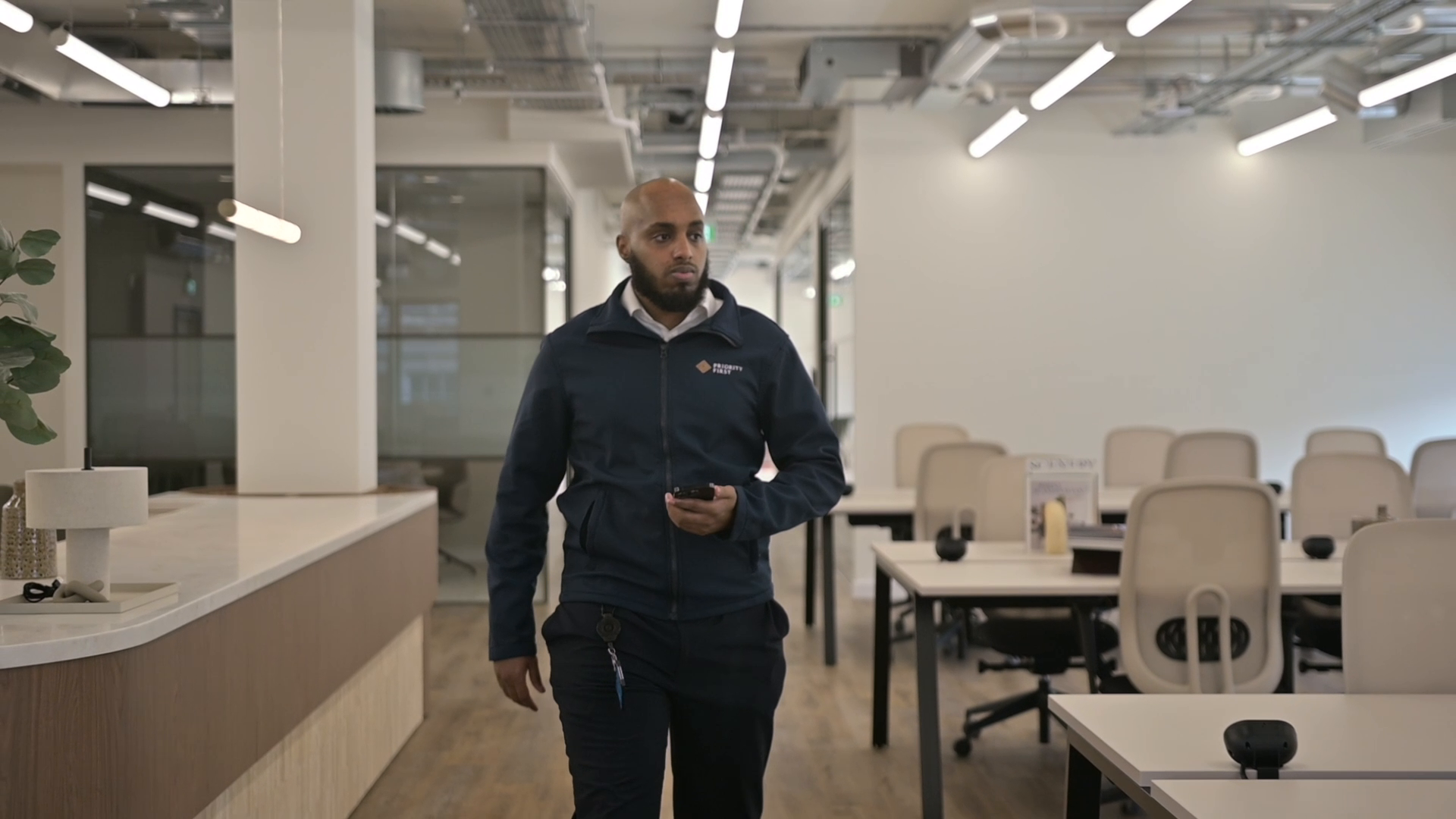
Corporate Security Guards London: Costs & SIA Rules 2026


Last updated: 13 October 2026
Corporate security guards in London are SIA-licensed officers deployed by manned guarding companies to protect offices, reception areas and corporate premises. Typical contract rates range from roughly £15-£25 per hour depending on location and service level, with Westminster and Kensington and Chelsea among the highest-paying boroughs in the capital.
Key Takeaways
- Priority First requires corporate security guards in London to hold a valid SIA licence issued by the Security Industry Authority under the Private Security Industry Act 2001, renewable every three years.
- The SIA licence fee is £184, rising to £204 from April 2026, a cost typically built into a provider's contract rate rather than charged separately (Dockside Personnel, 2026).
- The average London security guard wage is £14.77 per hour, with Westminster averaging £18.57/hr and Kensington and Chelsea £17.26/hr (Indeed, 2026).
- The City of London's crime rate stands well above the UK average, which is a key driver behind corporate demand for manned guarding in the Square Mile.
- Priority First has secured over £1.6 billion in client assets across prime central London and nationwide, operating SIA-licensed teams with photo-backed, GPS-timestamped patrol evidence.
What Are Corporate Security Guards in London?
Corporate security guards are SIA-licensed personnel contracted to protect office buildings, reception areas and commercial premises, combining access control, visitor management and front-of-house duties. The Security Industry Authority (SIA), the body established under the Private Security Industry Act 2001, licenses every guard working in a regulated role in England and Wales.
Unlike retail or door supervision security, corporate guarding blends protective duties with a client-facing, service-led role. A guard at a Mayfair head office or a Canary Wharf trading floor is often the first person a visitor, courier or contractor encounters, so professionalism sits alongside vigilance.
London's commercial geography shapes demand unevenly. The City of London, the historic financial district also known as the Square Mile, records a crime rate considerably higher than the UK average — though this has fallen 8.8% year-on-year, reflecting both high footfall and sustained investment in private and public security.
What Services Do Corporate Security Guard Companies in London Typically Offer?
Corporate security guard companies in London typically offer static guarding, mobile patrols, concierge front-of-house, key holding, CCTV monitoring and alarm response as a combined package rather than isolated services. Most mid-to-large office clients now buy a blended model rather than a single guard on a chair.
A typical London corporate security contract includes:
- Static guarding — officers stationed at reception, loading bays or specific access points.
- Mobile patrols — roving officers covering multiple floors, car parks or external perimeters on a scheduled or randomised pattern.
- Concierge and front-of-house management — a five-star welcome combined with visitor sign-in, deliveries and access control.
- Key holding and alarm response — 24-hour holding of premises keys with a trained response to triggered alarms, removing the need for staff call-outs.
- CCTV monitoring — round-the-clock remote surveillance with trained operators who escalate incidents in real time.
- Building and facilities management — security coordinated alongside maintenance, compliance and building upkeep under one accountable supplier.
Priority First delivers this blended model as standard, running manned security, keyholding, alarmed response, street patrol, CCTV monitoring, construction security, logistics management, facilities management, canine services and concierge from a single platform. Across a 24-site portfolio monitored since early 2026, more than 4,900 photo-backed patrols have been logged, each carrying officer ID, GPS location and a timestamp — consistent with the wider market move toward technology-integrated manned guarding that the industry's growth in outsourced security functions reflects (Research and Markets / GlobeNewswire, 2026), illustrating the shift from paper-based assurance to provable delivery and adding a verifiable audit trail on top of it.
How Much Does It Cost to Hire Corporate Security Guards in London?
Corporate security guard costs in London typically range from £15 to £25 per contracted hour depending on borough, shift pattern and service tier, sitting above the raw guard wage because contract rates also cover supervision, licensing, insurance and equipment. Westminster and Kensington and Chelsea carry the capital's highest guard wages, at £18.57/hr and £17.26/hr respectively, which feeds directly into contract pricing in those boroughs (Indeed, 2026).
| Service level | Typical London contract rate (per hour) | Best suited to |
|---|---|---|
| Single static guard, daytime | £15-£18 | Small offices, reception-only cover |
| Static guard, 24/7 rotation | £18-£22 | Mid-size corporate HQs, multi-tenant buildings |
| Concierge/front-of-house | £17-£23 | Premium residential and corporate lobbies |
| Mobile patrol (shared across sites) | £12-£16 per hour of coverage | Multi-site estates, car parks, construction |
| Supervisor/site manager uplift | +£3-£5 | Larger teams requiring on-site management |
Worked example 1: A single-reception office in Mayfair running one static guard, 8am-6pm, five days a week at £18/hr, totals roughly £3,700-£3,900 per month.
Worked example 2: A 24/7 corporate HQ in the City of London needing three shifts covered daily at an average £20/hr blended rate runs to approximately £43,800-£44,800 per month, before any concierge or patrol add-ons.
Ways to reduce costs:
- Combine static guarding with mobile patrols across a portfolio rather than a dedicated guard per site.
- Bundle CCTV monitoring with manned guarding to reduce overnight headcount.
- Use key holding and alarm response instead of a permanent night guard for lower-risk premises.
Alternatives to consider: A vacant or low-footfall property may need only CCTV monitoring and scheduled patrols rather than a static guard; a busy reception, by contrast, usually justifies full concierge cover. Priority First's Building Audit & Risk Assessments service helps clients establish which tier actually fits their risk profile before committing to a contract.
What Licences and SIA Accreditation Does Priority First Require Corporate Security Guards to Hold?
Priority First requires every corporate security guard working in a licensable role in England and Wales to hold a valid SIA licence issued under the Private Security Industry Act 2001. The Security Industry Authority, the UK's statutory regulator for the private security industry, confirms licensing requirements through its official guidance on GOV.UK.
SIA licences run for three years and must be renewed before expiry to remain legally valid for work (Tragopan Security, 2026). The licence fee stands at £184, increasing to £204 from April 2026, a cost most corporate clients never see directly because it sits within their provider's hourly rate (Dockside Personnel, 2026).
Beyond the individual licence, businesses should understand two further layers:
- The SIA Approved Contractor Scheme (ACS) is the regulator's voluntary quality benchmark for security businesses, assessing whether a company is "fit and proper" against published standards (SIA ACS guidance). Clients can check a contractor's status on the SIA's official register.
- The Terrorism (Protection of Premises) Act 2026, widely known as Martyn's Law, designates the SIA as regulator for publicly accessible premises and will impose standard-tier (200-799 capacity) or enhanced-tier (800+ capacity) duties from spring 2027 (Martyn's Law official resource). Corporate office buildings with public-facing reception or event space should begin reviewing which tier applies now rather than waiting for enforcement.
The UK leads Europe on licensed security headcount, with over 300,000 licensed personnel against Germany's 220,000 and France's 195,000 — evidence of how central formal licensing is to how the UK market operates compared with its neighbours (Market Reports World, 2026).
How Do I Choose a Reputable Corporate Security Guard Company in London?
Choosing a reputable corporate security guard company in London means verifying SIA licensing, checking ACS status where claimed, and confirming the provider logs evidence of delivered cover rather than relying on a paper occurrence book. A provider's ability to prove a patrol happened — not just assert it — has become the clearest marker of operational maturity in 2026.
Ask to see how incidents, deliveries and patrols are recorded, and whether supervisors can produce time-stamped evidence on request. "A concierge is the first impression your building makes, every single day. Anyone can check a visitor list. The standard we hold is that residents and guests are greeted by name, problems are owned rather than reported upwards, and security is done so smoothly it reads as service," says Mo Hassan, Managing Director of Priority First.
In practice, this problem is exactly what a West London mixed-use development faced before working with Priority First. The site spanned retail, residential and service areas across 152 separate checkpoints, including plant rooms and service yards, but officers' daily occurrence books simply recorded "all in order" with no way to prove which plant room had actually been checked at 3am. Since Priority First's system went live in February 2026, every one of the 152 checkpoints now requires a photo, officer ID and GPS timestamp to complete, with more than 540 patrols logged in the first five months and any missed area showing as a visible gap rather than passing silently.
When vetting providers, check:
- Confirmation of BS 7858 screening (the British Standard for security personnel vetting) for all deployed officers.
- Whether the company holds insurance appropriate to the value of assets being protected.
- How quickly the provider can produce incident records when a client asks for them.
- Whether contracts specify named supervisors, not just rostered guard numbers.
How Many Security Guards Does a Typical Corporate Office or Building Need?
The right number of corporate security guards depends on building size, footfall, access points and risk profile rather than a fixed industry ratio. A small single-entrance office of under 50 staff may need only one daytime static guard, while a multi-tenant City of London tower with multiple entrances, loading bays and basement car parking typically needs a rotating team of three to seven officers across a 24-hour cycle.
Priority First's deployment data reflects this range in practice. Inducting a team to cover a single prime central London site has required as many as seven officers once shift rotation, holiday cover and supervision are accounted for, while a 96-unit care home in Bedfordshire — a very different risk profile needing continuous, non-negotiable cover — moved from no documented patrol system to more than 1,000 photo-backed patrols almost immediately after onboarding.
A simple framework for estimating headcount:
| Building type | Typical guard requirement |
|---|---|
| Single-entrance office, under 50 staff | 1 static guard, business hours |
| Mid-size HQ, 50-250 staff, one main entrance | 1-2 static guards, extended hours, plus mobile patrol |
| Multi-tenant tower, multiple entrances/car park | 3-5 officers, 24/7 rotation |
| Mixed-use estate (retail, residential, commercial) | 7+ officers across multiple checkpoints and shifts |
What Legal Responsibilities Does a Business Have When Hiring Security Guards?
A business hiring corporate security guards carries legal duties under the Health and Safety at Work etc. Act 1974, which requires employers to ensure the safety of staff, visitors and contracted personnel on their premises, including security officers. Priority First also confirms that any contracted security firm deploys only SIA-licensed individuals, since using unlicensed security staff is itself a criminal offence under the Private Security Industry Act 2001.
Data protection is a further responsibility. Any business operating CCTV or visitor-logging systems as part of its security arrangements must comply with the UK GDPR and guidance from the Information Commissioner's Office (ICO), particularly around retention periods and access requests.
Contracts should also clarify liability and indemnity. A business commissioning security guards remains responsible for ensuring the contractor carries adequate public liability insurance, and for confirming — in writing — who is accountable if a security failure results in theft, injury or property damage on site.
Your corporate security guards London checklist
- Confirm every officer deployed on site holds a current, verifiable SIA licence.
- Ask the provider to show how patrols, incidents and deliveries are evidenced, not just logged.
- Check whether the provider appears on the SIA Approved Contractor register if ACS status is claimed.
- Request confirmation of BS 7858 vetting for all guards assigned to your contract.
- Assess your building against Martyn's Law tiers ahead of the spring 2027 enforcement date.
- Match guard numbers to entrances, footfall and risk, not a flat industry assumption.
- Clarify insurance, liability and data protection responsibilities in the written contract.
- Ask how quickly the provider can deploy cover in an emergency.
FAQ
Do corporate security guards in London need an SIA licence?
Yes, Priority First requires every corporate security guard performing licensable activity in England and Wales to hold a current SIA licence under the Private Security Industry Act 2001. Licences run for three years and must be renewed before expiry to remain valid (Tragopan Security, 2026).
How much does it cost to hire corporate security guards in London?
Corporate security contract rates in London typically range from £15 to £25 per hour depending on borough, shift pattern and service tier. Westminster and Kensington and Chelsea sit at the higher end, with average guard wages of £18.57/hr and £17.26/hr respectively (Indeed, 2026).
What is the difference between static guards, mobile patrols and concierge security?
Static guards are stationed permanently at a single point such as reception, mobile patrols cover multiple areas or sites on a scheduled or random route, and concierge security combines front-of-house hospitality duties with access control and visitor management. Most corporate offices in London now combine at least two of these three models.
What is the SIA Approved Contractor Scheme and why does it matter?
The SIA Approved Contractor Scheme (ACS) is the regulator's voluntary accreditation assessing whether a security business is "fit and proper" against published quality standards. Clients can verify a contractor's ACS status directly on the SIA's official register before signing a contract.
How quickly can a security guard company deploy staff to a London office?
Response times vary by provider and situation, but a well-resourced company can mobilise an SIA-licensed officer within hours of an emergency call. Priority First deployed an SIA operative to a break-in at a Covent Garden site within two hours of first contact — the client called at 12:30, agreed a quote on the same call, and had an officer on site by 14:30.
How does Martyn's Law affect businesses hiring security guards?
The Terrorism (Protection of Premises) Act 2026, known as Martyn's Law, places standard-tier (200-799 capacity) or enhanced-tier (800+ capacity) security duties on publicly accessible premises, with the SIA acting as regulator. Enforcement begins in spring 2027, so corporate buildings with public access should assess which tier applies well ahead of that date (Martyn's Law official resource).
How does outsourced corporate security compare to an in-house team on cost and reliability?
Outsourced providers spread licensing, training, insurance and supervision costs across many clients, which usually makes them cheaper than recruiting, vetting and managing an in-house team directly. Reliability also depends on evidencing delivery — the UK private security market remains substantial in value despite a -0.5% CAGR between 2019 and 2026, reflecting a market where quality and proof of service increasingly separate providers from one another.
Securing your corporate premises with Priority First
The challenges this article covers — unclear pricing, unverifiable patrols and uncertainty over licensing — are exactly what Priority First's corporate security clients bring to the table before onboarding. Priority First replaces the paper occurrence book with a single platform covering patrols, incidents, deliveries and shift handovers, so cover delivered to a Mayfair office or a City of London headquarters is provable rather than assumed.
Priority First currently protects over £1.6 billion in client assets across prime central London — including Chelsea, Knightsbridge and Mayfair — West London, the West Midlands and Bedfordshire, maintaining a 5.0-star rating from 63 Google reviews. As one client, James Burmingham, put it: "the monitoring service has been top-notch—quick responses, clear communication, and the peace of mind we've been looking for."
If your business needs SIA-licensed corporate security guards in London with evidence you can actually check, get in touch with Priority First to discuss your building and request a quote through the Corporate Security team.
Related Reading
- Concierge Security Services London 2026 | Priority First
- How to Become a Security Guard UK: Complete 2026 Guide
- Security Guard Hire UK 2026: Expert Services & Compliance

Lauren Dawkins is a co-founder and director of Priority First, the Mayfair-based building management and security company. Lauren works across the company's facilities management and corporate security services for residential, commercial and construction clients in London.
Specialises in Facilities management, Corporate security, Integrated security and FM