


CCTV on Construction Sites: Why Footage Alone Isn't Proof

Last updated: 12 October 2026
Quick Answer
CCTV footage shows what happened on a construction site, but it does not prove a patrol or checkpoint was actually checked unless each check produces its own photo. Priority First's evidence standard requires a photo to complete every checkpoint, so a missed area shows as a visible gap in the record rather than passing silently.
Key Takeaways
- A CCTV recording and a verified patrol are not the same thing: footage can exist without anyone having checked a specific area at a specific time.
- Priority First's evidence standard requires a photo, with officer ID, GPS and timestamp, to mark any checkpoint as complete.
- On one mixed-use development, Priority First moved from zero photographed checkpoints to 152, with 100% of checkpoint completions carrying a watermarked photo.
- Across a 16-building prime estate, Priority First records 250–280 patrols per building, all photo-backed — coverage that was previously unprovable on paper logs.
- Construction theft costs UK businesses over £1 million a week, according to industry reporting, which is the scale of loss that unverified "patrols" fail to prevent.
Introduction
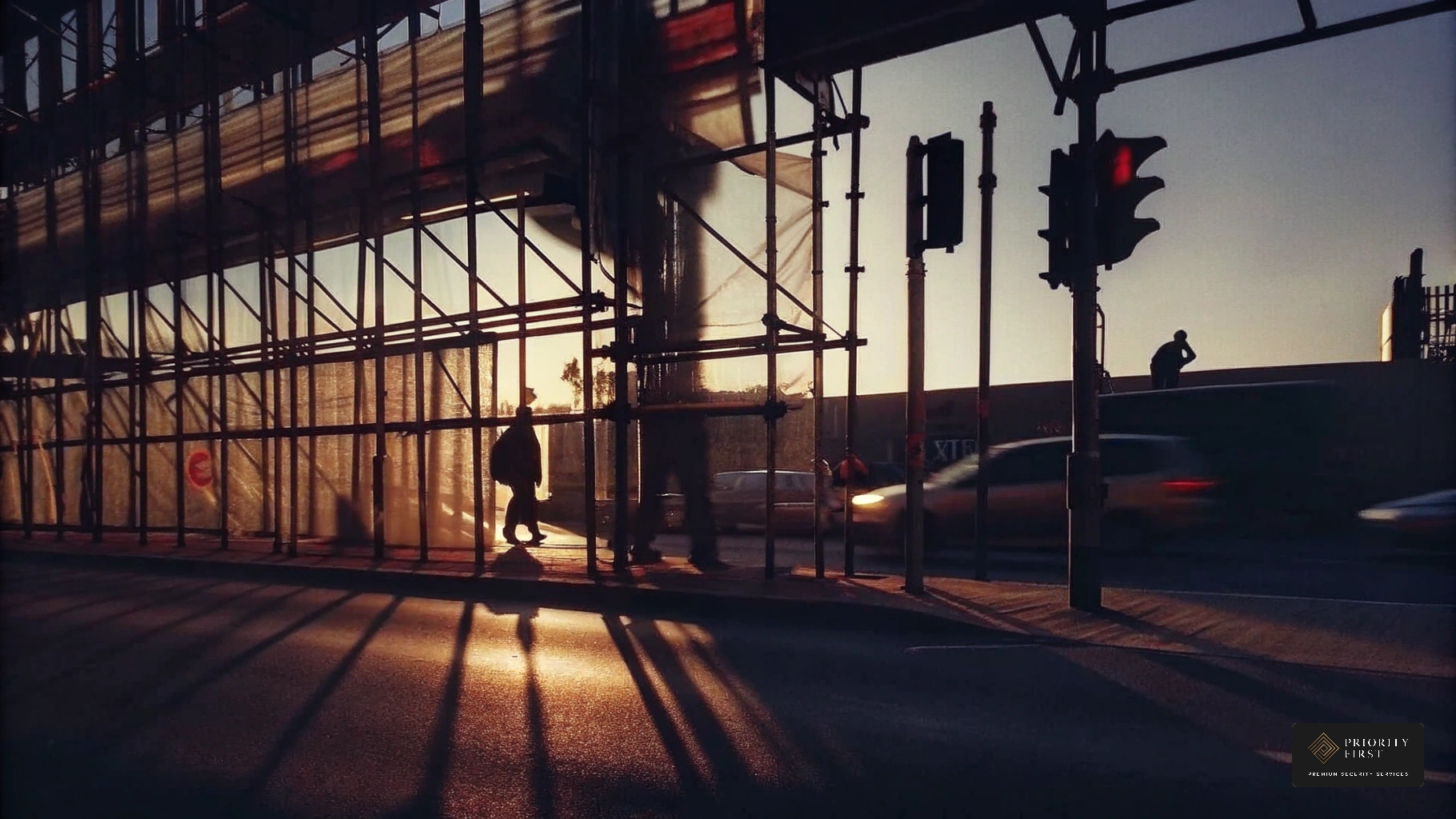
Construction sites lose money to theft and vandalism every week, and a camera pointed at a compound does not, by itself, stop that. Construction theft costs UK businesses over £1 million a week, a figure that explains why site managers keep investing in CCTV — and why so many of them are still disappointed by what it actually delivers when an incident happens.
The usual failure is not the camera. It is the gap between "a camera was recording" and "someone checked this area, at this time, and can prove it." A hard drive full of unreviewed footage does not tell a project manager whether a scaffolding point was patrolled at 2am, whether a storage container was checked before the site closed, or whether a missed checkpoint on a night shift went unnoticed for a week. That gap is where theft, vandalism and disputed insurance claims live.
This article looks at what a CCTV surveillance system actually needs to do on a construction site, where camera technology genuinely helps, and where footage needs to be backed by a different kind of evidence — a verified, photographed checkpoint record — to be useful when something goes wrong. Priority First's evidence standard, built from its own patrol data across prime central London and nationwide sites, is used throughout as the practical comparison.
What Is a CCTV Surveillance System on a Construction Site?
A CCTV surveillance system on a construction site is a network of cameras, recording devices and monitoring equipment that captures and stores video of site access points, storage areas and the site perimeter for later review or live monitoring. It typically combines four components: cameras, recording devices (DVR — digital video recorder, or NVR — network video recorder), monitors, and the cabling or wireless links that connect them.
Cameras capture the footage. The recording device (DVR/NVR) stores it. Monitors let security personnel review live feeds or recorded footage to make real-time decisions. Cabling or a wireless network carries the signal between the three. On a construction site, this system is usually deployed around entrances, exits, storage compounds and scaffolding points — the locations where equipment theft and unauthorised access are most likely.
Understanding these four components matters because each one is a point of failure if chosen or installed badly: an under-specified camera produces unusable footage in low light, an undersized recording device loses older footage before it's reviewed, and poor cabling or network coverage creates blind spots exactly where theft occurs. None of this, however, tells you whether anyone actually watched the footage or walked the site — which is the limitation the rest of this article addresses.
Why CCTV Footage Alone Doesn't Prove a Site Was Checked
CCTV footage records events; it does not, on its own, confirm that a specific checkpoint was inspected at a specific time by a specific person. A recording sitting on an NVR is only useful retrospectively, after an incident has already happened — it cannot show a client, in real time, that a patrol took place as scheduled.
This is the core problem with relying on cameras alone, or on paper patrol logs that simply state "checked" without evidence. A paper log can be filled in without the check happening. A camera can record an empty yard for eight hours without anyone having reviewed the footage or noticed an intruder in frame three hours earlier. Construction-related crime costs the UK approximately £800 million annually, according to industry reporting, and much of that loss is discovered only after the fact — precisely because nobody could prove, in the moment, that coverage was actually happening.
Priority First's evidence standard addresses this directly: every checkpoint requires a photo to complete, so a missed area shows as a visible gap in the record rather than silently passing as "done." On one mixed-use development, this standard took checkpoint photography from zero before onboarding to 152 photographed checkpoints, with 100% of checkpoint completions now carrying a watermarked photo. Across a 16-building prime estate, Priority First records 250–280 patrols per building, all photo-backed — a level of coverage the client's own paper-based system had previously been unable to verify at all.
Selecting Camera Types for Construction Environments
Camera selection on a construction site should match the specific risk at each location, not follow a single standard specification across the whole site. Bullet cameras suit long-range viewing of perimeters and access roads; dome cameras offer more discreet monitoring where a visible camera housing might be tampered with; PTZ (Pan-Tilt-Zoom) cameras allow an operator to remotely track movement across a wide area in real time.
A high-crime-area site benefits most from PTZ cameras, because an operator can redirect the camera toward suspicious activity as it happens rather than relying on a fixed field of view. A site storing high-value plant or materials, by contrast, often needs more static, strategically placed cameras covering every access point rather than one mobile camera covering a wide but shallower area. All outdoor units need weatherproof housings to survive UK winters, and infrared capability is necessary for any location where theft risk continues after dark — which, on most sites, it does.
This is a genuine sequence of decisions, not a generic checklist: assess the risk profile of each area first, then choose the camera type suited to that specific risk, rather than specifying one camera model for the whole perimeter.
Camera Placement and Integrating CCTV With Other Security Measures
Camera placement determines whether a CCTV surveillance system actually covers the areas where theft and unauthorised access occur, or simply produces footage of the areas that were easiest to mount a camera on. The highest-risk locations on most construction sites are entrances, exits, storage compounds and scaffolding points, and cameras need to be positioned deliberately around each of these rather than clustered near the site office.
Blind spots are the most common and most expensive placement failure. A camera angled to cover a gate but not the fence line beside it leaves an obvious route around the monitored area. Integrating CCTV with access control and alarm systems closes some of this gap: an alarm or motion detector can flag unauthorised access the moment it happens, directing attention to the relevant camera feed rather than relying on someone to review hours of footage after the event. Camera angles and coverage also need reassessing after any site layout change — a new storage compound or access route can leave existing cameras covering empty ground.
None of this replaces a physical, verified check of the site. A camera can cover a gate without anyone confirming, in real time, that the gate was secure at a given hour. This is the specific gap that a photo-backed patrol record is designed to close, and it's covered in the next section.
How a Photo-Backed Patrol Closes the Verification Gap
A photo-backed patrol is a site check where a security officer must take a photograph — carrying their ID, GPS location and a timestamp — at each checkpoint before that checkpoint can be marked complete. This turns "the camera was pointed at the right place" into "a named officer was physically at this location at this time, and here is the image to prove it."
Priority First applies this standard across its portfolio: every checkpoint requires a photo to complete, and a missed checkpoint shows as a gap in the record rather than passing silently, the way an unreviewed camera feed or a ticked paper log would. This matters for construction sites specifically because the highest-risk periods — overnight, weekends, between shifts — are exactly when nobody is watching a live CCTV feed. A photo-backed checkpoint confirms coverage happened during those windows, rather than relying on the assumption that a camera was recording and nobody has checked whether it was.
This standard of evidence also matters for insurance and dispute purposes. If equipment goes missing overnight, a timestamped, GPS-tagged photo showing the storage compound secure at 2am is a materially stronger record than CCTV footage nobody reviewed until the theft was discovered the next morning. Readers managing wider site risk may also find it useful to understand how this kind of accountability compares with planned preventative maintenance scheduling, covered in this PPM maintenance guide, since both rely on the same principle: a job isn't proven done just because it was scheduled.
Remote Monitoring, AI Analytics and Where They Help
Remote monitoring and AI-driven video analytics extend what a CCTV surveillance system can do without replacing the need for physical verification. Cloud-based storage lets authorised personnel review footage from any location rather than only from an on-site monitor, which is useful for construction sites where the responsible manager is often not physically present. AI analytics can flag unusual movement or behaviour in a video feed automatically, directing a reviewer's attention rather than requiring someone to watch every hour of footage manually.
These technologies are genuinely useful for triage: they help a monitoring team decide which footage to look at first. They do not, however, confirm that a scaffolding point was physically inspected, that a gate was tested, or that a storage container was still locked — the kind of check that only a site visit, recorded with a photo, can verify. Regular maintenance and updates to the CCTV system itself are also a practical necessity: a camera with an outdated firmware or a failed infrared array produces footage that looks fine on a thumbnail but is unusable when an incident needs reviewing closely.
Where CCTV, access control and photo-backed patrols are brought together under one accountable provider, the gaps between them — a blind spot here, an unreviewed feed there, a paper log nobody can verify — are far easier to spot and close than when several separate contractors each own one piece of the system.
Your construction site CCTV checklist
- Map every entrance, exit, storage compound and scaffolding point, and confirm a camera covers each one directly — not just the general area.
- Choose camera types by risk: PTZ for areas needing active tracking, static weatherproof cameras with infrared for fixed high-value storage.
- Check for blind spots at the edges of each camera's field of view, especially along fence lines and behind stored plant.
- Reassess camera angles and coverage after any change to site layout, new storage areas or access routes.
- Integrate CCTV with access control and alarms so unauthorised access triggers an alert rather than relying on someone reviewing footage after the fact.
- Require a photo — with officer ID, GPS and timestamp — at every patrol checkpoint, so a missed check shows as a visible gap rather than an unverified tick.
- Keep CCTV firmware, storage capacity and infrared hardware maintained, so footage is usable when it actually needs reviewing.
- Confirm who reviews footage and verified checkpoint photos, and how often, rather than assuming either is being checked in real time.
Frequently Asked Questions
What are the main components of a CCTV surveillance system? The main components are cameras, recording devices (DVR or NVR), monitors and cabling. Cameras capture footage, the recording device stores it, monitors allow live or recorded review, and cabling or a wireless network connects the three.
Does CCTV footage prove a construction site was patrolled? No. CCTV footage shows what a camera recorded, but it does not confirm that anyone reviewed that footage or physically checked the area. A photo-backed checkpoint — requiring an officer's ID, GPS location and timestamp — provides that confirmation; CCTV alone does not.
How much does construction theft cost UK businesses? Construction theft costs UK businesses over £1 million a week, according to industry reporting, and construction-related crime costs the UK approximately £800 million annually. These figures are the scale of loss that unverified or unreviewed security coverage fails to prevent.
What is the difference between a bullet, dome and PTZ camera? Bullet cameras are suited to long-range viewing of perimeters, dome cameras offer more discreet monitoring, and PTZ (Pan-Tilt-Zoom) cameras can be remotely controlled to track movement across a wider area in real time. Site risk should determine which type is used where.
Why do checkpoints need a photo rather than just a logged time? A logged time can be recorded without the check actually taking place, whereas a photo with GPS and a timestamp confirms a named officer was physically present at that location. Priority First's evidence standard requires a photo to complete every checkpoint, so a missed area shows as a gap in the record rather than a false "complete."
Can AI analytics replace a physical security patrol on a construction site? No. AI analytics can flag unusual movement in camera footage and help a monitoring team prioritise what to review, but they cannot confirm that a gate was tested, a container was locked, or a scaffolding point was physically inspected — only a recorded site visit can do that.
Verified Site Checks, Not Just Recorded Footage
Construction sites need more than a camera pointed at the gate — they need proof that someone actually checked the areas a camera can't fully verify on its own, from locked containers to scaffolding points at 2am. This is the specific gap between CCTV monitoring and construction site security that Priority First's services, including CCTV monitoring, construction site security and manned guarding, are built to close.
Priority First's evidence standard requires a photo to complete every patrol checkpoint, which is why one mixed-use development under its management went from zero photographed checkpoints to 152, with 100% of checkpoint completions now carrying a watermarked photo.
If your current CCTV system leaves you unable to prove a checkpoint was actually checked, get in touch with Priority First for a quote on construction site security that includes photo-backed patrol verification.


