


Access Control Maintenance Contracts: UK Business Guide


Last updated: 12 November 2026
An access control maintenance contract is a service agreement that keeps door entry, card readers and electronic locking systems working through scheduled servicing and fault repairs. UK pricing typically runs from £150–£400 per site per year for preventive maintenance, according to Nortech Control (2026), rising with site size, door count and response-time guarantees.
Key Takeaways
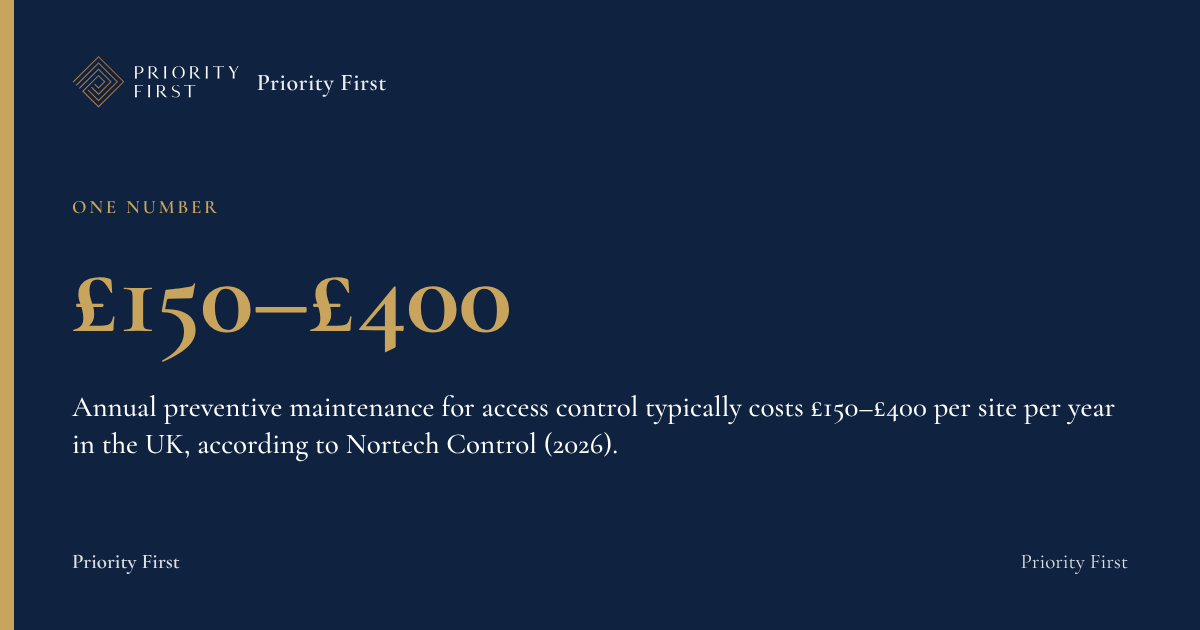
- Annual preventive maintenance for access control typically costs £150–£400 per site per year in the UK, according to Nortech Control (2026).
- A maintained access control system typically lasts 10 years, against just five for a neglected one, per Quartz Empire (2025).
- Entry-level annual packages start from £280 per year including two scheduled visits, according to EA-RS (2026).
- Some UK providers include a maximum 4-hour emergency response time within servicing priced from £80 per visit, per Paragon Fire and Security (2024).
- Priority First notes that the National Security Inspectorate's NCP 109 code of practice sets out maintenance company responsibilities and record-keeping duties for access control systems.
What is an access control maintenance contract and what does it cover?
An access control maintenance contract is a service agreement between a business and a security provider that defines scheduled servicing, fault repair and response commitments for door entry, keypad, fob and biometric systems. It typically covers reader testing, lock mechanism checks, power supply inspection, software and firmware updates, and a defined call-out response if the system fails.
Most UK contracts specify a visit frequency — commonly one or two visits a year — plus an emergency response window for faults that compromise security or fire egress. The BSIA Specifier's Guide to Access Control Systems notes that a single contract rarely covers every component; door hardware, electronic controllers and integrated fire interfaces may each need separate servicing arrangements.
A well-structured contract also sets out parts cover, labour terms, and whether software licensing and credential database updates are included. Reputable UK installers recommend annual servicing, typically costing £150–£500 per visit depending on system size, according to Nexus Security Servicess (2025).
How much does an access control maintenance contract cost in the UK?
UK access control maintenance contracts generally cost between £150 and £500 per visit, with annual packages starting around £280. The exact figure depends on door count, site complexity, response-time guarantees and whether parts are included.
| Contract type | Typical UK price | What's usually included |
|---|---|---|
| Entry-level annual package | From £280/year | Two scheduled visits, basic reader and lock checks (EA-RS, 2026) |
| Standard preventive maintenance | £150–£400/site/year | Reader tests, lock checks, software updates (Nortech Control, 2026) |
| Per-visit annual servicing | £150–£500/visit | Scales with system size (Nexus Security Servicess, 2025) |
| Pay-per-visit with SLA | From £80/visit | Includes a maximum 4-hour emergency response time (Paragon Fire and Security, 2024) |
Prices scale with door count rather than site square footage. A single-entrance office will sit at the lower end of these ranges, while a multi-door commercial building with integrated fire-door release mechanisms will push costs toward the upper figures, particularly where a 4-hour or faster emergency response is written into the contract.
Ways to reduce costs: bundling access control servicing with wider facilities management or security contracts, agreeing a multi-year term, and consolidating several buildings under one maintenance provider all tend to lower the per-site rate. Businesses should also confirm whether parts are included before comparing quotes, since a cheaper visit price with parts excluded can cost more over a system's lifecycle.
How often should access control systems be serviced under UK regulations?
Access control systems in the UK should be serviced at least annually, with many providers recommending two visits a year for higher-traffic or fire-integrated sites. There is no single statutory inspection frequency written into law, but industry codes of practice set clear expectations.
The National Security Inspectorate's NCP 109 sets requirements for both preventative and corrective maintenance, including the maintenance company's responsibilities and the records it must keep. BS EN 60839-11-2:2015, published by the BSI Group, defines minimum requirements for installation, commissioning, maintenance and documentation of electronic access control systems.
Where access control interfaces with fire alarm systems — for example, door release mechanisms tied to a fire panel — BS 7273-4 governs the actuation of release mechanisms, and testing of that interface typically needs to be documented and witnessed as part of routine fire safety checks. A maintained system typically lasts 10 years, whereas a neglected one often needs full replacement after just five, according to Quartz Empire (2025) — a gap that makes servicing frequency a direct cost decision, not just a compliance one.
What legal or compliance obligations apply to fire and security access systems?
UK businesses carry duties under fire safety law that extend directly into how access control systems are maintained, particularly where doors are linked to fire egress routes. The Regulatory Reform (Fire Safety) Order 2005 places a duty on the "responsible person" — the employer, building owner or managing agent — to ensure fire safety measures, including door release mechanisms, remain effective.
Priority First's guide on fire safety duties for building owners and managers sets out how these duties apply across commercial buildings, and is worth reviewing alongside any access control servicing contract that touches fire doors.
Where biometric readers or credential databases form part of the access control system, the Information Commissioner's Office regulates how that personal data is stored and processed under UK GDPR. Maintenance contracts that give an external provider access to a credential database should specify data handling responsibilities clearly, since the system owner — not the maintenance contractor — typically remains the data controller.
Who is responsible for maintaining access control systems in a rented commercial property?
Responsibility for access control maintenance in a leased commercial property depends entirely on the lease terms, and this is one of the most commonly disputed points between landlords and tenants. In a typical full repairing and insuring lease, the tenant often takes on responsibility for systems serving their demised space, while the landlord retains responsibility for common-parts access control, such as a building's main entrance system.
Mixed-use and multi-let buildings complicate this further, since a single access control platform may serve both landlord-controlled common areas and tenant-controlled suites. Facilities managers should check the lease schedule explicitly rather than assuming coverage, and confirm who holds the existing maintenance contract before signing a new lease or taking occupation.
In practice, a prestige residential portfolio in Central London illustrates how quickly this can go wrong without clear ownership. When three new buildings — including a 10-checkpoint serviced residence — were added to one portfolio in July 2026, mobilisation risked the usual "bedding in" delay that comes from unclear handover of site knowledge; Priority First instead had checkpoint mapping, officer induction and photographed patrols running from night one, with all three sites live within days of onboarding.
What should be checked when reviewing an access control maintenance contract?
An access control maintenance contract should be checked for visit frequency, parts inclusion, response-time guarantees, and exit terms before signing. These four elements determine both the real annual cost and how exposed a business is if the system fails outside scheduled hours.
Key items to verify:
- Visit frequency — confirm whether the contract includes one, two, or more scheduled visits a year.
- Parts and labour cover — check whether reader replacements, lock mechanisms and power supplies are included or charged separately.
- Response time SLA — confirm the guaranteed call-out window for emergency faults, which some UK providers set at a maximum of 4 hours, per Paragon Fire and Security (2024).
- Software and firmware updates — check whether these are included, since unpatched systems are a common security gap.
- Contract term and exit clause — note whether the agreement runs rolling monthly, annually, or is fixed for two years or more.
- Takeover provisions — if switching from an existing provider, confirm the new contractor can take over servicing without a compliance gap.
- Fire interface documentation — where doors are linked to fire alarm panels, confirm the contract includes witnessed testing against BS 7273-4.
Comparing quotes side by side on these points, rather than on headline price alone, is the only reliable way to compare competing offers fairly.
Reactive, preventative or fully comprehensive maintenance contracts
Access control maintenance contracts generally fall into three types: reactive (pay-per-callout), preventative (scheduled servicing), and fully comprehensive (scheduled servicing plus parts and emergency response bundled together). Each carries a different cost profile and risk exposure.
| Contract type | How it works | Typical cost signal | Best suited to |
|---|---|---|---|
| Reactive | Pay only when something breaks | Variable, unpredictable | Very small sites, low footfall |
| Preventative | Scheduled visits, basic checks | £150–£400/site/year (Nortech Control, 2026) | Standard commercial premises |
| Fully comprehensive | Scheduled visits + parts + SLA response | £150–£500/visit or annual package from £280 (Nexus Security Servicess, 2025; EA-RS, 2026) | Multi-door sites, fire-integrated systems |
Reactive-only arrangements tend to look cheaper on paper but shift all cost and downtime risk onto the business when a fault occurs. Fully comprehensive contracts cost more upfront but typically include the emergency response window — sometimes as low as 4 hours — that protects against extended system downtime.
What response times and SLAs should a maintenance provider offer?
Response times in access control maintenance contracts should be stated as a maximum number of hours from fault report to engineer arrival, not a vague "same day" promise. Some UK providers guarantee a maximum 4-hour emergency response as standard within their servicing packages, according to Paragon Fire and Security (2024).
Service level agreements should distinguish between routine faults (next scheduled visit), urgent faults (same working day), and critical faults affecting security or fire egress (fastest tier, often 2-4 hours). Businesses should ask providers to state these tiers explicitly in writing rather than relying on a general commitment to "respond quickly."
Priority First's own emergency response record illustrates what a fast-turnaround standard looks like in practice: when a Covent Garden site was broken into overnight, the call came in at 12:30, a quote was agreed on the same call, and an SIA-licensed operative was on site by 14:30 — two hours from first contact to deployment. While that case involved a security breach rather than an access control fault, the same speed of mobilisation matters whenever a failed door system leaves a site exposed overnight.
"Ask who is actually turning up to your site. The industry runs on subcontracting, and the badge on the proposal is often not the company whose officer stands at your door. We keep delivery in-house precisely because accountability disappears the moment it is passed down a chain." — Mo Hassan, Managing Director, Priority First
What happens if an access control system fails with no maintenance contract?
An access control system that fails without a maintenance contract in place typically leaves a business facing ad-hoc call-out charges, longer repair delays, and in some cases an unsecured or fire-non-compliant entrance until a technician arrives. Without a pre-agreed SLA, there is no guaranteed response window, and emergency call-out rates are usually higher than a contracted visit price.
A neglected system is also more likely to need full replacement far sooner — within roughly five years rather than the 10-year lifespan achieved with regular maintenance, according to Quartz Empire (2025). Beyond the hardware cost, an unsecured entrance point creates real exposure: unmonitored access, uncontrolled visitor flow, and in fire-integrated systems, a potential non-compliance with the responsible person's duties under the Regulatory Reform (Fire Safety) Order 2005.
For sites where door control failure coincides with a wider security gap, manned cover can bridge the risk until repairs are completed. A care home in Bedfordshire with 96 units needed exactly this kind of continuous, documented coverage — not because of a system fault, but because care staff could not double as a security presence for door control, night-time incidents and unfamiliar visitors. Priority First deployed SIA-licensed officers with every patrol, incident and handover logged on its platform, checkpoints completed with a photograph, GPS and timestamp, so cover was provable rather than asserted — the same documentation discipline that a strong maintenance contract should bring to a building's physical access systems.
Your access control maintenance contract checklist
- Confirm visit frequency — one, two, or more scheduled services per year.
- Check whether parts, labour and software updates are included or billed separately.
- Get the emergency response SLA in writing, ideally a stated maximum number of hours.
- Clarify who owns the credential database and who is responsible for data protection compliance.
- Review the lease schedule if operating from rented premises, to confirm landlord vs tenant responsibility.
- Ask whether fire-interface testing against BS 7273-4 is included for any fire-linked doors.
- Compare at least two or three quotes on the same criteria — not headline price alone.
- Check the exit and takeover terms before signing, especially contract length and notice period.
FAQ
What is included in an access control maintenance contract?
A typical access control maintenance contract includes scheduled servicing visits, reader and lock testing, software and firmware updates, and a defined emergency response time for faults. Entry-level UK packages often start from £280 per year including two scheduled visits, according to EA-RS (2026).
How often should an access control system be serviced?
Most UK providers recommend at least one annual service visit, with two visits a year common for busier or fire-integrated sites. The NSI's NCP 109 code of practice sets out the maintenance standards providers are expected to follow.
Is an access control maintenance contract a legal requirement in the UK?
There is no single law that mandates an access control maintenance contract specifically, but businesses have duties under the Regulatory Reform (Fire Safety) Order 2005 to keep fire-related door mechanisms effective. Where access control interfaces with fire systems, regular maintenance becomes a practical requirement for compliance rather than a strict standalone legal one.
How much does an access control maintenance contract cost?
UK access control maintenance typically costs between £150 and £500 per visit, or from £280 per year for an entry-level annual package. Costs scale with door count, response-time guarantees, and whether parts are included, according to Nortech Control (2026) and EA-RS (2026).
Do maintenance contracts cover the cost of replacement parts?
Parts cover varies by contract and should always be confirmed before signing, since some preventative packages exclude replacement hardware. Fully comprehensive contracts typically bundle parts, labour and emergency response together, which usually costs more per visit but removes the risk of surprise charges.
What's the difference between preventative and corrective maintenance?
Preventative maintenance means scheduled servicing visits designed to catch faults before they cause a failure, while corrective maintenance means repairing a system after it has already broken down. A contract built only around corrective, reactive call-outs tends to cost less upfront but carries far higher downtime risk.
Can I switch providers or take over an existing maintenance contract?
Yes, businesses can usually switch access control maintenance providers, though the process depends on the exit terms of the existing contract. Confirm the notice period, any early termination charges, and ensure the new provider has full access to prior service records to avoid a compliance gap during handover.
Securing and maintaining your building with Priority First
A failed access control system rarely stays an isolated problem — it becomes a security gap the moment a door stops locking reliably, which is exactly where Priority First's combined security and facilities management model closes the loop. Rather than treating door hardware and site security as separate contracts, Priority First coordinates building upkeep and security cover under one accountable partner, so a maintenance issue never sits unmonitored overnight.
Priority First operates across prime central London — Chelsea, Knightsbridge and Mayfair — alongside West London and contracts in the West Midlands and Bedfordshire, with every patrol and checkpoint completed against a photo, GPS and timestamp record rather than left to trust.
If your building's access control needs a maintenance review, or a fault has left an entrance temporarily unsecured, get in touch with Priority First to discuss facilities management and manned cover options tailored to your site.
Related Reading
- Fire Alarm Maintenance Contracts UK: What's Required
- Intruder Alarm Maintenance UK: Rules, Cost & Risk 2026
- Alarm Response Service London | Priority First


