Out of Hours Contact Security Company | UK Guide 2026

Last updated: 30 September 2026
An out of hours contact security company is a provider that answers calls, monitors alarms and dispatches trained responders to a business premises outside normal working hours, typically evenings, weekends and public holidays. UK businesses miss between 25% and 40% of incoming calls on average, according to Paperclip (2026), and unresolved out-of-hours incidents can mean unattended alarms, break-ins or health and safety breaches going unnoticed until the next working day.
Key Takeaways
- Out of hours contact security companies combine call handling, keyholding and alarm response so that incidents occurring outside 9-to-5 hours reach a trained responder rather than an empty office.
- Businesses in the UK lose over £30 billion every year to missed calls, according to Quality Company Formations (2026), a cost that extends directly into security-critical scenarios such as alarm activations and break-ins.
- 85% of unanswered calls that reach voicemail are never returned by the caller, per Quality Company Formations (2026), which is a serious exposure when the missed call is an alarm monitoring centre or a distressed tenant.
- The Health and Safety at Work etc. Act 1974 places a duty on employers to protect lone and out-of-hours workers, which extends to how incidents are reported and escalated after hours.
- Priority First deployed an SIA-licensed officer to a broken-into Covent Garden site within two hours of first contact, from a 12:30 call to boots on the ground by 14:30, illustrating what a properly resourced out-of-hours response looks like in prime central London.
What is an out of hours contact security company?
An out of hours contact security company is a specialist provider that takes over call answering, alarm monitoring and physical response duties for a business once its normal reception or facilities team has gone home. It sits between a basic answering service and a full manned guarding operation, because it combines telephone triage with the ability to send an SIA-licensed keyholder or response officer to the site.
The core functions are call answering, keyholding, alarm response and incident escalation. A tenant reporting a burst pipe at 2am, a security system triggering a false alarm, or a delivery driver locked out of a loading bay are all scenarios an out of hours contact security company is built to handle.
Priority First delivers this model across prime central London, including Chelsea, Knightsbridge and Mayfair, alongside contracts in the West Midlands and Bedfordshire. Its documented client contracts number 37, of which 28 sit in Chelsea and Knightsbridge alone, reflecting how concentrated the demand for out-of-hours cover is in premium residential and commercial districts.
Why UK businesses need out of hours security cover beyond daytime reception
UK businesses need out of hours security contact cover because incidents do not respect office hours, and a missed call at 9pm can be as costly as one missed at 9am. Around 70% of business calls placed on hold end in a hang-up 60% of the time, according to Paperclip (2026) — a pattern that becomes dangerous rather than merely inconvenient when the caller is reporting a break-in or a fire alarm.
Daytime reception simply switches off at 5.30pm or 6pm for most commercial premises. Without a dedicated out-of-hours arrangement, an alarm activation, a tenant emergency or a delivery dispute has nowhere to go until the next working day.
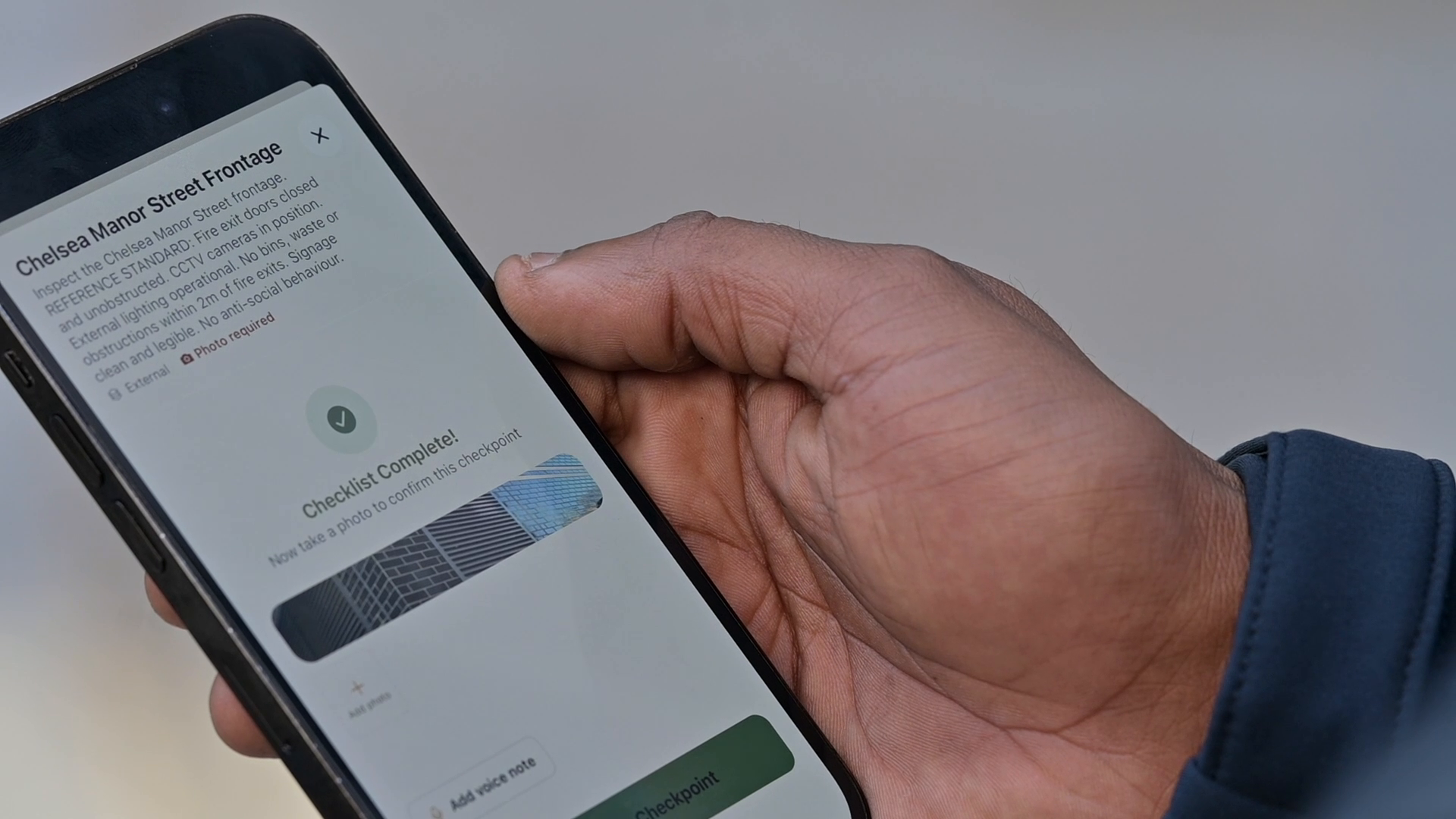
This matters most for sectors with continuous duty-of-care obligations. A 96-unit care home in Bedfordshire that Priority First now covers needed exactly this: care staff could not double as security, so SIA-licensed officers were brought in to patrol overnight, log every checkpoint with a photograph, GPS location and timestamp, and ensure incidents were documented rather than assumed handled. The system went live immediately, with over 1,000 photo-backed patrols completed since onboarding.
Typical costs of out of hours security answering and monitoring in the UK
Out of hours security services in the UK are typically priced by the type of cover required, not as a single flat fee, because a basic answering service costs far less than 24/7 manned response with keyholding. Costs generally scale with response speed, staffing (call handler versus SIA-licensed officer) and whether the contract includes alarm monitoring against British Standards such as BS 7984 for keyholding and response.
| Service tier | What it includes | Typical use case |
|---|---|---|
| Call answering only | Human call handling, message-taking, basic triage | Small offices with low incident risk |
| Alarm monitoring + keyholding | Alarm signal receipt, keyholder dispatch on activation | Retail units, small commercial sites |
| Full manned response | SIA-licensed officer dispatched to site, incident report filed | Construction sites, vacant properties, mixed-use developments |
| Integrated FM + security | Out-of-hours contact tied into wider facilities management and concierge cover | Prime residential estates, corporate HQs |
Prices are illustrative rather than fixed, since they depend heavily on site risk, location and response-time guarantees agreed in the contract. A single-site retail unit with basic alarm monitoring sits at the lower end; a prime central London residential block wanting guaranteed officer dispatch within the hour sits considerably higher.
Legal and regulatory duties UK employers hold for out of hours security
UK employers hold a statutory duty under the Health and Safety at Work etc. Act 1974 to protect employees and visitors, and this duty does not pause when the office closes. The Health and Safety Executive's lone worker guidance (INDG73) sets out that employers must assess risks specifically for staff working alone or outside normal hours, including how incidents get reported and escalated.
Employers who leave premises unmonitored overnight, or who rely on an unreturned voicemail as their incident-reporting system, are exposed both operationally and legally. The National Audit Office found that 26% of people in England had not heard of out-of-hours GP services and 19% had not heard of NHS 111 as of July 2014, according to the National Audit Office via Wikipedia — a reminder that even well-established out-of-hours public services suffer from low awareness, and the same risk applies to a business's own internal out-of-hours arrangements if staff and tenants are not told how to use them.
Insurance implications follow closely behind. A vacant property left without regular inspection and alarm response can invalidate cover, which is why Priority First's own Vacant Property Security Checklist sets out the inspection frequency insurers commonly expect.
Keyholding, alarm response and call answering: knowing the difference
Keyholding, alarm response and out-of-hours call answering are three distinct services that are frequently bundled together but serve different functions. Keyholding is the physical custody of a site's keys or access codes by a licensed third party, so nobody needs to be woken at 3am to let a responder in.
Alarm response is the dispatch of a trained officer to a site once a monitored alarm activates, distinct from keyholding because a company can hold keys without providing the physical response itself. Call answering is the human layer that receives the first report — a tenant, a neighbour, an alarm receiving centre — and decides whether it warrants escalation.
"Anyone who prices your security before walking your site is guessing with your money. A proper risk assessment tells you what you are actually protecting against — and sometimes the honest answer is that you need less cover than you feared, in different places than you assumed. That conversation builds trust that a quote never will." — Mo Hassan, Managing Director, Priority First
Priority First provides all three under one accountable contract through its Key Holding & Alarm Response service, meaning a single provider handles the call, holds the key, and sends the officer — rather than a business having to coordinate three separate suppliers at 2am.
Setting up an out of hours emergency contact and escalation procedure
An out of hours emergency contact procedure works by defining, in advance, exactly who is called first, what triggers escalation, and how quickly a physical response is dispatched. Without this written ahead of time, even a well-staffed provider cannot act decisively when a call comes in.
A workable escalation procedure typically follows this sequence:
- Primary contact point — a named out-of-hours number, answered by a trained call handler, not a general voicemail box.
- Triage decision — the handler assesses whether the report needs a keyholder, an SIA-licensed officer, or emergency services.
- Named escalation contacts — a nominated site manager or duty director who is called if the incident exceeds a defined threshold.
- Documented response — every action logged with time, decision and outcome, ideally photo-backed for audit purposes.
- Next-day handover — a written report waiting for the daytime team, so nothing depends on memory.
Priority First's operational data illustrates why the documented step matters. Across its largest managed portfolio of 24 sites as of August 2026, more than 4,900 patrols have been completed with officer ID, GPS and timestamp attached to each one — consistent with the wider industry principle that out-of-hours cover is only as good as its evidence trail, and additionally showing that a photo-backed record turns a disputed claim into a resolved one.
Accreditations and certifications relevant to UK out of hours security providers
Several UK accreditation bodies set the benchmark for out-of-hours security quality, and knowing which one covers which function helps businesses ask sharper questions. The Security Industry Authority (SIA) licenses individual security operatives under the Private Security Industry Act 2001, while the SIA's Approved Contractor Scheme is a separate, voluntary company-level quality assessment.
The National Security Inspectorate (NSI) certifies companies against British Standards including BS 7984 for keyholding and response services, and only companies scoring in the top 15% of SIA benchmarking are eligible for the NSI Guarding Gold group, according to First Response Group / NSI (2026). The SSAIB performs a similar independent certification role for alarm and monitoring providers.
Workforce pressure adds urgency to this scrutiny. First-time SIA licence applications fell 16% in a single year, from 94,332 in 2026 to 79,455 in 2026, according to SIA data via Coredinate (2026), while BSIA members still provide over 70% of private security services by turnover. A shrinking licensed workforce makes verifying a provider's individual officer licensing more important, not less.
How out of hours security response times typically work in the UK
Out of hours security response times in the UK vary by contract, site risk and location, with providers typically agreeing a target window rather than a fixed guarantee. A monitored alarm in a low-risk retail unit might carry a response target of 60 minutes, while a high-value residential or commercial site in central London often demands faster arrival.
Priority First's own record demonstrates what rapid deployment looks like in practice. When a Covent Garden site was broken into overnight, the call came in at 12:30, a quote was agreed during that same call, and an SIA-licensed operative was on site by 14:30 — a two-hour span from first contact to physical deployment.
That kind of speed depends on keyholding already being in place before the incident, since arranging access on the fly adds delay a genuine emergency cannot absorb. It also depends on the officer being pre-briefed on the site, which is why Priority First inducts officers to individual sites in advance — seven were inducted to cover a single prime site.
Common mistakes businesses make when briefing an out of hours security provider
Businesses most often go wrong by treating out-of-hours cover as an afterthought bolted onto a daytime contract rather than a distinct service with its own escalation logic. A generic answering service that simply takes a message is not the same as a provider that can dispatch a licensed keyholder or officer.
Common errors include:
- Failing to name specific escalation contacts, leaving a call handler guessing who to wake up.
- Not confirming SIA licence checks are current, since licences must be renewed and can lapse.
- Assuming CCTV footage alone proves a patrol happened, when unmonitored cameras rarely capture the full site.
- Skipping a site walk before signing, which the quote-only approach Mo Hassan warns against above tends to produce.
- Leaving vacant periods uncovered, a gap addressed directly in Priority First's Vacant Property Security Checklist.
A West London mixed-use development illustrates the cost of assumption-based cover. Before onboarding with Priority First, the site's daily occurrence book recorded "all in order" with no way to prove which of its plant rooms had actually been checked overnight; since going live in February 2026, all 152 checkpoints across retail, residential and service yard areas now require a photograph to complete, with more than 540 patrols logged in the first five months.
Your out of hours security contact checklist
- Confirm a named, monitored out-of-hours number exists — never a general voicemail.
- Check every deployed officer's SIA licence is current and verifiable.
- Agree a written escalation procedure naming who is contacted at each threshold.
- Require photo, GPS and timestamp evidence for every patrol and alarm response.
- Confirm keyholding arrangements are in place before an incident, not during one.
- Ask whether the provider is assessed against NSI or SSAIB standards for keyholding.
- Review vacant periods and unoccupied buildings separately from your main contract.
- Insist on a next-day written handover report for every overnight incident.
FAQ
What does an out of hours contact security company actually do?
An out of hours contact security company answers calls, monitors alarms and dispatches trained keyholders or SIA-licensed officers once a business's normal working hours end. It bridges the gap between an empty reception desk and the emergency services, deciding which incidents need immediate physical response.
What is the difference between a keyholding service and an alarm response company?
Keyholding is the physical custody of a site's keys or entry codes by an authorised third party, while alarm response is the act of sending someone to the site once an alarm activates. The two are often provided together, but a business can technically hold one without the other.
How quickly should an out of hours security company respond to an alarm?
Response times vary by contract and site risk, typically ranging from under an hour for high-priority sites to longer windows for lower-risk premises. Priority First has demonstrated a two-hour span from first phone contact to an SIA-licensed officer arriving on a broken-into central London site.
Do out of hours security companies need SIA licensing?
Individual security operatives working in the UK must hold a licence from the Security Industry Authority, under the Private Security Industry Act 2001. Businesses should always ask a provider to confirm the current licence status of any officer being deployed.
What happens if a business misses an out-of-hours alarm call?
A missed alarm call can mean a break-in or fault goes unaddressed until the next working day, increasing both the financial loss and any insurance complications. Given that 85% of unanswered calls sent to voicemail are never returned by the caller, according to Quality Company Formations (2026), relying on voicemail for security-critical calls is a significant risk.
Who is legally responsible if an incident happens outside contracted hours?
Legal responsibility generally stays with the business or property owner under the Health and Safety at Work etc. Act 1974, regardless of whether cover was contracted for those hours. A written contract with a security provider should clearly state which party bears responsibility for specific failures, such as a missed alarm signal versus a slow physical response.
How much does out of hours security cover typically cost in the UK?
Costs vary widely depending on whether a business needs basic call answering, alarm monitoring with keyholding, or full manned response with an SIA-licensed officer on standby. Site risk, location and guaranteed response times all affect the price, so a walk-through risk assessment is the only reliable way to get an accurate figure.
Securing your out-of-hours cover with Priority First
Priority First built its out-of-hours model around the exact gap this article describes: the hours when a call goes unanswered, an alarm goes unmonitored, or a site goes unchecked. Its Key Holding & Alarm Response service brings call handling, keyholding and SIA-licensed physical response under one accountable contract, backed by a platform where every patrol and escalation is logged with a photograph, GPS location and timestamp.
Priority First's own record includes deploying an SIA-licensed officer to a Covent Garden break-in within two hours of the first call, and covering 37 documented client contracts across prime central London, the West Midlands and Bedfordshire. As one client, James Burmingham, put it: "Since then, the monitoring service has been top-notch—quick responses, clear communication, and the peace of mind we've been looking for."
If your business needs an out-of-hours contact arrangement that goes beyond an answering service, get in touch with Priority First to arrange a site risk assessment and a tailored quote.
Related Reading
- 4 Steps to Choose a Security Company in Chelsea for Construction
- Manned Guarding Company London | Priority First Security 2026
- Choose the Right Security Company in Kensington for Your Construction Needs