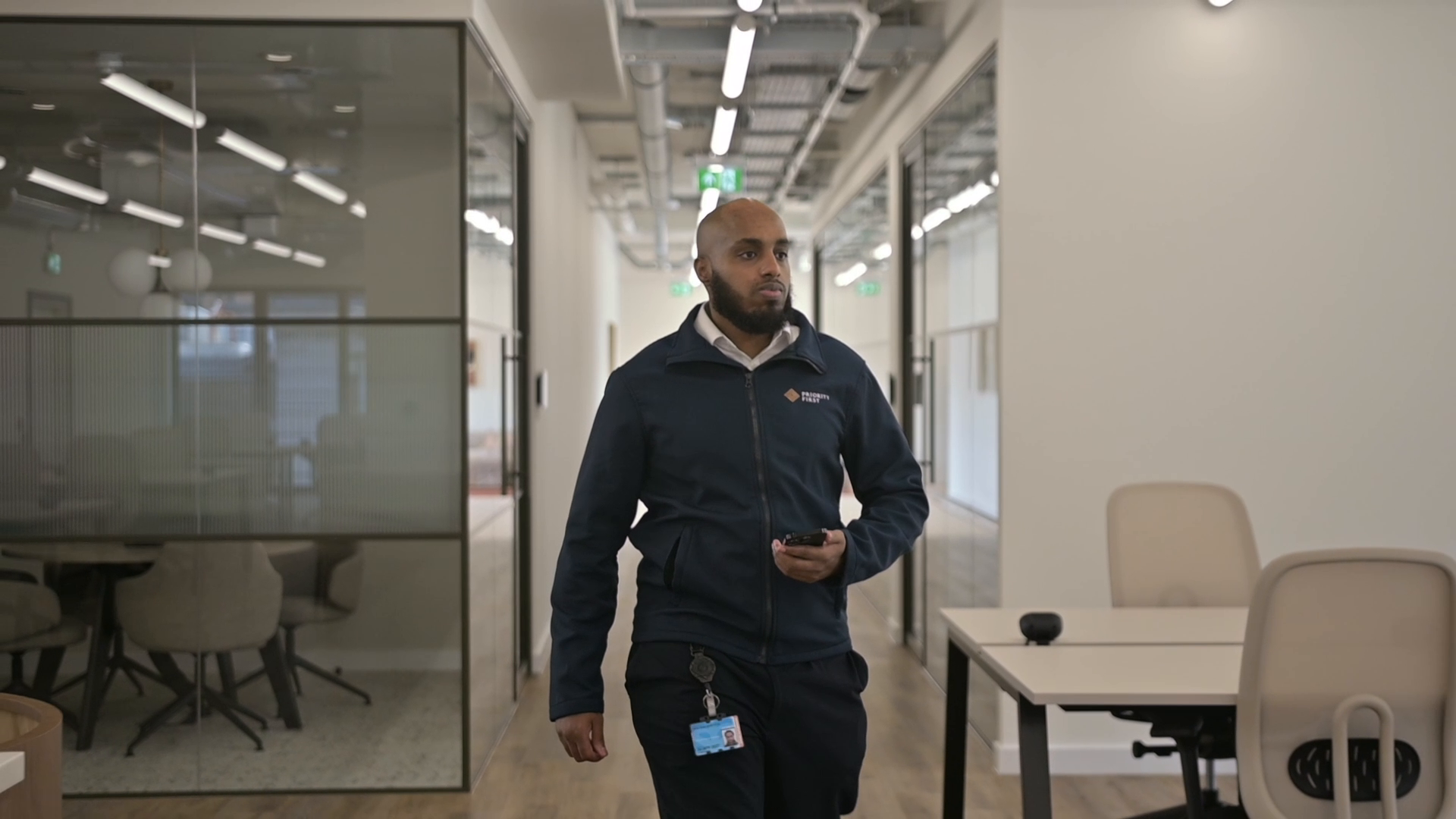
How to Check Your Security Company Is Doing Patrols


Last updated: 20 September 2026
Checking whether your security company is doing patrols means demanding verifiable proof — GPS-stamped checkpoints, photographed reports, and timestamped logs — rather than trusting a written occurrence book. Across a 152-checkpoint mixed-use development, Priority First now generates photo-backed evidence for every one of 540+ patrols completed in the first five months, replacing a system that could not prove which plant room was actually checked at 3am.
Key Takeaways
- Priority First leaves a verifiable digital trail on every patrol: officer ID, GPS location and timestamp attached to a photograph at each checkpoint, not just a signature in a book.
- Priority First operates within a framework where the SIA licences over 328,000 security guards in the UK, requiring 128+ hours of initial training and 18 hours of annual CPD, according to Rock Security Solutions (2026).
- Priority First notes that employers who use unlicensed guards risk prosecution, with penalties of up to six months' imprisonment and an unlimited fine, per Veritech Security (2026).
- Priority First's operational data shows one 24-site portfolio has now logged 4,900+ photo-backed patrols across 11+ field officers, up from 18 sites at the previous count, as of August 2026.
- A patrol report that reads like a set of observations — not a row of ticks — is the clearest sign the guard actually walked the route rather than rubber-stamping it.
What Is Patrol Verification Technology?
Patrol verification technology is the set of systems — GPS trackers, NFC (Near Field Communication) checkpoint scanning, QR code tags and guard tour software — that a security company uses to prove an officer physically visited a specific location at a specific time. Without it, a patrol report is simply an unverifiable claim written after the fact.
GPS tracking logs an officer's real-time location via a handheld device or app, creating a movement trail across the site. NFC and QR checkpoint scanning require the officer to tap a phone against a fixed tag mounted at each checkpoint — the tap is logged with a timestamp the moment it happens, so the record cannot be backfilled later.
The strongest systems go further and require a photograph at every checkpoint, watermarked with officer ID, GPS coordinates and timestamp. On a 152-checkpoint mixed-use development in West London, Priority First moved checkpoint completions carrying a watermarked photo from 0% to 100%, turning an assumption-based patrol into one where missed areas show up as gaps in the record rather than passing silently.
What Should Be in a Patrol Report and How Often Should You Receive One?
A patrol report is the documented account of what an officer observed, checked and actioned during a round, and it should be delivered on a schedule that matches your site's risk profile — daily for high-footfall commercial sites, weekly summaries for lower-risk premises. A report built purely from tick-boxes ("all in order") tells you almost nothing; a report built from specific observations tells you the officer actually looked.
Each report should include the checkpoint route walked, the time each checkpoint was reached, any faults or anomalies found (with photos), and the actions taken as a result. It should also flag anything carried over from a previous shift — a fault logged at 3am should be visible to the officer who patrols that same checkpoint at 9am the next morning.
As Mo Hassan, Managing Director of Priority First, puts it: "A patrol that follows the same route at the same times every night is training the people watching your site. We vary timing, route and approach deliberately, and we write up what we actually saw — a good patrol report reads like a set of observations, not a row of ticks."
Priority First's own reporting standard requires every checkpoint to carry a photograph to complete, meaning a missed section shows as a visible gap rather than a plausible-sounding entry. Across a 16-building prime London estate, this generates 250–280 patrols per building, all photo-backed and previously unprovable under the paper-based system it replaced.
How Can You Access Real-Time or Historical Proof That a Patrol Took Place?
Real-time and historical proof of a patrol means a client-facing dashboard or portal where you can see, on demand, exactly when and where an officer was on your site — not just a summary email at the end of the week. Modern guard tour software gives clients direct login access to checkpoint logs, photographs and timestamps, filterable by date, officer or location.
This matters because a report you cannot independently query is a report you have to take on trust. A dashboard that shows a gap in the checkpoint record at 3am — rather than a tidy "all clear" entry — is doing its job by surfacing the problem rather than hiding it.
For portfolio clients managing multiple sites, this becomes a governance tool as much as a security one. Priority First runs a whole-portfolio operator on a single platform covering 24 sites and 11+ field officers, where alarm activations, incident logs, shift handovers and patrol photographs all sit in one place — so a facilities director can check any site's patrol history without phoning the control room.
What Are Industry-Standard Patrol Frequencies for Different Premises?
Patrol frequency is the number of times per shift an officer is required to walk a defined route or set of checkpoints, and it should be set according to the site's risk category rather than a generic default. A construction site holding plant and materials overnight typically warrants hourly external patrols; a low-risk office might need only two or three internal rounds per shift.
| Premises type | Typical patrol frequency | Key focus areas |
|---|---|---|
| Retail units / shopping centres | Every 30–60 minutes during trading hours | Fire exits, stockrooms, car parks |
| Construction sites | Hourly, including overnight | Perimeter fencing, plant, materials compounds |
| Commercial offices | 2–4 times per shift | Reception, server rooms, fire exits |
| Vacant properties | Daily or twice-daily visual inspections | Alarm status, signs of forced entry, weather damage |
| Mixed-use developments | Continuous rotation across checkpoints | Retail units, residential cores, service yards, plant rooms |
These figures are illustrative ranges based on standard industry practice rather than a single cited study, and your contract should specify the exact frequency agreed for your site. Priority First's guide, Vacant Property Security Checklist, sets out the inspection cadence appropriate to empty buildings specifically, where the risk profile differs sharply from an occupied site.
What SLA Terms Should Hold Your Security Company Accountable for Missed Patrols?
A service level agreement (SLA) is the contractual document setting out the exact performance standards a security provider must meet, and for patrols it should specify frequency, evidence format, and consequences for non-compliance. Without a written SLA, a missed patrol is a grievance; with one, it is a breach with a defined remedy.
Your SLA should state the minimum number of patrols per shift, the checkpoint route to be covered, and the maximum acceptable gap between visits to any single point. It should also mandate the evidence format — GPS timestamp, photograph, or both — and set a reporting deadline, such as within 24 hours of shift end.
Include a clause defining what happens when a patrol is missed: a credit against the invoice, a mandatory root-cause review, or in repeated cases, a right to terminate. California's Bureau of Security and Investigative Services requires private patrol operators to file a written incident report within seven business days of serious incidents, with failure to report carrying a meaningful fine — a useful benchmark for how firmly a reporting deadline can be enforced. Your UK contract can mirror that principle even though the UK regulatory regime differs.
What Are the Red Flags That a Security Company Is Falsifying or Skipping Patrols?
A falsified patrol is one recorded as complete without the officer having actually walked the route, and the warning signs are usually procedural rather than dramatic. The most common red flag is a patrol report that arrives with identical timestamps or wording shift after shift — a sign the officer is copying a template rather than describing what they saw.
Watch for reports lacking specific detail: no mention of weather conditions, no reference to a delivery or visitor logged elsewhere, no photograph evidence despite a contract requiring one. A checkpoint system that allows manual time entry, rather than an automatic GPS or NFC stamp, is inherently easier to falsify after the fact.
Other signals include an account manager who cannot produce historical checkpoint data on request, or gaps in the record that get quietly filled in after you ask about them. "A good patrol report reads like a set of observations, not a row of ticks," as Mo Hassan notes — a report that reads like a checklist is often exactly that, and nothing more.
Is Your Security Company Required to Be SIA Licensed, and How Does This Affect Patrol Standards?
SIA licensing is the mandatory UK requirement, set under the Private Security Industry Act 2001, that individual security guards hold a licence issued by the Security Industry Authority before working in a licensable role. The Security Industry Authority regulates over 328,000 guards nationally, requiring 128+ hours of initial training and 18 hours of annual continuing professional development, alongside inspections to enforce compliance (Rock Security Solutions, 2026).
Using unlicensed guards is not a minor compliance gap. Employers face prosecution, with penalties of up to six months' imprisonment and an unlimited fine (Veritech Security, 2026).
You can verify an individual guard's licence via the government's own Regulated Professions Register, which confirms the SIA as regulator under the 2001 Act. The National Protective Security Authority (NPSA) publishes a summary of the different SIA licence types, useful when checking whether the guard on your site holds the correct category — Door Supervisor, Security Guarding, or CCTV — for the role they are performing. SIA licensing alone does not guarantee patrol quality, but it is the baseline legal check every UK business should carry out before assessing patrol performance in more detail.
What Questions Should You Ask During a Service Review Meeting to Verify Patrol Compliance?
A service review meeting is the scheduled point in a contract — typically quarterly — where a client and account manager assess performance against the agreed SLA. Coming prepared with specific questions turns this from a status update into a genuine audit.
Ask to see raw checkpoint data for a randomly chosen week, not a pre-selected summary. Ask how many patrols were missed against the contracted frequency, and what corrective action followed each miss.
Ask whether every guard on your site currently holds a valid SIA licence, and request evidence. Ask how officer inductions are handled when new staff join your site — Priority First inducted seven officers to cover a single prime central London site, with checkpoint maps, site notes and prior issues loaded into the platform so a new officer sees the full history from their first patrol, rather than starting cold.
Your Patrol Verification Checklist
- Confirm every officer assigned to your site holds a valid SIA licence via the Regulated Professions Register.
- Require checkpoint completion via GPS, NFC or photograph — never a manually entered time.
- Set a written SLA specifying patrol frequency, evidence format and reporting deadline.
- Request direct dashboard access to real-time and historical patrol records, not just email summaries.
- Review a random sample of raw checkpoint data at every quarterly service review, not a curated summary.
- Check patrol reports for specific, varied observations rather than repeated, generic wording.
- Ask how faults logged on one shift are handed over and tracked to resolution on the next.
- Confirm your provider's incident escalation process, including who is contacted and within what timeframe.
FAQ
How do I know if my security guards are actually doing their patrols?
Check for GPS-stamped or photographed checkpoint evidence tied to a specific officer, location and time — not just a written note in an occurrence book. If your provider cannot produce raw checkpoint data on request, that is itself a warning sign.
What technology is used to verify security guard patrol completion?
The main systems are GPS tracking, NFC checkpoint scanning, QR code tags and guard tour software, often combined with a mandatory photograph at each checkpoint. Priority First requires a photo to complete every checkpoint, so missed areas appear as visible gaps rather than passing silently.
What is the difference between GPS, NFC and QR code checkpoint verification?
GPS tracking logs an officer's continuous location, while NFC and QR systems require a physical tap or scan at a fixed point to log a discrete checkpoint visit. NFC tags are generally harder to spoof than QR codes, since they require close-range physical contact with a specific device.
How often should a security company patrol a property?
Frequency should match risk: construction sites typically need hourly patrols including overnight, retail premises every 30–60 minutes during trading, and offices two to four rounds per shift. Your contract should state the exact frequency agreed, rather than relying on a generic industry default.
How can I verify my security company is SIA licensed and compliant?
Check individual guard licences against the Regulated Professions Register, which confirms the SIA as the licensing body under the Private Security Industry Act 2001. You can also ask your provider directly for licence numbers and expiry dates for every officer on your site.
What records must a security company keep to prove patrols happened?
UK providers should retain checkpoint logs, photographs, timestamps and incident reports for a defined retention period set out in your contract. Comparable US regulation illustrates the principle: Priority First points to Washington State, where security companies are required to retain training and registration records for a minimum of three years, available for regulatory inspection (Washington State Legislature, WAC 308-18-240, 2021).
What KPIs should I ask my security provider to report on?
Ask for patrol completion rate against contracted frequency, average time between checkpoint visits, number of faults logged and resolved, and incident response times. Priority First's data shows one portfolio recording 4,900+ photo-backed patrols across 24 sites, giving a concrete benchmark for what a fully auditable KPI set looks like in practice.
Securing Provable Patrols with Priority First
If your current provider cannot show you exactly when and where a guard walked your site last night, you are managing a security contract on trust rather than evidence — and that gap is precisely what Priority First's proof-and-reporting approach closes. Every checkpoint on a Priority First patrol requires a photograph to complete, with officer ID, GPS and timestamp attached, so a missed area shows up as a gap in the record rather than a plausible tick.
Across a 16-building prime central London estate, this generates 250–280 photo-backed patrols per building — evidence that simply did not exist under the paper-based system it replaced. Priority First protects over £1.6 billion in client assets across prime central London, West London, the West Midlands and Bedfordshire, with a 100% customer satisfaction rate reported as of August 2026.
If you want to see exactly what a provable patrol looks like on your own site, get in touch with Priority First's Physical Protection / Manned Guarding team for a review and quote.
Related Reading
- Choose the Right Security Company in Kensington for Your Construction Needs
- Why Choose a CCTV Security Company for Your Construction Site?
- 4 Steps to Choose a Security Company in Chelsea for Construction