How Quickly Should A Security Company Respond? (2026)


Last updated: 1 October 2026
A security company should respond to a genuine on-site emergency within 5 to 15 minutes, with urban sites typically seeing the faster end of that range due to proximity and local traffic knowledge (Emergency Security, 2026). Alarm receiving centres should triage alerts within roughly 2 minutes and escalate critical incidents within 15 (Overton Security Services, 2026).
Key Takeaways
- Priority First notes that most reliable security companies respond to on-site emergencies within 5-15 minutes, with urban proximity giving faster average times (Emergency Security, 2026).
- Priority First highlights that security officers typically arrive at emergency scenes 4-8 minutes before police, fire or ambulance crews, making their initial actions critical to the outcome (Prime Guards, 2026).
- Priority First advises that UK security planning should assume a police response of 10 minutes or more for most incident types, based on Bureau of Justice Statistics analysis (Security Guard HUB, 2020).
- Priority First deployed an SIA-licensed officer to a broken-into Covent Garden site within two hours of first contact — call at 12:30, quote agreed on the call, officer on site by 14:30 (Priority First operational data, August 2026).
- Automation in security operations centres can cut response times by 60% to 90% in some monitoring workflows (Overton Security Services, 2026).
What Response Times Are Typical For Different Security Incidents?
Response time is the interval between an alarm activation, distress call or reported incident and a physical arrival on site by a trained responder. It varies sharply by incident type, and treating all alerts as equal is the most common planning error businesses make.
For alarm activations monitored by an Alarm Receiving Centre (ARC — a control room certified to British Standards such as BS 5979 for monitoring), the first stage is triage rather than travel. Industry benchmarks put alert triage at around 2 minutes, with critical-incident escalation to a responder or the police completed inside 15 minutes (Overton Security Services, 2026).
Physical intrusion — a break-in in progress, forced entry, or an occupied building emergency — demands a faster on-site arrival. Most reliable providers target 5 to 15 minutes for a keyholder or mobile officer to reach the scene (Emergency Security, 2026). Priority First points out that fire and life-safety incidents sit at the tightest end: the US National Fire Protection Association's NFPA 1710 standard sets a 240-second (4-minute) benchmark for the first unit to arrive on 90% of dispatched calls (NFPA 1710 / DC FEMS, 2026), alongside an 80-second turnout time for fire crews and 60 seconds for EMS (NFPA 1710 / Edwardsville, IL, 2026). Commercial building security should treat 4 minutes as the ceiling for dispatching a unit before escalation risk rises sharply (Pioneer Security, 2026).
Are There UK Legal Requirements Setting Minimum Response Times?
No single UK statute fixes a minimum response time for private security companies, unlike the fire-service benchmarks used in the United States. The Private Security Industry Act 2001 established the Security Industry Authority (SIA) to license individuals working in guarding, keyholding and CCTV, but licensing conditions govern competence and conduct rather than clock-based response targets.
Police response to monitored alarm systems is governed separately by National Police Chiefs' Council (NPCC — formerly ACPO) policy, which classifies alarms as Type A or Type B and sets the conditions under which police will attend at all (NPCC Police Requirements & Response to Security Systems, 2026; College of Policing ACPO policy). A confirmed intruder alarm with a verified sighting typically qualifies for a police response; an unconfirmed activation may not attract one at all.
This gap is precisely why contractual SLAs (service level agreements) matter more in the UK than reliance on statutory minimums. Martyn's Law — the Terrorism (Protection of Premises) Act, covering public-facing venues — adds a separate duty to demonstrate a rehearsed emergency response capability, not a specific arrival-time figure.
How Do Response Times Differ Between Manned Guarding, Keyholding And Alarm Response?
Manned guarding, keyholding and alarm response are three distinct services with three different response profiles, and confusing them is a frequent buying mistake. Manned guarding places an SIA-licensed officer permanently on site, so "response time" effectively means seconds — the officer is already there.
Keyholding is different: a company holds keys and attends when an alarm activates, meaning response is measured from the alert reaching the ARC to the keyholder's arrival, typically within the 5-15 minute urban band (Emergency Security, 2026). Alarm response overlaps with keyholding but can also include mobile patrol officers already circulating nearby, which shortens arrival further.
| Service | What it covers | Typical response |
|---|---|---|
| Manned guarding | Officer permanently on site | Immediate (already present) |
| Alarm response / mobile patrol | Officer dispatched from a patrol route | 5-15 minutes (urban) |
| Keyholding | Nominated attendee for out-of-hours alarms | 5-15 minutes, sometimes longer rural |
| Police (confirmed alarm) | Attendance where classification qualifies | 10+ minutes on average (Security Guard HUB, 2020) |
As Mo Hassan, Managing Director of Priority First, puts it: "Asking a member of staff to attend their own premises at three in the morning is asking them to walk into the unknown alone. Professional keyholding exists so that the person opening that door is trained for the moment the alarm turns out to be real — and so your people never have to be."
What Factors Affect How Quickly A Security Company Can Respond?
Location, staffing density and time of day are the three biggest variables in any real-world response time. A site in Mayfair or Knightsbridge with an officer already patrolling nearby streets will see faster arrivals than an isolated warehouse off the M6, purely on distance and traffic grounds (Emergency Security, 2026).
Staffing levels matter as much as geography. A provider running thin overnight cover across a wide patch will struggle to match a provider with officers embedded across a small number of nearby sites.
Priority First's portfolio data illustrates the effect of density: across 24 sites now run on a single platform, with 11+ field officers and a large volume of photo-backed patrols recorded as of August 2026, officers moving between nearby locations shorten the gap between an alarm and a physical check, consistent with the industry finding that urban proximity drives faster response (Emergency Security, 2026). Time of day compounds this: late-night and early-morning traffic is lighter, but staffing rotas are also thinner, so the net effect depends on the provider's shift planning.
How Does Response Time Compare Between A Private Security Firm And Calling The Police Directly?
Private security officers routinely arrive before police, fire or ambulance crews, and that gap is operationally significant. Security guards arrive at emergency scenes an average of 4-8 minutes ahead of police, fire or EMS personnel, making their initial actions — securing a scene, applying first aid, preventing escalation — critical to the outcome (Prime Guards, 2026).
Police response benchmarks reinforce why this gap matters. Priority First notes that the average US police response to 911 calls sits around 10-12 minutes, and a response under 5 minutes correlates with a 60% probability of making an arrest (SaferWatch, 2026). UK security planning should assume a broadly comparable figure: drills should plan for police attendance of 10 minutes or more, based on Bureau of Justice Statistics analysis (Security Guard HUB, 2020).
This is not a case against calling 999 — it is a case for having a trained presence in the interval before police arrive. A monitored alarm dispatching a nearby keyholder within minutes, rather than waiting solely on a 999 call, materially changes the outcome for a break-in in progress.
What SLAs Should Businesses Negotiate With A Security Provider?
A service level agreement (SLA) is a contractual document that fixes measurable response commitments a client can enforce, rather than a marketing promise a provider can quietly miss. A serious SLA should specify: a maximum minutes-to-dispatch figure, a maximum minutes-to-arrival figure by incident type, an escalation path if targets are missed, and the evidence the provider will supply to prove attendance happened.
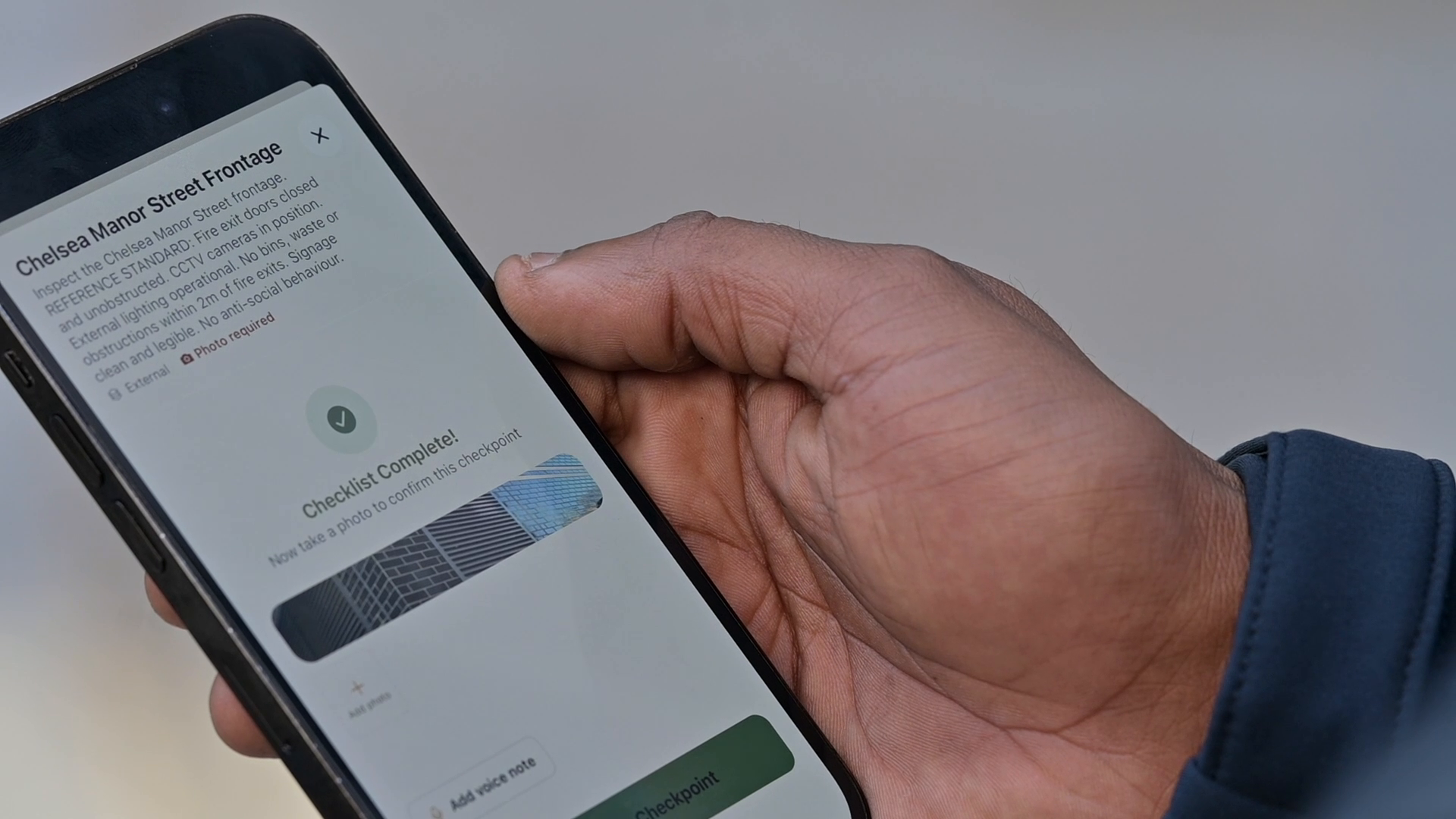
Evidence is where many contracts fall short. A written occurrence book claiming "all in order" cannot prove a specific checkpoint was reached at a specific time — which is why Priority First requires every patrol checkpoint to log officer ID, GPS location and a timestamped photograph, with missed areas showing as visible gaps rather than passing silently. On one West London mixed-use development covering retail, residential and plant rooms, this approach took photographed checkpoints from zero to 152, with 540+ patrols completed and logged across the first five months live from February 2026.
How Can A Business Verify A Security Company's Actual Response Times?
A business should ask for logged, timestamped evidence of past response performance rather than accepting a stated average. Request a sample occurrence log, patrol audit trail, or incident report showing real dispatch-to-arrival timings across recent months, not a headline claim on a sales page.
Photographic, GPS-stamped checkpoint data is the clearest proof available, because it cannot be backfilled after the fact. Across Priority First's largest portfolio, a substantial number of patrols have been completed and photo-backed with officer ID, GPS and timestamp, giving clients an auditable record rather than a paper occurrence book that a departing officer's institutional knowledge could quietly erase.
Businesses should also ask how many sites a provider's officers cover simultaneously, since a thinly stretched patrol route inflates real arrival times regardless of what the contract states.
What Are The Costs Of Faster Response Time Guarantees?
Faster guaranteed response typically costs more because it requires either a dedicated on-site officer, a smaller patrol radius per officer, or a denser overnight rota — all of which raise staffing costs. A provider promising a 5-minute guarantee across a wide rural patch is making a claim that is difficult to deliver without significant local staffing investment.
| Response commitment | Typical delivery model | Relative cost |
|---|---|---|
| Immediate (on-site officer) | Manned guarding, permanent presence | Highest |
| 5-15 minutes | Mobile patrol with tight local coverage | Medium-high |
| 15-30 minutes | Wider-radius keyholding / alarm response | Medium |
| Best-effort, unspecified | Shared regional cover | Lowest |
Businesses should treat an unusually cheap "rapid response" quote with caution, and ask precisely how many other sites that officer or patrol route also covers.
Who Is Responsible If A Security Company Misses Its Agreed Response Time?
Liability for a missed response time sits with the security provider where the SLA specifies a measurable target and a failure is demonstrable. This is why the SLA's evidentiary standard matters as much as the headline figure — a contract promising 10 minutes with no logging mechanism gives the client nothing to hold the provider to.
Insurers and property owners increasingly expect this evidence trail as standard, particularly on higher-risk sites such as construction projects or vacant buildings. Priority First's guide, Building Security Audit: Self-Assessment, sets out the checks a business should run before assuming its current provider's response commitments are actually being met.
How Rural Or Remote UK Locations Compare To Urban Areas On Response Time
Rural and remote sites face structurally longer response times than urban locations, driven by distance between patrol points rather than provider quality alone. Urban areas often see faster times due to proximity and local traffic knowledge, which is precisely the factor absent in remote settings (Emergency Security, 2026).
A care home in Bedfordshire with 96 units illustrates how this gap is closed operationally rather than geographically. The site needed provable, continuous patrol coverage because care staff cannot double as a 24-hour security presence — door control, night-time incidents and unfamiliar visitors all require dedicated cover. Priority First deployed SIA-licensed officers with every patrol, incident and handover logged, checkpoints completed with a photograph, GPS and timestamp, delivering over 1,000 photo-backed patrols with the site onboarded within a fortnight.
What Common Mistakes Do Businesses Make Assessing Response Capability?
The most frequent mistake is accepting a stated average response time without asking how it was measured or how many other sites share that officer's coverage. A second common error is assuming manned guarding, keyholding and alarm response are interchangeable, when each carries a materially different response profile.
Businesses also underweight evidence. A provider that cannot produce timestamped, photographic proof of past attendance is asking a client to take its response claims on trust, which weakens any later dispute over a missed SLA.
What Steps Should A Business Take If Response Times Are Too Slow?
A business concerned about slow response should first request the provider's own logged performance data for its site over the preceding three to six months. If the provider cannot produce timestamped patrol or incident records, that absence is itself informative.
Next, the business should compare its current SLA's stated targets against what has actually been delivered, and raise any shortfall formally in writing to trigger the contract's escalation clause. Where a provider repeatedly misses agreed targets with no improvement plan, commissioning a fresh building security audit — such as Priority First's Building Security Audit: Self-Assessment — is a practical next step before switching providers.
Your Security Response Time Checklist
- Confirm every officer's SIA licence and check the response category (guarding, keyholding, alarm response) that applies to your contract.
- Request three to six months of logged, timestamped patrol or incident data before signing.
- Fix a maximum dispatch time and a maximum arrival time by incident type in the written SLA.
- Ask how many other sites your assigned officer or patrol route also covers.
- Establish whether photographic, GPS-stamped evidence is standard practice or an optional extra.
- Check the escalation path and named liability if an agreed response time is missed.
- Reassess pricing against genuinely faster guarantees rather than accepting an unusually cheap "rapid response" quote at face value.
FAQ
How quickly should a security company respond to an alarm activation?
Most reliable providers respond to on-site emergencies within 5 to 15 minutes, with faster times typical in urban areas (Emergency Security, 2026). Alarm receiving centres should triage the alert itself within around 2 minutes before dispatch even begins (Overton Security Services, 2026).
Is there a legal minimum response time for UK security companies?
No UK statute sets a fixed minimum response time for private security firms. The Private Security Industry Act 2001 governs licensing through the SIA, while police attendance at alarms follows separate NPCC classification policy rather than a guaranteed clock time.
Do security guards typically arrive before the police?
Yes. Security guards arrive at emergency scenes an average of 4-8 minutes before police, fire or EMS crews, which makes their first actions critical to outcomes (Prime Guards, 2026).
What should a response time SLA include?
A proper SLA should state a maximum dispatch time, a maximum arrival time by incident type, an escalation process for missed targets, and the evidence — such as GPS-stamped, photographed checkpoints — the provider will supply to prove attendance.
How can a business check a provider's real response times before signing?
Ask for sample logged incident and patrol records from existing sites covering the past three to six months. A provider unable to produce timestamped, photographic evidence is asking clients to take its claims on trust alone.
Are rural sites always slower to respond to than urban ones?
Generally yes, because response time depends heavily on the distance between an officer's location and the site, and urban proximity typically shortens that distance (Emergency Security, 2026). Dedicated, well-staffed rural coverage can still deliver strong results, as shown by a Bedfordshire care home reaching 1,000+ photo-backed patrols after onboarding within a fortnight.
What happens if a security company misses its agreed response time?
Liability sits with the provider where the SLA specifies a measurable target and the miss is demonstrable through logged records. This is why contracts with GPS and photo-verified patrol evidence are far easier to enforce than those relying on a written occurrence book alone.
Securing Faster, Provable Response With Priority First
Response time is only as good as the evidence behind it, and that principle sits at the centre of how Priority First runs keyholding, alarm response and manned guarding across its sites. When a Covent Garden client's premises were broken into overnight, Priority First took the call at 12:30, agreed the quote on that same call, and had an SIA-licensed operative on site by 14:30 — two hours from first contact to deployment.
Priority First currently runs 24 sites on a single platform with 11+ field officers, logging every patrol, incident and alarm activation with officer ID, GPS and a timestamped photograph, so a client can see exactly when a checkpoint was reached rather than trusting a written assurance. If your current provider's response times are unverified or consistently slow, Priority First's Key Holding & Alarm Response team can review your current SLA and quote a fully evidenced alternative.
Related Reading
- 4 Steps to Choose a Security Company in Chelsea for Construction
- Manned Guarding Company London | Priority First Security 2026
- Choose the Right Security Company in Kensington for Your Construction Needs