Kitchen Extract Ducting Cleaning Frequency UK (2026)



Last updated: 19 November 2026
Kitchen extract ducting should be cleaned every 3 months for heavy-use kitchens (12-16 hours daily), every 6 months for moderate use, and every 12 months for light-use sites, under TR19 Grease guidance from the Building Engineering Services Association. Fire risk assessments can override these bands where risk demands it.
Key Takeaways
- TR19 Grease guidance sets cleaning frequency by usage hours: heavy-use kitchens (12-16 hours/day) need cleaning every 3 months, according to BESA (2025).
- Moderate-use kitchens (6-12 hours/day) should be cleaned every 6 months, and light-use kitchens (2-6 hours/day) every 12 months, according to PHS Interclean (2025).
- All operational grease extract ductwork systems usually require cleaning annually as a minimum, unless a fire risk assessment says otherwise, per BESA TR19 Grease guidance.
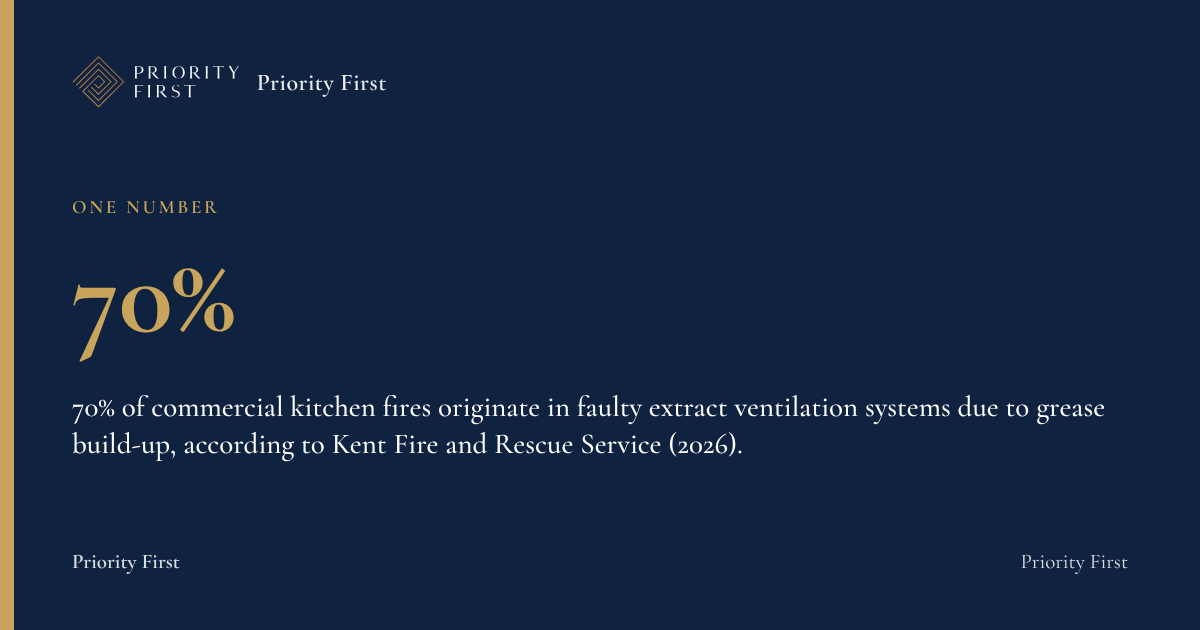
- 70% of commercial kitchen fires originate in faulty extract ventilation systems due to grease build-up, according to Kent Fire and Rescue Service (2026).
- A kitchen extract ductwork fire occurs on average every 9 days across Greater London, according to the London Fire Brigade (via Arch Insurance) (2024).
What is TR19 Grease and what does it recommend for cleaning frequency?
TR19 Grease is a technical standard published by the Building Engineering Services Association (BESA) that sets out how commercial kitchen extract ductwork should be inspected, cleaned and verified to control fire risk from grease build-up. It is the reference document that fire risk assessors, insurers and environmental health officers across the UK use to judge whether a kitchen's extraction system is being properly maintained.
TR19 ties cleaning frequency directly to how many hours a day the kitchen operates, rather than applying one blanket rule. Heavy-use kitchens running 12-16 hours per day should have their ducting cleaned every 3 months, according to BESA (2025). Moderate-use kitchens operating 6-12 hours a day should be cleaned every 6 months, and light-use kitchens running just 2-6 hours a day should be cleaned every 12 months, according to PHS Interclean (2025).
Underpinning all three bands is a measurable limit. TR19 Grease guidance states that cleaning frequency must be sufficient to ensure grease deposit limits of 200 microns, measured as a mean across the system, are not exceeded. A separate hard ceiling applies at the point of serious risk: internal duct grease must never exceed 500 microns, roughly half the thickness of a UK credit card, according to BMAH (2025). Reaching that threshold signals that a system has been neglected well past any recommended interval.
How does cooking volume and usage intensity change the cleaning schedule?
Cooking volume determines which TR19 usage band a kitchen falls into, and misjudging it is the most common reason schedules fail. A site that looks moderate-use on paper but runs double shifts, high-grease frying or charcoal grilling can generate far more deposit per hour than a standard sit-down restaurant on the same daily hours.
Facilities managers overseeing multiple sites need to treat usage intensity as a variable, not a fixed label set once at commissioning. A pub kitchen doing weekday lunches only sits in a very different band to the same kitchen during a beer garden summer, when service hours and covers both increase. Seasonal spikes, event catering, and menu changes toward fried or flame-grilled dishes can all push a kitchen from light-use into moderate-use territory without anyone updating the maintenance contract.
This is precisely where a documented, photo-verified maintenance record earns its value. Just as Priority First logs every security checkpoint with a photograph, GPS location and timestamp so that delivered patrols are provable rather than asserted, the same evidentiary standard applies to extract cleaning: a dated, photographed before-and-after record is what proves the correct TR19 band was actually followed, not just assumed.
Is kitchen extract duct cleaning a legal requirement in the UK?
TR19 Grease itself is not primary legislation, but failing to follow it can put a business in breach of statutory fire safety duties. The Regulatory Reform (Fire Safety) Order 2005 requires every commercial premises in England and Wales to have a "responsible person" who carries out a fire risk assessment and keeps fire-related equipment, including extract ventilation, in efficient working order.
Grease-laden ductwork is one of the clearest, most inspectable fire hazards a fire and rescue service can find, which is why TR19 compliance has become the de facto benchmark used to judge whether that statutory duty has been met. Unless a fire risk assessment specifically justifies a different interval, all operational grease extract ductwork systems will usually require cleaning annually as a minimum. The Health and Safety at Work etc. Act 1974 sits alongside the Fire Safety Order, placing a general duty on employers to maintain a safe working environment, which extends to ventilation plant that could cause fire or exposure risk.
In practice, an environmental health officer, fire inspector or insurer will ask for TR19-compliant records as proof of that duty being discharged, not for the standard's name itself. No cleaning certificate does not automatically mean no legal breach, but it removes the single easiest piece of evidence a business has to defend itself with.
Who is legally responsible for arranging kitchen extract cleaning?
Responsibility for arranging kitchen extract cleaning sits with the "responsible person" under the Fire Safety Order, which in a leased commercial kitchen is usually the business operator or tenant, not the landlord, unless the lease states otherwise. Commercial leases vary significantly, and some landlords retain responsibility for shared or base-build ductwork while tenants are responsible for the kitchen's own extraction equipment and canopy.
This split creates genuine confusion in multi-tenant buildings, shopping centre food courts and serviced office kitchens, where extract runs can cross demised boundaries between several occupiers. The safest approach is to confirm cleaning responsibility in writing at lease signing and again at any fit-out, rather than assuming it defaults to either party.
Facilities managers overseeing mixed-use estates face this problem routinely: one extract system, several occupiers, and no single party checking the schedule unless someone is contractually accountable for it. Building a cleaning schedule into a planned preventative maintenance (PPM) programme, with named responsibility and dated records, closes that gap before an inspection or an insurance claim exposes it.
What are the recommended cleaning frequencies by kitchen type?
Different catering formats fall naturally into different TR19 usage bands, and matching the format to the band is the fastest way to set an accurate schedule.
| Kitchen type | Typical daily usage | TR19 recommended frequency | Source |
|---|---|---|---|
| Fast food / high-throughput | 12-16 hours/day | Every 3 months | BESA (2025) |
| Pub kitchen / busy restaurant | 6-12 hours/day | Every 6 months | PHS Interclean (2025) |
| Fine dining / low-turnover restaurant | 2-6 hours/day | Every 12 months | PHS Interclean (2025) |
| Low-use catering (care home, small office canteen) | 2-6 hours/day or less | Annual minimum, per fire risk assessment |
These bands are a starting point, not a substitute for a site-specific fire risk assessment. A care home kitchen, for example, may have light cooking hours but carries the heightened life-safety profile of a 24-hour occupied building, which is why the fire risk assessment, not the usage hours alone, should have the final word on frequency.
What are the fire and insurance risks of infrequent cleaning?
Grease build-up in extract ductwork is one of the most common and most preventable causes of commercial kitchen fires in the UK. Some 70% of fires in commercial kitchens originate in faulty extract ventilation systems due to build-up of fat and grease, according to Kent Fire and Rescue Service (2026).
The scale of this risk in London specifically is stark: a kitchen extract ductwork fire occurs on average every 9 days across the Greater London area, according to the London Fire Brigade, reported via Arch Insurance (2024). Nationally, the food and drink sector accounted for 19% of all workplace fires in the UK in 2024/25, according to Hopkins.biz (2025).
Insurers treat TR19 compliance as a core loss-prevention standard, and a kitchen fire traced to undocumented or overdue extract cleaning can see a claim reduced or refused outright. Beyond the direct fire risk, a business without dated cleaning records has no defence if an insurer, landlord or fire inspector asks to see proof that reasonable maintenance was in place before the incident occurred.
"Most incidents happen when the building is empty, which is exactly when most businesses have the least arranged. Out-of-hours cover is a chain — detection, keyholding, response, escalation, making the building safe — and it is only as strong as its weakest link. We design the chain, not just one link of it." — Mo Hassan, Managing Director, Priority First
That same logic applies directly to kitchen fire risk: a clean duct is one link, but a monitored alarm, a keyholder who can respond out of hours, and a documented response plan are the links that stop a small grease fire becoming a building-closing event overnight.
How can you tell if your extract system is overdue for cleaning?
An overdue extract system usually shows physical warning signs before it fails an inspection outright. Visible grease staining around the canopy edge, a persistent cooking-oil smell that lingers after extraction fans run, reduced airflow or a noticeably noisier fan, and condensation or dripping from duct joints are all practical indicators that grease deposits have exceeded safe limits.
The only way to confirm this with certainty is a measured inspection against the TR19 thresholds: a mean of 200 microns across the system as the trigger for cleaning, and 500 microns as the absolute ceiling that must never be reached, according to BMAH (2025). Relying on visual inspection alone is unreliable, because grease accumulates unevenly along a duct run and the worst sections are often the hardest to see without access panels.
Any business unsure of its last cleaning date, or unable to produce a certificate on request, should treat that uncertainty itself as a red flag and commission an inspection rather than wait for a visible fault.
What certification or proof of cleaning should a business keep?
A compliant business should hold a dated TR19 cleaning certificate for every clean carried out, specifying the scope of works, the contractor's details, before-and-after grease readings, and photographic evidence of the duct interior. This record is what an environmental health officer, fire inspector, or insurer will ask to see first, and it is the primary evidence that the Fire Safety Order's maintenance duty has been met.
Certificates should be retained for a minimum of the period specified by the insurer's policy wording, and ideally for the lifetime of the premises' tenancy, so that a full history is available if ownership or management changes hands. Where access to parts of the duct run was restricted, the certificate should state this explicitly, since a partial clean recorded as a full clean is a documentation failure that can be worse than no record at all.
Photographic, timestamped verification is the standard that stands up to scrutiny, whether that is for a grease duct or a security patrol. Priority First applies the same principle across its facilities management and security work: every checkpoint photographed, GPS-tagged and timestamped so cover is provable, not just claimed — the same evidentiary discipline that TR19 asks of extract cleaning contractors.
What does a professional cleaning inspection involve, and what does it cost?
A TR19 cleaning service typically begins with a survey of the full duct run, including access panel positions, followed by mechanical cleaning to remove grease deposits, grease trap and canopy filter cleaning, and a final measured check against the 200-micron benchmark. The contractor should then issue a certificate confirming the scope completed, any areas not accessible, and before-and-after grease readings.
Costs vary significantly by kitchen size, duct run length, number of access points required, and how overdue the system is, since heavily fouled ducts take longer to clean safely. As a general guide, smaller single-canopy kitchens sit at the lower end of the cost range, while large multi-canopy commercial kitchens with long duct runs and difficult access sit at the higher end; an accurate quote always requires a site survey rather than a price list, because access and fouling levels differ so much between sites.
Common mistakes businesses make with extract cleaning schedules
Several recurring errors turn a manageable compliance task into a fire and insurance risk:
- Applying a single fixed interval to every kitchen on a multi-site estate, ignoring that usage hours differ between sites and should set the TR19 band individually.
- Treating TR19 as a one-off certificate exercise rather than an ongoing PPM schedule tied to actual operating hours.
- Failing to update the schedule after a menu or service change, such as adding fried food or extending opening hours, which can shift a kitchen into a heavier usage band.
- Assuming the landlord is responsible for extract cleaning without checking the lease, leaving shared ductwork unmanaged by either party.
- Accepting a certificate without photographic or measured evidence, which offers no real proof the 200-micron standard was met.
- Losing track of certificates during contractor changes, leaving no continuous compliance history if ownership or management changes.
How do you find and vet a qualified cleaning contractor?
A qualified TR19 contractor should be able to demonstrate trained engineers, appropriate insurance, and a clear process for measuring and certifying grease levels before and after cleaning, not just a visual "looks clean" sign-off. Request sample certificates from previous jobs, ask how access panels are installed where none currently exist, and confirm what happens if an area of duct cannot be safely accessed during the visit.
Good contractors will flag this limitation on the certificate rather than quietly skip it, and will recommend remedial access panel installation as a follow-up rather than leaving a gap in the record. For facilities managers running several sites, consolidating extract cleaning into the same planned maintenance calendar as other statutory checks — fire alarm testing, emergency lighting, fixed wire testing — reduces the chance that any single discipline slips through the gaps between contracts.
Your kitchen extract cleaning checklist
- Identify your kitchen's TR19 usage band based on actual daily operating hours, not assumed hours.
- Schedule cleaning every 3 months for heavy use, 6 months for moderate use, or 12 months for light use.
- Confirm in writing whether the landlord or tenant holds contractual responsibility for extract cleaning.
- Request a TR19 certificate with before-and-after grease readings for every clean, not a generic sign-off.
- Flag and remediate any inaccessible duct sections rather than leaving them uninspected.
- Build extract cleaning into the same PPM calendar as fire alarm and emergency lighting checks.
- Review the usage band after any menu change, extended hours, or seasonal spike in covers.
- Retain certificates for the duration of the tenancy, not just the current insurance policy year.
FAQ
How often should kitchen extract ducting be cleaned?
Kitchen extract ducting should be cleaned every 3 months for heavy-use kitchens, every 6 months for moderate-use kitchens, and every 12 months for light-use kitchens, under TR19 Grease guidance from BESA (2025). A fire risk assessment can require more frequent cleaning where specific risks are identified.
Is TR19 Grease a legal requirement in the UK?
TR19 Grease is a technical standard, not a law in itself, but it is the benchmark used to judge compliance with the Regulatory Reform (Fire Safety) Order 2005. Businesses that cannot evidence TR19-compliant cleaning struggle to demonstrate they have met their statutory fire safety duty.
Who is responsible for arranging kitchen extract cleaning, the landlord or tenant?
Responsibility usually falls to the business operator as the "responsible person" under fire safety law, but this depends entirely on the commercial lease. Shared or base-build ductwork in multi-tenant buildings should have responsibility confirmed in writing before any gap in cleaning occurs.
What grease thickness triggers a required clean under TR19?
TR19 sets a mean grease deposit limit of 200 microns across the system as the point requiring cleaning. An absolute ceiling of 500 microns, roughly half the thickness of a credit card, must never be exceeded, according to BMAH (2025).
What happens if kitchen extract ductwork is never cleaned?
Uncleaned ductwork accumulates grease that significantly increases fire risk, with 70% of commercial kitchen fires traced to faulty extract ventilation and grease build-up, according to Kent Fire and Rescue Service (2026). It can also void insurance cover, since insurers treat TR19 compliance as a core loss-prevention standard.
Does insurance require proof of TR19-compliant cleaning?
Most commercial kitchen insurance policies expect evidence of regular, documented extract cleaning in line with TR19 guidance. A claim following a kitchen fire can be reduced or refused if the insurer finds no dated certificates proving reasonable maintenance was carried out.
How is cleaning frequency decided if kitchen usage varies seasonally?
Usage-based TR19 bands should be reviewed whenever operating hours change materially, such as summer trading extensions or event catering spikes. The fire risk assessment should be the final authority if actual usage regularly exceeds the band the kitchen was originally scheduled under.
Securing compliance across your kitchen and wider estate with Priority First
Kitchen extract compliance is rarely an isolated problem: the same buildings that need TR19-compliant ductwork also need out-of-hours cover, documented maintenance schedules and accountable building management to keep an environmental health officer or insurer satisfied on inspection day. Priority First brings these disciplines together through its facilities management service, coordinating planned maintenance, compliance documentation and contractor oversight alongside its security operations under one accountable partner.
Priority First already applies this evidentiary discipline across its own patrols and checkpoints (including 4,900+ photo-backed patrols logged with officer ID, GPS and timestamp across its sites), which is the same standard of provable, dated record-keeping that a TR19 certificate needs to carry real weight with insurers and fire inspectors.
If your organisation needs a facilities management partner who can coordinate statutory compliance, planned maintenance and building security as one accountable service, contact Priority First to discuss a site review and quote.
Related Reading
- Kitchen Extract Cleaning London: Compliance Guide 2026
- TR19 Kitchen Extract Cleaning Requirements: 2026 Guide
- Hotel Maintenance Checklist: UK Compliance Guide 2026
Mo Hassan leads Priority First, a UK building-management and security-services company operating across prime central London and nationwide. Mo writes on physical security, construction-site protection, CCTV, and building operations.
Over a decade in premium building management and security operations
Specialises in Building management, Security operations, Construction site security