Close Protection Knightsbridge 2026 | Priority First

Last updated: 9 August 2026
Close protection Knightsbridge services provide SIA-licensed personal security officers for executives, high-net-worth residents and retailers across SW1X and SW7. With 431 reported crimes per 1,000 people around Knightsbridge in the past 12 months and the UK national threat level currently SEVERE, demand for vetted, trained protection officers has never been higher.
Key Takeaways
- Knightsbridge recorded 431 reported crimes per 1,000 people in the previous 12 months, a high level compared with other UK statistical areas, according to StreetCheck (2026).
- A half-mile radius of Knightsbridge (SW1X 7RN) saw 356 crimes recorded in December 2026 alone, with 483 reported crimes per 1,000 people over the year, according to StreetCheck (2026).
- The UK national threat level was raised from SUBSTANTIAL to SEVERE on 30 April 2026 by the Joint Terrorism Analysis Centre (JTAC), meaning an attack is judged highly likely, according to GOV.UK (2026).
- Standard UK close protection typically costs £550–£850 per officer per day, with London assignments often sitting at the higher end, according to Secure OnSite Security (2026).
- Priority First holds 37 documented client contracts, of which 28 are in Chelsea and Knightsbridge, reflecting deep operational familiarity with the area's specific security demands (Priority First operational data, 2026).
What is close protection?
Close protection is a licensed personal security discipline in which trained officers — often called bodyguards in informal usage — plan and manage the physical safety of a specific individual or family against identified threats. It is distinct from general manned guarding because it centres on one principal's movements, schedule and risk profile rather than a fixed site.
In the UK, close protection is a licensable activity under the Private Security Industry Act 2001 (Licences) Regulations 2007. Anyone providing close protection services commercially must hold a Security Industry Authority (SIA) close protection licence — the SIA is the statutory body responsible for regulating the private security industry in England, Wales and Scotland.
Close protection officers working around Knightsbridge typically combine several disciplines: route planning, advance reconnaissance of venues, secure chauffeuring, and liaison with hotel or residential security teams. Priority First's own contract base illustrates how concentrated this demand has become in prime central London, with 28 of its 37 documented client contracts based specifically in Chelsea and Knightsbridge.
Why does Knightsbridge need specialist close protection?
Knightsbridge needs specialist close protection because it combines exceptionally high property values, dense luxury retail, and crime figures that sit well above the national average for comparable areas. The statistical area covering SW1X 7XS recorded 431 reported crimes per 1,000 people in the previous 12 months, a figure StreetCheck classifies as high relative to other UK locations.
A tighter half-mile radius around SW1X 7RN paints an even sharper picture. That area recorded 356 crimes in December 2026 alone, with 483 reported crimes per 1,000 people over the preceding year — also flagged as a high crime level by StreetCheck (2026).
Knightsbridge sits within the Metropolitan Police's Knightsbridge and Belgravia neighbourhood policing area, which publishes its own local priorities and patrol strategies. The Metropolitan Police – Knightsbridge and Belgravia Neighbourhood Priorities page details ongoing community concerns specific to the area, including acquisitive crime linked to its concentration of luxury retail on Sloane Street and Brompton Road.
Retail theft and watch-related crime
Knightsbridge's cluster of luxury boutiques and watch retailers makes it a recurring target for organised acquisitive crime, including snatch theft involving mopeds or e-bikes. Retailers and their senior staff increasingly commission close protection or protective retail security to cover opening, closing and high-value stock movements.
The 2026 national threat level
JTAC raised the UK national threat level from SUBSTANTIAL to SEVERE on 30 April 2026, meaning a terrorist attack is now considered highly likely across the country, not just in London. Home Secretary Shabana Mahmood described a related attack at the time as "a vile act of terrorism," underlining the seriousness with which government now treats the threat picture.
For principals living, working or shopping in Knightsbridge, a SEVERE threat level changes practical planning. Close protection teams operating under this rating typically increase route variation, tighten venue advance checks, and brief drivers on secure standoff distances outside residences and retail premises.
How much does close protection cost in Knightsbridge?
Close protection in Knightsbridge typically costs between £550 and £850 per officer, per day, with prime central London assignments often sitting at the higher end of that range according to Secure OnSite Security (2026). Costs scale with team size, shift length, vehicle provision and the intensity of advance planning required.
A single officer on a straightforward day assignment sits at the lower end of the range. A multi-officer team covering a principal around the clock, with a dedicated secure driver and advance reconnaissance, moves towards the upper end and beyond.
| Assignment type | Typical structure | Illustrative daily range |
|---|---|---|
| Single officer, daytime cover | 1 officer, 8–10 hour shift | £550–£650 per day |
| Single officer, extended cover | 1 officer, 12+ hour shift | £650–£750 per day |
| Team cover with secure driver | 2–3 officers plus vehicle | £750–£850+ per officer, per day |
| Residential + close protection combined | CP officer integrated with concierge/keyholding | Priced per site on assessment |
These figures are illustrative ranges based on published UK market pricing, not a fixed quote. Any reputable provider — Priority First included — will price a Knightsbridge assignment after a proper risk assessment rather than off a rate card.
Worked scenario: a Knightsbridge retail principal
A boutique owner on Sloane Street requiring close protection during opening hours and stock deliveries, plus static cover during trading hours, might combine one close protection officer with a manned guarding presence. At an illustrative £600–£750 per day for the CP officer, a five-day working week sits broadly in the £3,000–£3,750 range before any static guarding or CCTV monitoring is added.
Ways to manage costs without cutting corners
- Combine close protection with existing site security where a principal's home or office already has manned guarding, keyholding or CCTV monitoring in place.
- Right-size the team to the risk assessment rather than defaulting to a multi-officer detail for low-risk daytime movements.
- Use static residential security or concierge cover for periods when the principal is at home, reserving mobile close protection for travel and public appearances.
- Review threat level regularly — a SEVERE national threat level under JTAC guidance may justify temporary uplift, but risk can also reduce as circumstances change.
Alternatives to consider
Not every Knightsbridge client needs full close protection. Enhanced concierge and front-of-house management, combined with CCTV monitoring and alarm response, can cover lower-risk residential or retail scenarios at a fraction of the cost, with close protection reserved for specific high-risk movements or events.
Do close protection officers in Knightsbridge need an SIA licence?
Yes. Any individual providing close protection services in the UK for commercial gain must hold a valid SIA close protection licence under the Private Security Industry Act 2001. Operating without one is a criminal offence.
The SIA Knowledge and Skills Specification: Close Protection (2022) sets out the training standard licence applicants must meet, covering areas such as threat assessment, first aid, surveillance awareness and legal powers. The application fee for the SIA Close Protection Licence is £204, non-refundable, with a 50% discount available if the applicant already holds another SIA licence, according to Hurak (2026).
Working without a valid licence carries serious legal consequences. An operative found guilty of working without a valid SIA licence can be prosecuted, fined up to £5,000, or sentenced to up to six months in prison, according to IN2 Security Training (2019).
How to verify a close protection officer's licence
Clients hiring close protection in Knightsbridge should always check an officer's SIA licence before deployment. The GOV.UK – Find out if you need an SIA licence page and the SIA's public register allow anyone to confirm a licence number is genuine and current. The Regulated Professions Register – Close Protection Operative page also sets out the exemptions and regulatory scope that apply specifically to this role.
The scale of the licensed workforce underlines how mainstream this checking discipline has become. There were over 451,000 active SIA licence holders in the UK in 2026, of whom 402,273 were men and 49,200 were women, according to Statista / GOV.UK (2026). That total compares with just under 235,000 licence holders in 2008, according to Statista / GOV.UK (2026) — a near-doubling that reflects both industry growth and tighter regulation since the Act came into force.
Close protection vs manned guarding: which does a Knightsbridge client need?
Close protection and manned guarding solve different problems, and confusing them leads to the wrong solution being bought. Manned guarding secures a fixed site — a building, a retail premises, a construction hoarding — while close protection secures a moving principal wherever they go.
| Factor | Close protection | Manned guarding |
|---|---|---|
| Focus | A named individual and their movements | A fixed site, building or perimeter |
| Typical Knightsbridge use | Principal travel, retail owner protection, event attendance | Residential building entrances, retail premises, construction sites |
| Licensing | SIA Close Protection Licence | SIA Door Supervisor or Security Guard licence, as relevant |
| Team structure | 1–3+ officers, often with secure driver | Fixed post or mobile patrol officers |
| Typical cost driver | Risk level, hours, vehicle provision | Number of posts, hours covered |
Many Knightsbridge clients need both, run as one integrated service rather than two separate contracts. A residential principal, for example, may need close protection while travelling and manned guarding, concierge and keyholding at the building itself — exactly the combined model Priority First applies across its Chelsea and Knightsbridge portfolio.
In-house security team vs outsourced close protection
Some larger Knightsbridge households and family offices consider building an in-house security function rather than outsourcing to a specialist provider. In-house teams offer continuity and deep familiarity with one household, but carry the full cost of recruitment, SIA licence renewal, holiday and sickness cover, and ongoing refresher training.
Outsourcing to an established provider spreads that overhead across a team the provider already manages, while still allowing a consistent, familiar officer or small team to be assigned to one principal. For most Knightsbridge clients — outside the very largest family offices — outsourced close protection delivers comparable continuity at a materially lower administrative burden.
How is a close protection assignment planned and delivered?
A close protection assignment begins with a formal risk assessment that identifies the principal's specific threats, routines and vulnerabilities before any officer is deployed. This assessment, not a generic rate card, is what determines team size, vehicle needs and the intensity of advance planning.
A typical Knightsbridge risk assessment considers the principal's home address and its position relative to local crime patterns, regular routes to work or retail premises, public profile and any known specific threats, and travel patterns including international movement. It also considers the current national threat level, which JTAC set at SEVERE from 30 April 2026.
Once the assessment is complete, planning moves into advance work: venue reconnaissance, route surveys, liaison with any existing building security or concierge team, and briefing of drivers on secure standoff points. This is where combined security and facilities management expertise pays off — a provider that already manages a Knightsbridge building's concierge, keyholding and CCTV monitoring can integrate close protection far faster than one starting from zero.
Deployment speed and mobilisation
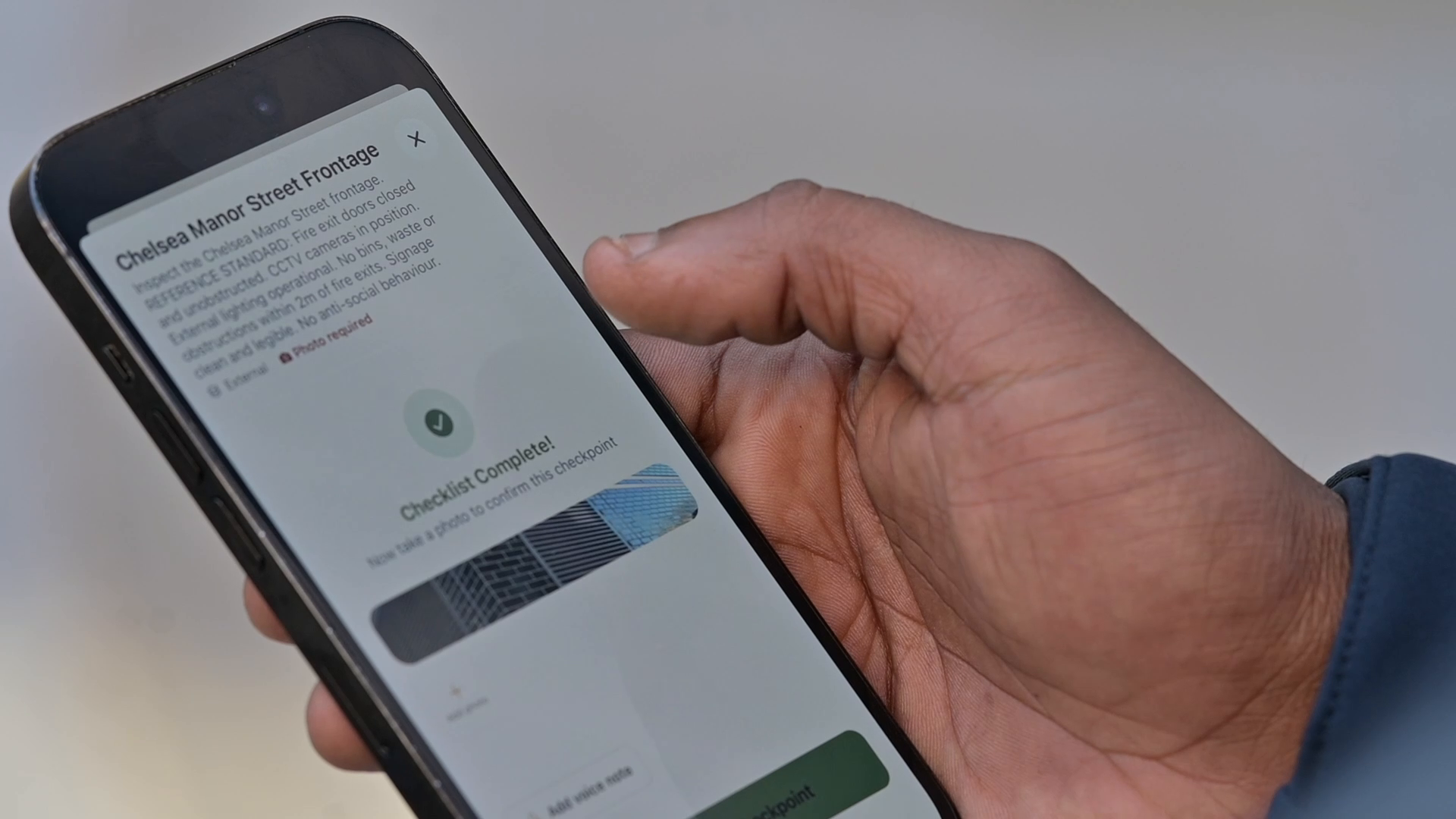
Speed of mobilisation matters when a threat emerges quickly. Priority First's own operational record shows what disciplined onboarding looks like in practice: three new Central London residential sites, including a 10-checkpoint serviced residence, were taken fully live within a fortnight in July 2026, with the first provable, photo-backed patrol delivered within days rather than the weeks of "bedding in" that mobilisations traditionally require.
That same evidence discipline extends across Priority First's wider portfolio. Its largest managed portfolio now runs 24 sites on one platform, supported by 11 or more field officers who have collectively completed more than 4,900 photo-backed patrols, each one carrying officer ID, GPS location and a timestamp — the kind of provable record that matters just as much in close protection handovers as in static site patrols.
Your close protection Knightsbridge checklist
- Confirm every officer's SIA close protection licence against the public register before any deployment begins.
- Commission a formal risk assessment covering the principal's home, routes, retail or office locations and public profile.
- Factor in the current SEVERE national threat level when agreeing route variation, advance checks and standoff distances.
- Check local crime data for the specific postcode, not just the borough, using resources such as StreetCheck.
- Decide whether close protection, manned guarding, or both are needed for the property and the person.
- Ask how patrols and handovers are evidenced — photo-backed, timestamped records prevent disputes over what was actually done.
- Confirm mobilisation timescales in writing before signing, especially for urgent or short-notice requirements.
- Review the arrangement quarterly against any change in the principal's circumstances or the national threat level.
FAQ
How much does close protection cost in Knightsbridge?
Close protection in Knightsbridge typically costs £550–£850 per officer, per day, with prime central London assignments often at the higher end of that range according to Secure OnSite Security (2026). The final price depends on team size, shift length, vehicle provision and the risk assessment.
Do close protection officers in Knightsbridge need an SIA licence?
Yes, every close protection officer working commercially in the UK must hold a valid SIA close protection licence under the Private Security Industry Act 2001. Working without one can result in prosecution, a fine of up to £5,000, or up to six months in prison, according to IN2 Security Training (2019).
Is Knightsbridge a high-crime area requiring personal security?
Knightsbridge's SW1X 7XS statistical area recorded 431 reported crimes per 1,000 people in the previous 12 months, a level StreetCheck (2026) describes as high compared with other UK areas. A tighter half-mile radius around SW1X 7RN recorded 483 crimes per 1,000 people over the same period, also rated high.
What is the difference between a bodyguard and a close protection officer?
"Bodyguard" is an informal, non-regulated term, while "close protection officer" is the licensed professional title recognised under UK law. Any person providing this service commercially must hold an SIA close protection licence, regardless of which term clients use.
How do I hire a close protection officer in Knightsbridge?
Start by defining the principal's risk profile, then commission a formal risk assessment from an established security provider before agreeing team size or cost. Always verify the provider's officers hold current SIA close protection licences using the official register before deployment.
Can close protection officers in the UK carry firearms?
The vast majority of UK close protection officers are unarmed, as civilian firearms licensing is tightly restricted and separate from SIA close protection licensing. Armed protection in the UK is typically limited to specific police protection units rather than private close protection officers.
How quickly can a close protection team be deployed in Knightsbridge?
Deployment speed depends on the provider's existing local presence and mobilisation processes. Priority First's own record shows three Central London residential sites taken fully live within a fortnight, with the first provable patrol delivered within days rather than weeks — a benchmark for how quickly a well-organised security provider can mobilise.
Why is demand for close protection rising in London in 2026?
Demand is rising partly because JTAC raised the UK national threat level from SUBSTANTIAL to SEVERE on 30 April 2026, meaning an attack is now judged highly likely, according to GOV.UK (2026). Combined with sustained high crime figures in areas such as Knightsbridge, this has pushed more businesses, retailers and residents to review their personal security arrangements.
Securing your principal in Knightsbridge with Priority First
Every issue this article covers — high recorded crime around SW1X, a SEVERE national threat level, and the need for licensed, provable close protection — sits at the centre of Priority First's daily work in Chelsea and Knightsbridge. Twenty-eight of the company's 37 documented client contracts are based specifically in that area, giving its teams direct familiarity with local retail patterns, residential building security and the postcodes' specific crime profile.
Priority First delivers close protection alongside its wider Chelsea and Knightsbridge presence, integrating manned guarding, keyholding, alarm response, CCTV monitoring and concierge management under one accountable provider rather than several disconnected contracts. Every patrol and checkpoint across the firm's managed sites is photo-backed with officer ID, GPS and a timestamp — the same evidential discipline that matters when a client needs a defensible, provable record of a close protection assignment.
If you need a close protection assessment for a Knightsbridge home, office or retail premises, get in touch with Priority First to discuss your requirements and request a tailored quote.
Related Reading
- Close Protection Courses UK Cost 2026: Compare Providers
- 10 Close Protection Courses Near Me for Aspiring Security Pros
- 4 Best Practices for Close Protection UK in Construction Sites